Support

Kangiqsujuaq Airport

About the Airport

Kangiqsujuaq Airport (Wakeham Bay) is not merely a landing strip on the edge of the earth, but a true lifeline for the Inuit village of the same name in the Nunavik region. Located amidst the harsh yet breathtaking Arctic tundra, it serves as a gateway to a world of unique culture and pristine nature. For travellers seeking authentic adventures, arriving here is the first step in an unforgettable journey through the north of Canada.
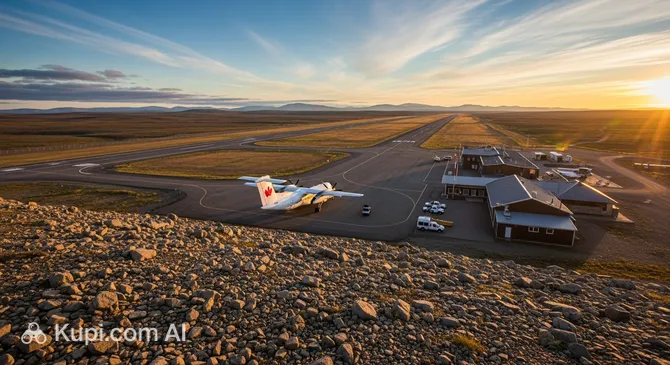
Kangiqsujuaq Airport. Source: Kupi.com Binoculars
IATA CodeYWB
ICAO Code CYKG
City Kangiqsujuaq
Distance to centre approx. 1.3 km
Status Domestic
Annual Passengers Serves the local population and tourist groups
Popular Airlines Air Inuit
ScheduleOnline board

The main feature of Kangiqsujuaq Airport is its vital role for the isolated settlement. It ensures the delivery of mail, food, and medicines, and is the only year-round means of reaching the "mainland". For local residents, it is an indispensable link to the outside world, and for tourists, it is a guarantee that even in the most remote corners of the Arctic, reliable infrastructure exists.

The airport itself is a compact complex with a single gravel runway. The terminal building is small and functional, without frills, which is typical for Arctic air harbours. There are no Duty-Free shops or numerous cafes here; the atmosphere rather resembles a cosy station where everyone knows each other. Flight operations are primarily handled by the airline Air Inuit, specialising in transport within northern Quebec.

For tourists, the airport is the starting point for exploring unique natural landscapes. Tours for wildlife observation, such as watching walruses on the islands in the Hudson Strait, are organised from here. It is also one of the transfer hubs for those heading to the famous Pingualuit National Park with its crystal-clear lake in a meteorite crater. Arrival in Kangiqsujuaq is the beginning of a true northern adventure.

Contact Information

Contacting representatives of Kangiqsujuaq Airport (YWB) can be challenging, as it is a small regional airport serving a local community. Most passenger services are provided directly by the airlines. Below is the most up-to-date contact information.

  • Official Website: Kangiqsujuaq Airport does not have its own official website. Information about its operations can be found on the resources of the Kativik Regional Government, which manages the airport, or on the website of the main carrier, Air Inuit.
  • Help Desk Phone: A direct public help desk number for the airport may not be available. For all questions related to schedules, bookings, and flight status, it is recommended to contact the airline directly. The airport phone number for general inquiries is: +1 819-338-3286.
  • Airport Address: Kangiqsujuaq Airport, Kangiqsujuaq, Quebec, J0M 1K0, Canada.
  • Email: There is no dedicated email address for general inquiries or passenger support.
  • Social Media: The airport does not maintain official pages on social networks. Current news and flight updates should be sought on the websites and accounts of the air carriers.
  • Lost Luggage Information: All issues related to lost or damaged luggage are handled by the airline that operated the flight. Please contact your carrier's baggage tracing service.
  • Passenger Support Contacts: Passenger support, including check-in, assistance for people with disabilities, and other services, is provided by airline staff at the airport.

How to Get to the Airport

Getting to the airport in Kangiqsujuaq is a task requiring preliminary planning, as this small Inuit settlement in the north of Canada has its own transport specifics. The airport is located in close proximity to the residential area, making it easily accessible, however, familiar urban options are absent here.

Public Transport

There is a complete absence of a public transport system, such as buses, trains, or a metro, in Kangiqsujuaq. Travellers should not count on this method of movement. The main modes of transport for locals are snowmobiles in winter and quad bikes (ATVs) in summer.

Taxi, Transfer, and Walking

The most reliable and common way to get to the airport is a pre-arranged transfer. If you have booked accommodation at a local hotel or cooperative (Co-op hotel), be sure to contact them before arrival. Typically, they provide a meet-and-greet service at the airport for their guests. There is no official taxi service in the village, but sometimes it is possible to arrange a ride with one of the locals for a small fee. Given that the distance from the village centre to the airport is only 1-2 kilometres, getting there on foot is a quite realistic option if you have little luggage. The walk will take about 15-25 minutes.

Car Rental and Parking

There are no representatives of major car rental companies in Kangiqsujuaq. In some cases, it may be possible to negotiate a short-term rental of a truck or quad bike through locals or organisations, but this is not a standard service. Parking at the airport consists of a small unguarded area where locals leave their vehicles. It is usually free of charge.

Key Recommendations

* Main Advice: Always arrange transport before your arrival by contacting your place of accommodation.
* Travel Time: By car or snowmobile, the trip from any point in the village to the airport will take no more than 5-10 minutes.
* Cost: Transfer from the hotel may be included in the accommodation cost or cost a nominal amount. A ride with a local resident is by negotiation. Walking is free.

Terminals and Map

Kangiqsujuaq Airport (YWB) is a small regional airport, so its structure is very simple and understandable for passengers. There is only one terminal here, which serves all flights — both arrivals and departures. Its main purpose is to ensure air connection for the local population and guests of the region.

The terminal building is a single-storey structure where all key zones are within walking distance of each other. You will not find long corridors or complex transitions between terminals here, as there is only one. The airport layout is extremely simple: check-in counters, the waiting area, and the boarding gate are located in one common hall, making navigation intuitively clear.

Departure and arrival zones are effectively combined here. After check-in, passengers proceed to a small waiting area. Arriving passengers enter the same hall where they collect their luggage. Check-in and security procedures (if required for your flight) take a minimal amount of time thanks to the low passenger flow. Usually, arriving at the airport 60–90 minutes before departure is sufficient to check in luggage and wait for boarding without rushing.

The feature of the terminal lies in its functionality and lack of excess. There are basic amenities here, such as a waiting room and restrooms, but do not expect shops, cafes, or business lounges. The main advantage of the airport in Kangiqsujuaq is the quick and calm passage of all formalities. The best recommendation for navigation is simply to follow the few signs or ask any staff member. It is practically impossible to get lost in this compact terminal.

Airport History

The history of Kangiqsujuaq Airport (YWB) is inextricably linked with the development of the Inuit village of Kangiqsujuaq, located in the Nunavik region in northern Canada. Its official opening in 1980 became a turning point for the community, helping to overcome its isolation. From the very beginning, the airport was created not as a commercial project, but as a vital transport artery ensuring connection with the rest of the world.

Initially, it was a simple gravel airstrip designed for small aircraft. These flights delivered mail, essential goods, medicines, and allowed for emergency medical assistance. For residents of the remote settlement, every landed plane was and remains a significant event connecting them to the mainland.

Over time, the airport infrastructure has gradually improved. Today, the airport is managed by the Kativik Regional Government and is part of a large-scale programme to improve Nunavik airports. Within this programme, a small but functional terminal building was constructed, and modern navigation equipment was installed. These steps allowed for the reception of larger turboprop aircraft, which today form the basis of regional aviation in northern Quebec.

The main achievement of the airport can be considered its stable and reliable operation in extreme Arctic conditions, which is a record in itself. An interesting fact: for the residents of Kangiqsujuaq, the airport is not just a transport hub, but a symbol of connection with the outside world. It plays a central role in social life, providing the opportunity to travel for business, receive specialised medical care, and maintain contact with relatives in other settlements.

Services and Amenities

Kangiqsujuaq Airport (YWB) is a small regional airport serving as an important transport hub for the Inuit community of the same name in northern Quebec. The airport's infrastructure is oriented towards meeting the basic needs of passengers travelling in the Arctic region and is quite modest compared to major city airports.

The main waiting hall is located in the terminal building. It is worth noting that there are no restaurants, cafes, or shops here. Travellers are advised to bring water and snacks with them. Sometimes vending machines may be installed in the waiting hall. Regarding modern amenities, access to Wi-Fi is generally absent, and standard electrical outlets in the waiting hall can be used to charge electronic devices.

Specialised services such as VIP lounges, business centres, bank branches, and currency exchange points are not provided at Kangiqsujuaq Airport. All financial matters should be resolved in advance in larger cities of departure or arrival.

For passengers with special needs, it is important to remember the following: the terminal building is designed with access for people with disabilities in mind, however, any necessary assistance, for example, when boarding the aircraft, should be arranged with your airline in advance. There are no special mother-and-child rooms or play areas for children at the airport. Medical assistance is limited to the staff's first aid capabilities.

There are no hotels within the airport itself or within walking distance. Accommodation options, such as the local cooperative hotel or guest houses, can be found in the village of Kangiqsujuaq. Given their limited number, it is strongly recommended to book accommodation well before your intended trip.

Dining

Travellers departing from Kangiqsujuaq Airport (YWB) must take into account that this is a small regional airport serving a remote community. Consequently, the selection of catering establishments in the terminal building is extremely limited or completely absent.

There are no restaurants or cafes offering full hot meals at the airport. Travellers should not count on the opportunity to try local cuisine or find options for special dietary needs, such as Halal, vegetarian, vegan, or gluten-free dishes, directly in the terminal building.

We strongly recommend that passengers eat beforehand in the village of Kangiqsujuaq or bring their own snacks and drinks. Sometimes vending machines with a basic set of snacks and beverages may be available in the terminal, but this is not guaranteed. To ensure a comfortable wait for your flight, it is best to take care of food and water in advance.

Travel Tips

Travelling through a regional airport like Kangiqsujuaq Airport has its own specifics. To ensure your trip goes smoothly, use these tips. Given the small size of the airport and the lower number of passengers, arriving 1.5-2 hours before the departure of a domestic flight is usually sufficient. Nevertheless, always check your airline's recommendations, especially in bad weather, which can affect the schedule.

Check-in and security control procedures in Kangiqsujuaq generally proceed faster than in major hubs. However, standard rules apply here too. Pack liquids in containers up to 100 ml in a transparent bag, and be ready to take out electronics for inspection. It is forbidden to take sharp objects, flammable substances, and other dangerous goods in hand luggage. Ensure that all valuables, documents, and necessary medicines are with you in the aircraft cabin.

When choosing a seat on the plane, prefer a window seat to enjoy the stunning views of the Arctic landscapes of Canada during takeoff and landing. If you have a connecting flight, check with the airline in advance whether you will need to collect and re-check your luggage at the transit point. Leave enough time between connecting flights, especially if flying from remote regions.

Since the airport mainly serves domestic flights, strict customs control is undergone only by passengers of rare international charters. For domestic flights, presenting an ID is sufficient. To save money, book tickets in advance and consider online check-in. Note that in small airports, the choice of food and drinks may be very limited or absent, so it is better to take a light snack with you.

In case of flight delay or cancellation, which is not uncommon for northern regions due to weather conditions, immediately contact your airline representative. Keep their contacts at hand and be prepared for possible schedule changes. Having travel insurance covering such cases can significantly simplify the situation and compensate for unforeseen expenses.

Reached the end of the page?

That means the route is fully explored