Support

J. Yrausquin Airport

About the Airport

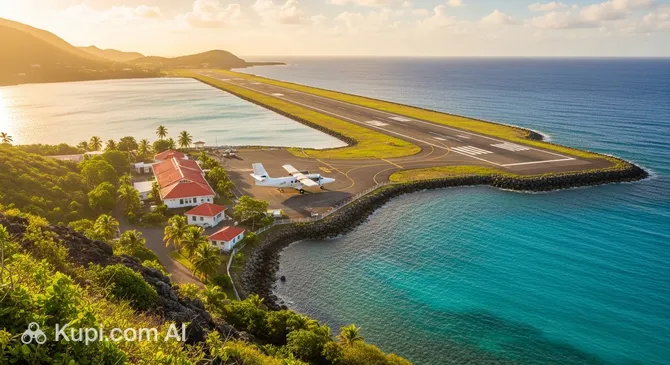
J. Yrausquin Airport. Source: Kupi.com Binoculars
Fasten your seatbelts; you are in for perhaps the most thrilling landing of your life! Juancho E. Yrausquin Airport on the island of Saba is not just a transport hub, but a true legend of aviation, officially recognised as possessing the shortest commercial runway in the world. Here, where a 400-metre track is wedged between sheer cliffs and a drop into the Caribbean Sea, every flight transforms into a unique experience, accessible only to small propeller aircraft and highly qualified pilots. This is the sole aerial gateway to the "Unspoiled Queen" of the Caribbean, and the arrival itself is rightfully considered a distinct tourist adventure.
IATA Code SAB
ICAO Code TNCS
City Flat Point, Saba Island
Distance to Centre ~6 km (15–20 min by taxi to The Bottom)
Status International (Regional)
Passengers per Year ~25,000 (2023 data)
Schedule Check carrier's website

Features and Advantages of the Airport

Saba's airport is a unique engineering object that attracts aviation enthusiasts from around the globe. Despite its reputation as "dangerous" due to the complex terrain, it is one of the safest in the region thanks to the strictest operational requirements.

World Record Holder

The main feature of the airport is its runway, which is only 400 metres (1,312 feet) long. It is shorter than the decks of many aircraft carriers. Consequently, jet liners are prohibited from landing here; the airport accepts only manoeuvrable turboprop aircraft such as the DHC-6 Twin Otter or BN-2 Islander, capable of short takeoff and landing (STOL).

Picturesque Location

The airfield is located on the only flat section of the rocky island — Flat Point. On one side, the runway is flanked by high hills, and at both ends, it drops directly into the sea from a height of about 18 metres. The view during the landing approach is fantastic: the emerald slopes of the Saba volcano and the endless blue of the ocean.

Exclusivity and Comfort

Since only small aircraft with a capacity of up to 19 people fly here, there are never crowds in the terminal. The process of claiming luggage and passing through passport control takes mere minutes. The atmosphere inside is very homely and calm, which sharply distinguishes SAB from major international hubs.

Spectacular for Spotters

Even if you are not flying, visiting the airport surroundings is a mandatory part of the programme. From the road, there is an excellent view of the runway, where you can observe the skill of pilots landing planes on a "handkerchief" of land in the middle of the ocean.

Contact Information

  • Official Website: The airport does not have a separate official website. Current information about flights and services is usually published on the Saba government website (sabagov.nl) and the official tourism portal.
  • Information Desk Phone: +599 416-2249
  • Address: Juancho E. Yrausquin Airport, Flat Point, Saba, Caribbean Netherlands
  • Email: For general enquiries, it is best to use the telephone, as a public email for passengers is not widely advertised. For administrative matters, you may contact: airportmanager@sabagov.nl
  • Social Media: The airport does not maintain its own social media pages. News and updates related to air travel can be tracked on the pages of the Saba Tourist Office.
  • Lost Luggage Information: For issues related to lost or damaged luggage, you should primarily contact the representative of your airline (most often Winair) at the airport.
  • Passenger Support Contacts: Passenger support is provided via the information desk directly in the airport building or via the main information desk telephone number.

How to Get to the Airport

Getting to Juancho E. Yrausquin Airport (SAB), located on the north-eastern tip of the island of Saba, is quite simple due to its compact size. The island, which is part of the Caribbean Netherlands, does not have an extensive transport network but offers several convenient ways to get around.

Taxi and Transfer

The main and most popular way to get to the airport is by taxi. There are several official taxi drivers on the island who can meet you at almost any point. A trip from the capital, The Bottom, will take approximately 15-20 minutes, and from the village of Windwardside — about 10 minutes. Fares on the island are generally fixed, but it is always better to confirm the cost with the driver before starting the journey. Many taxi drivers can also provide a small tour along the way, sharing interesting facts about Saba.

Car Rental

If you prefer independence, you can rent a car. Several local companies offer rental services. This is an excellent option for exploring the island at your own pace. Please note that the main and only road on Saba, aptly named "The Road", is known for its sharp turns and serpentines, so driving requires attentiveness. The route to the airport is well marked.

Parking and Public Transport

The airport has a small parking area, sufficient for short stops to drop off or pick up passengers. Due to the small size of the island and the specific terrain, there is no public transport system here, such as buses or trains. Walking to the airport is not recommended due to steep slopes and the lack of pavements on most of the route.

Connections with Other Islands

Most travellers arrive in Saba via neighbouring islands. The key transport hub is Princess Juliana International Airport (SXM) on the island of Sint Maarten, from where short 15-minute flights to Saba are operated. You can also reach Saba via other nearby airports, such as F. D. Roosevelt Airport (EUX) on Sint Eustatius or Saint Barthélemy Airport (SBH).

Terminals and Map

Juancho E. Yrausquin Airport, known for its record-breaking short runway, has a terminal zone corresponding in size and infrastructure. You will not find an extensive network of terminals here — the airport consists of a single compact building that serves both arriving and departing flights. Its modest dimensions are its main advantage, making navigation extremely simple and fast.

The layout of the terminal is intuitively clear. In fact, it is one large room divided into functional zones. Upon entry, the check-in counters are located. The departure zone is a small waiting area with chairs where passengers await the boarding call. The arrival zone is located right here, and luggage is issued almost immediately after it is unloaded from the aircraft. The concept of "transfer between terminals" does not exist here, as all operations take place in one space.

Thanks to the small size of the airport and the limited number of passengers on each flight, completing all procedures takes a minimum amount of time. Check-in and security screening usually last no more than 15–20 minutes. It is recommended to arrive at the airport about an hour before departure — this time is more than enough to complete all formalities without rushing and enjoy the calm atmosphere.

The main recommendation for navigation in the airport of Saba is not to worry about it. Getting lost here is practically impossible. Everything is in direct line of sight, and the staff are always ready to help and advise. The atmosphere here is more reminiscent of a private majlis or club than an official institution, making the start or end of your journey truly pleasant and stress-free.

Airport History

The history of Juancho E. Yrausquin Airport (SAB) is a tale of courage and engineering ingenuity. Located on the tiny island of Saba, part of the Caribbean Netherlands, it has entered aviation history thanks to one unique record. The idea of building a runway on a virtually sheer volcanic rock was considered impossible for a long time. Nevertheless, in 1959, local residents under the guidance of an engineer from Curaçao cleared the only relatively flat place on the island, known as Flat Point.

The official opening of the airport took place on 18 September 1963, although the first aircraft, piloted by the legendary aviator Rémy de Haenen, landed here even before all works were completed. The airport was named after Juancho Yrausquin, a minister from Aruba who actively supported the project but tragically died in a plane crash before its opening. From the very beginning, it became clear that this airfield was special. Its runway is only 400 metres long, making it the shortest commercial runway in the world. On both sides, it drops into the sea, which requires the highest level of skill from pilots.

Due to its unique characteristics, the airport has never undergone significant runway expansion. Major modernisations have focused on infrastructure: in 1998, a new terminal was built, replacing the old, more modest building. Navigation equipment is regularly updated to improve flight safety. The airport is certified to accept only certain types of aircraft with short takeoff and landing (STOL) capabilities, such as the DHC-6 Twin Otter and Britten-Norman Islander, which are used by the main carrier — Winair.

Despite the apparent danger, there has not been a single major incident in the entire history of the airport, which testifies to the highest professionalism of the pilots and ground services. Every pilot permitted to fly to Saba undergoes special training and certification. Landing at Juancho E. Yrausquin Airport is considered one of the most thrilling in the world and is in itself an unforgettable attraction for tourists deciding to visit this amazing island.

Services and Amenities

Juancho E. Yrausquin Airport (SAB) on the island of Saba is one of the smallest commercial airports in the world, and its infrastructure corresponds to its compact dimensions. The terminal offers only a basic set of services necessary for a short wait for a flight, which is part of the unique experience of travelling to this secluded island in the Caribbean Netherlands.

In the airport building, you will find a small bar or café where you can buy beverages, light snacks, and sandwiches. The selection here is limited, so if you prefer a full meal, it is better to eat in advance. A small kiosk with souvenirs may also be operating, where you can purchase memorabilia about the island. There are no large shops, including Duty Free, at the airport.

Passengers should note that Juancho E. Yrausquin Airport does not have specialised lounges or VIP areas. The waiting area is common for all passengers. Access to Wi-Fi may be limited or unavailable, and the number of sockets for charging electronic devices is minimal. It is recommended to charge all your gadgets in advance.

The terminal lacks banking branches, currency exchange points, and ATMs. All financial transactions, including cash withdrawals, should be carried out in the island's towns before arriving at the airport. Medical services are limited to the provision of basic first aid; there is no pharmacy or medical centre at the airport.

Specialised services for passengers with children, such as play areas or mother and child rooms, are not provided. Passengers with reduced mobility are advised to notify their airline in advance of the need for assistance so that airport staff can ensure accompaniment during boarding and disembarkation.

There are no hotels, business centres, or conference halls on the airport territory or in its immediate vicinity. All accommodation options are located in different parts of the island, which can be reached by taxi in a short time. When planning business meetings, one should rely on the facilities of hotels or other establishments on the island.

Dining

Juancho E. Yrausquin Airport (SAB) on the island of Saba is known for its uniqueness and the world's shortest commercial runway. Due to its very compact size, dining options here are limited but allow you to wait for your flight comfortably.

In the single and small terminal building, there is a small café bar that serves all passengers. There is no division into numerous establishments or zones, as in major airports. The atmosphere is very informal and friendly, fitting the general spirit of the island.

The establishment's menu offers a basic set for a snack. You can expect:

  • Light snacks: crisps, sandwiches, pastries.
  • Beverages: coffee, tea, soft drinks, and juices.
  • Other drinks: a selection of international beverages is generally available.

This place is ideal for a quick bite or to have a refreshing drink while watching the impressive takeoffs and landings.

There is no full-service restaurant with hot meals at the airport. The opening hours of the café are strictly tied to the flight schedule — it is open for passengers of arriving and departing aircraft and closes shortly after their departure. Specialised dietary options (Halal, vegetarian, gluten-free, etc.) are likely unavailable here, so travellers with strict dietary requirements are advised to carry snacks with them. Prices in the café are moderate, on par with the average on the island.

Travel Tips

Travelling through Juancho E. Yrausquin Airport is an adventure in itself, as it is famous for the shortest commercial runway in the world. To make your experience as comfortable as possible, use these tips.

Arrival Time and Check-in. The airport on the island of Saba is very compact. There are no long queues or the bustle of large aviation hubs. It is recommended to arrive approximately 1-1.5 hours before departure. This time is quite sufficient to calmly pass check-in and pre-flight screening. Procedures here are fast and organised.

Seat Selection and Hand Luggage. If possible, be sure to choose a window seat. Landing and taking off from such a short runway, surrounded by cliffs and the sea, is a breathtaking spectacle that will become one of the most vivid memories of the trip. Pay attention to strict restrictions on the weight and size of luggage, both hand luggage and checked bags. Aircraft flying to Saba (usually small propeller planes) have limited payload capacity. Always check baggage allowances with your airline (most often Winair) in advance to avoid extra charges.

Customs Control and Transfers. Customs and immigration formalities in the Caribbean Netherlands are standard. Keep your passport, tickets, and accommodation booking confirmation ready. Most flights to Saba operate with a transfer at Princess Juliana Airport (SXM) on the island of Sint Maarten. Allow sufficient time for the connection, especially if you need to collect luggage and check in again.

Economy and Unforeseen Situations. To save money, book tickets in advance, as the number of flights is limited. Travelling light will also help avoid excess weight fees. Flights to Saba are highly dependent on weather conditions, especially wind. In case of delay or cancellation, be prepared to wait. The airport has a very limited selection of services — there are no large shops or restaurants. We recommend having a book, a charged power bank, and a light snack with you. Save your airline's contacts to receive information about schedule changes promptly.

Reached the end of the page?

That means the route is fully explored