Support

Canefield Airport

Airports in the city

About the Airport

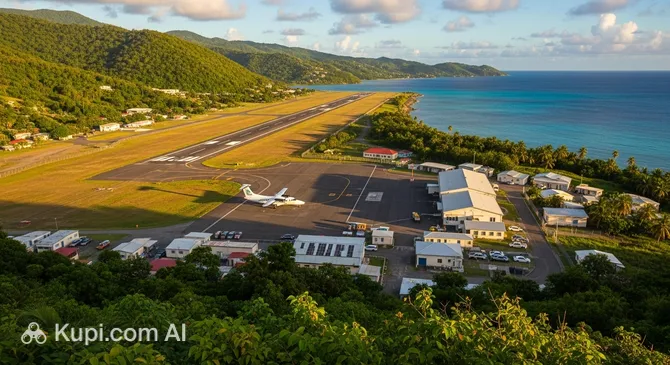
Canefield Airport. Source: Kupi.com Binoculars

This air gateway is not merely a transport hub, but a true portal into the heart of lush Dominica, located literally a stone's throw from the bustle of the capital. Canefield is devoid of the endless corridors found in giant international hubs, offering instead a cosy, almost boutique atmosphere and a breathtaking approach for landing between the azure sea and green hills. Here, the journey begins not with exhausting queues, but with a gentle sea breeze and the feeling that you have landed right on the city promenade.

IATA Code DCF
ICAO Code TDCF
City Roseau
Distance to Centre ~5 km
Status Regional / International
Annual Passengers About 15,000
Schedule Recommended to check with the carrier

Features and Advantages of the Airport

Canefield Airport possesses a unique set of characteristics that make it the preferred choice for a specific category of travellers, despite its modest size.

The main advantage is location. The airport is situated just a 10–15 minute drive from the centre of the capital, the city of Roseau. For comparison, the journey from the main international airport, Douglas-Charles (formerly Melville Hall), takes over an hour along winding serpentine roads. This makes Canefield an ideal option for business travellers and those who value their time.

Exclusivity and speed. Thanks to the low passenger flow, check-in procedures, customs, and passport control take place here with lightning speed. You can leave the terminal building with your luggage as quickly as 15 minutes after landing.

Limitations as a feature. The airport's runway is only about 954 metres long. This means Canefield accepts only small turboprop aircraft and private business jets. Landing here is considered visually impressive but requires high skill from pilots, as the runway is sandwiched between a mountain slope and the coastline. The airport operates only during daylight hours.

Contact Information

You can contact representatives of Canefield Airport (DCF) in several ways. Below are the main contact details for passengers.

  • Official Website: The airport is managed by the Dominica Air and Sea Ports Authority (DASPA). All official information can be found on their website: daspa.dm.
  • Information Desk Phone: +1 (767) 449-1199. When calling from abroad, do not forget to use the international code for Dominica.
  • Airport Address: Canefield Airport (DCF), Canefield, Saint Paul Parish, Dominica. The airport is located a few kilometres north of the country's capital, the city of Roseau.
  • Email: For general enquiries and support, you may contact them at customerservice@daspa.dm.
  • Social Media: Official news and updates are published on the Dominica Air & Sea Ports Authority page on social networks, such as Facebook.
  • Lost Luggage Information: In the event of loss or damage to luggage, it is recommended to first contact your airline directly. For additional assistance from airport services, you may use the general contact details.
  • Passenger Support Contacts: To resolve issues related to your stay and service at the airport, it is best to use the main phone number or email address listed above.

How to Get to the Airport

Canefield Airport (DCF) is located very close to the capital of Dominica, the city of Roseau, just a few kilometres to the north. Thanks to such a convenient location, getting to it from the city centre is quick and easy; the trip usually takes no more than 10-15 minutes depending on traffic conditions.

The most popular and convenient way to get to the airport is by taxi. A car can be found in the city or booked in advance through your hotel. The cost of the trip is generally fixed, but it is recommended to clarify it with the driver before starting the journey, as taximeters are not always used. This is a reliable option, especially if you are travelling with luggage. You can also use private transfer services, which ensure additional comfort.

For more budget-conscious travellers, local route taxis (minibuses) are suitable. They ply the main roads of the island and make a stop not far from the airport. This is the cheapest way to travel, however, it is worth noting that they do not have a strict schedule, and during peak hours they can be crowded. This option is better suited for tourists with light luggage.

If you plan to actively explore the island, an excellent solution would be car rental. Several rental companies operate in Roseau and at the airport itself. Having your own transport will give you complete freedom of movement. It is important to remember that traffic in Dominica is on the left, and roads can be narrow and winding. Near the Canefield airport terminal, there is a small parking area where you can leave a car.

It is worth noting that Canefield Airport serves mainly regional and charter flights. Most international flights arrive at the country's main airport — Melville Hall Airport (DOM), which is located significantly further from the capital. Other nearby international air hubs are located on neighbouring islands, including Pointe-à-Pitre International Airport in Guadeloupe and Martinique Aimé Césaire International Airport.

Terminals and Map

Canefield Airport (DCF) is a small and compact airport serving primarily regional flights. Its structure is extremely simple, making navigation intuitively clear even for those visiting for the first time.

The airport has just one terminal, which is used for all operations, including passenger arrivals and departures. There is no separation into domestic and international terminals, as all flights (mainly to neighbouring Caribbean islands) are processed in one building. Consequently, there is no need for transfers between terminals.

The terminal layout is exceedingly simple. Upon entering, you find yourself in a common area where the check-in counters of several airlines are located. The departure and arrival zones are, essentially, different parts of one small hall. After check-in, passengers pass through a single security screening point, beyond which is a small waiting lounge with a boarding gate. The arrivals area consists of a hall where passport control takes place and luggage is claimed, which is usually delivered very quickly.

Due to its size, the airport does not offer a wide range of services. Expect to find only the most basic amenities. Check-in and screening procedures typically proceed very quickly — often taking no more than 20-30 minutes in total. Nevertheless, it is recommended to arrive at the airport 1.5-2 hours before departure to complete all formalities without rushing.

Airport History

Canefield Airport (DCF), located in close proximity to the capital Roseau, was opened in 1979. Its construction was an important step for improving the transport accessibility of Dominica, as it provided more convenient air connections for the capital region, complementing the main Melville Hall Airport (now Douglas-Charles), located on the other end of the island.

The history of the airport is closely intertwined with its key role during periods of crisis. Almost immediately after opening, in the same year of 1979, Canefield became a vital centre for receiving humanitarian aid and coordinating recovery efforts following the devastating Hurricane David. This same function was critically important in 2017, when Hurricane Maria caused colossal damage to the island. The airport became the main artery for delivering aid and evacuating people while the main airport was closed.

Since its foundation, Canefield Airport has been oriented towards accepting small turboprop aircraft performing short flights between the islands of the Caribbean basin. Its runway is relatively short, which is the main reason for restrictions on the types of aircraft accepted. Significant expansion of the airport has always been difficult due to its location — it is sandwiched between the sea and the hills. Periodic modernisations have been aimed mainly at improving terminal buildings and navigation equipment to maintain safety standards.

Interesting fact: due to its location, short runway, and proximity to hills, landing at Canefield Airport is considered one of the most challenging in the region. It requires high skill and precise calculation from pilots, making every arrival and departure from this airport a unique event in its own right.

Services and Amenities

Canefield Airport (DCF) is a small regional airport in Dominica, serving primarily short flights between Caribbean islands. Given its compact dimensions, the range of services and amenities here is basic but sufficient for a comfortable wait before departure.

A small snack bar or café operates for passengers, where one can purchase light snacks, sandwiches, and beverages. This is a convenient place to have a bite before boarding. There may also be a small shop in the terminal offering souvenirs and essential items, but the selection is generally limited.

Wi-Fi may be available in the airport building, however, its speed and stability can vary. Power outlets are provided for charging electronic devices, but their number is small, so it is better to have a portable charger with you. Banking services, including ATMs and currency exchange points, are generally absent at Canefield Airport. It is recommended to perform all financial transactions in advance in the capital, the city of Roseau.

Passengers with reduced mobility are provided with basic assistance for moving around the terminal and boarding the aircraft. Nevertheless, to receive specialised services, it is recommended to contact the airline in advance. There are no specialised mother and child rooms or play areas for children at the airport. If first aid is required, you may approach the airport staff.

There are no hotels, conference halls, or business centres on the territory of Canefield Airport. The nearest options for accommodation and holding business meetings are located in the capital, Roseau, and its surroundings, which can be reached by taxi in a short time.

Where to Eat

Canefield Airport (DCF) is a small regional airport serving mainly domestic and short international flights. Due to its compact size, the choice of dining establishments here is quite limited and designed for passengers awaiting their flight. Do not expect a food court or a variety of restaurants here, as found in major international hubs.

In the airport's single terminal, a small café or snack bar usually operates. Here, travellers can find a basic set of items for a quick snack. The menu typically includes:

  • Light snacks: sandwiches, crisps, local pastries.
  • Beverages: coffee, tea, bottled water, carbonated drinks, and fresh juices made from tropical fruits.
  • Sometimes local refreshing beverages can be found in the assortment.

This establishment is ideal for having a quick bite before departure. For a full lunch or dinner, it is recommended to eat at one of the numerous cafés or restaurants in the nearby city of Roseau before arriving at the airport. Specialised vegetarian, vegan, or gluten-free dishes are likely absent from the menu, although you can check the composition of sandwiches with the staff. Travellers adhering to Halal dietary requirements are advised to enquire about ingredients.

The café is located in the general area of the terminal (landside), accessible to all visitors. Its opening hours are usually directly linked to the flight schedule — the establishment opens before departures and closes after the last aircraft have left. Prices for food and drinks are moderate but may be slightly higher than in the city.

Tips for Travellers

Travelling through Canefield Airport, located near the capital Roseau, can be a pleasant start to your adventure on the island of Dominica. To ensure everything goes smoothly, take advantage of our tips. Since this is a small regional airport, we recommend arriving 2 hours before departure. This time will be sufficient to complete check-in, drop off luggage, and pass pre-flight screening without haste.

Check-in and security control processes at Canefield Airport usually proceed faster than at major international hubs. Nevertheless, keep all necessary documents ready: passport, ticket, and visa (if required). Security staff adhere to standard regulations, so pack all liquids over 100 ml in your checked luggage in advance.

Flights served at Canefield are often operated on small turboprop aircraft. To enjoy breathtaking views of the lush green landscapes of Dominica during takeoff and landing, choose a window seat. If comfort and legroom are more important to you, an aisle seat is better suited. For those sensitive to turbulence, seats over the wing would be the optimal choice.

Pay special attention to carry-on luggage rules. Besides the standard restriction on liquids (in containers no more than 100 ml, packed in a transparent bag), regional airlines may set stricter limits on the weight and dimensions of carry-on bags. Be sure to clarify these requirements with your carrier to avoid the need to check your bag at the boarding gate.

Canefield is not a major transit hub, so transfers here are rare. If you do have a connecting flight planned, check with the airline in advance whether your luggage will be checked through automatically. It is easy to orient yourself in the small terminal, but it is better to know in advance where to go after arrival.

Upon entering Dominica, you will have to pass customs control. Fill out migration and customs declarations in advance, which are usually distributed on the plane. Be prepared to honestly declare all goods subject to mandatory declaration. Usually, the procedure goes quickly and without unnecessary questions if you do not have anything prohibited for import.

To save time and money, check in for your flight online and travel light to avoid paying for luggage. It is better to book a transfer from the airport in advance — this may be cheaper than taking a taxi on the spot. Note that the choice of cafés and shops at the airport is limited, so bring a light snack and a bottle for water (which can be filled after screening).

In case of a flight delay, the first thing to do is contact a representative of your airline for up-to-date information. Since amenities in a small airport may be limited, it is useful to have a portable charger, a book, or downloaded films with you. For lengthy delays, the airline is obliged to provide vouchers for meals or hotel accommodation — do not hesitate to clarify your rights.

Reached the end of the page?

That means the route is fully explored