Mambéré-Kadéï is an amazing region in the western part of the CAR, immersing travelers in the atmosphere of authentic, untouched Africa. There are no bustling metropolises here, but there are vast expanses where life flows in harmony with nature. The region attracts those seeking solitude and wanting to see the daily life of local agricultural communities, whose traditions are rooted in the deep past.
Geographically, the city and its surrounding prefecture are located in a picturesque hilly area covered with forests and savannahs. With a population of about 233,666 people, this region remains predominantly rural, which defines its calm and measured character. Most of the life is concentrated around fertile lands and water arteries that create the unique landscape of Central Africa.
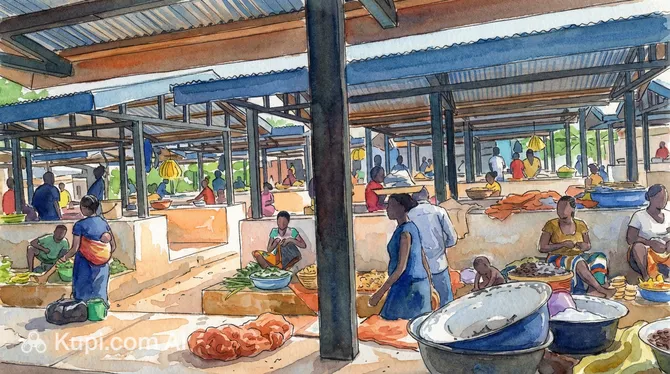
Mambéré-Kadéï. Illustration.
Source: Kupi.com AI
The main natural asset here is the Mambéré River, which gave its name to the entire region. Tourists who venture into these parts can get acquainted with the unique history of the region and see traditional farming where cassava, yams, and corn are grown. A visit to Mambéré-Kadéï is an invitation to explore authentic routes far from standard travel guides.
Weather Overview
The climate in Mambéré-Kadéï is typical for the tropical zone of Central Africa and is characterized by a clear change between the dry and rainy seasons. If you are planning a trip, keep in mind that the climate of the region involves high humidity throughout most of the year, which affects road conditions and general travel circumstances.
The hottest months are January and February, when air temperatures can reach +35°C, and there is practically no precipitation. During this period, nature looks drier, but movement through the region is simplified as much as possible. The rainy season begins in April, peaking in September and October: during this time, heavy rainfall occurs (up to 195 mm per month), and daytime temperatures become more comfortable, hovering around +28°C.
The optimal time for a visit is considered to be the period from November to March, when dry weather sets in. During this time, humidity decreases and the sky remains clear, which is ideal for ecotourism and moving between communes. When setting out, always keep in mind that even in the dry season, brief downpours are possible due to the proximity to dense equatorial forests.
Average monthly temperature
Average monthly precipitation
Interesting Facts
The prefecture was named after the deep Mambéré River, which is the main water artery and life source for local residents.
Mambéré-Kadéï covers an impressive area of 15,740 km², making it one of the largest administrative units in the Central African Republic.
The administrative center of the region is the town of Carnot—the largest settlement in the prefecture, home to about 160,000 people.
The region's economy is almost entirely based on agriculture, and the main crops grown here on a large scale are cassava, yams, and corn.
The prefecture is divided into four sub-prefectures: Carnot, Amada-Gaza, Gadzi, and Senkpa-Mbaere, each possessing its own unique natural landscape.
How to Get There
The accessibility of Mambéré-Kadéï presents a real challenge even for experienced travelers. Due to its distance from major highways and the specifics of the landscape, the journey to this region requires careful planning. The main flow of goods and people moves via land routes from the capital, Bangui, or through neighboring prefectures.
For those who prefer air travel, there is an airfield in the town of Carnot. However, keep in mind that regular commercial flights are very rare here. Most air communication is carried out via private charters or humanitarian missions, and the airfield infrastructure remains basic. Most travelers arrive here by 4WD vehicles from the city of Bouar.
Railway communication is completely absent in this part of Africa, so unpaved roads remain the primary means of transport. In the dry season, the journey can be relatively fast, but during the rainy season, roads are often washed out, and travel time can increase to several days. It is recommended to use only reliable four-wheel-drive vehicles for travel within the region.
Main Attractions
The Mambéré-Kadéï region and its surroundings cannot boast of classic architectural monuments, but they offer something more—pristine nature and a sincere way of life. The main point of attraction is the majestic Mambéré River, flowing through the entire region. Its banks, framed by dense gallery forests, are an ideal place for those who enjoy ecological tourism and wildlife observation.
In the administrative center, the town of Carnot, tourists can experience the flavor of local markets and communes such as Topia and Mbali. These places are interesting primarily for their atmosphere: here you can see traditional farming in action and get to know the daily life of local residents. A walk through the rural lands where tropical crops are grown allows for a better understanding of the economic rhythm of this part of Africa.
For those seeking visual impressions, the region offers panoramic views from forested hills transitioning into endless savannahs. Despite the lack of developed infrastructure, it is this wild and untamed beauty of the landscapes that makes Mambéré-Kadéï a unique place for true explorers ready to trade comfort for authentic discoveries.
Local Cuisine
The culinary traditions of Mambéré-Kadéï are closely tied to the land and its fruits. The basis of the local diet consists of agricultural crops grown everywhere here. The most popular dish is fufu—a thick cassava porridge served with various sauces and vegetable stews. Yams and corn are also widely consumed, serving as the base for flatbreads and side dishes.
Meat dishes are often prepared from game or poultry and are generously seasoned with local herbs. Since the region is rich in rivers, freshwater fish cooked over an open fire sometimes appears on the menu. For drinks, residents prefer traditional herbal infusions or palm wine, which is very popular during community celebrations.
There are practically no restaurants in the city in the Western sense of the word. All gastronomic life is concentrated in local markets and small street food stalls, where food is prepared right in front of passersby. This is the best way to try authentic cuisine, but travelers should exercise caution and choose places with high turnover, where products are always fresh.
Travel Tips
A trip to Mambéré-Kadéï requires serious preparation, as this region is far from the beaten tourist path. These tips will help you make your journey as safe and comfortable as possible.
Clothing and equipment: Take light clothing made of natural fabrics, but be sure to bring long-sleeved items to protect against insects in the evening. Sturdy closed shoes are mandatory for walking on rough terrain.
Transport: The only reliable way to get around is to rent a 4WD vehicle with an experienced driver. Do not plan trips after dark due to poor road conditions and safety measures.
Finances: Only CFA francs in cash are accepted in the region. There are practically no ATMs, and cards do not work, so bring a sufficient supply of currency exchanged in advance in Bangui.
Health: Be sure to carry a full first-aid kit, a supply of antiseptics, and repellents. Consult a doctor regarding malaria prophylaxis and ensure you have all necessary vaccinations.
Connectivity: Mobile communication is unstable and only works in large centers like Carnot. Wi-Fi is practically non-existent, so it is better to purchase a local SIM card for emergency calls.
Etiquette: Always greet local residents before asking for anything. Before photographing people or their homes, be sure to ask for permission—it is a sign of respect.
What to avoid: Do not travel alone to remote areas without a local guide and avoid discussing political topics with strangers.
Extra tip: Always carry a supply of drinking water and snacks, as there may not be a single shop or cafe along the way.
Despite all the difficulties, Mambéré-Kadéï will give you unforgettable impressions and allow you to see real life in the heart of Africa. Be open to new things and respect local customs!
Entertainment & Nightlife
Entertainment in Mambéré-Kadéï is of a specific, traditional nature. In the usual urban sense, there is practically no nightlife here: you won't find modern clubs, cinemas, or large concert halls. The centers of social activity are the local markets and family gatherings, where in the evenings residents share news to the sounds of traditional instruments.
Local holidays and community festivals are sometimes held in the town of Carnot, accompanied by folk songs and dances. This is the best time to see the cultural richness of the region. Daytime entertainment comes down to exploring natural attractions—walking along the riverbanks or trips to small communes where you can observe the work of artisans.
It is important for travelers to remember safety: travel on the prefecture's roads is highly discouraged during evening and nighttime hours. All activity dies down after sunset, so leisure activities should be planned for daylight hours. To find more diverse entertainment or modern restaurants, tourists have to travel to the country's capital, Bangui.
Parks & Museums
In Mambéré-Kadéï, you won't find well-kept city parks with benches or majestic museum buildings. Nature itself performs the function of recreation areas and cultural spaces here. The main "green hall" of the region is the virgin forests and vast savannahs that occupy most of the territory and amaze with their biological diversity.
Although there are no official museums in the region, the history and culture of the local people are literally in the air. Traditional buildings in the villages and the products of local artisans seen in the markets serve as exhibits. The natural landscapes along the Mambéré River serve as natural platforms for observing an ecosystem that has preserved its pristine appearance over centuries.
The absence of organized cultural institutions is compensated by the opportunity to see "living ethnography." Instead of galleries, tourists visit communes where traditions are passed down from generation to generation through oral legends and collective labor. Such immersion in the environment often proves to be much more educational than looking at dusty museum display cases.
Getting Around
Public transport in Mambéré-Kadéï is poorly developed and represented mainly by informal carriers. Within the town of Carnot and between large communes, the most popular means of transportation are moto-taxis (motorbike taxis). This is a fast, though not the most comfortable, way to get from one point to another through narrow rural streets.
Intercity communication is carried out by trucks converted for passenger transport or private 4WD vehicles. There are no systematic bus routes with a clear schedule: transport departs as it fills up. Fares are always paid in cash to the driver, and the price should be agreed upon in advance to avoid misunderstandings.
The condition of the roads in the prefecture is the determining factor for transport. Most routes are unpaved roads, which become difficult to pass during the rainy season. Travelers are recommended to rent a car with a local driver who knows the terrain and can handle the off-road conditions. Walking is only possible within settlements, as distances between communes are significant.
Accommodation
The choice of accommodation in Mambéré-Kadéï is extremely limited and geared more toward unpretentious travelers or employees of international organizations. There are no hotel chains or luxury resorts in the region. The main accommodation options are concentrated in the town of Carnot, where simple guesthouses with basic amenities can be found.
Often, accommodation consists of small guesthouses that offer a minimal set of services: a bed, a mosquito net, and sometimes access to electricity during certain hours. For longer stays, expats and mission workers prefer to rent rooms or small houses from locals, which requires prior personal arrangements.
When planning a trip, it is important to understand that booking through international online services is not possible here. It is recommended to contact local contacts or the host party in advance to organize overnight stays. The price range is usually low, but the level of comfort corresponds to a remote rural province, so it is worth bringing necessary items for sleep and personal hygiene.
Nearby Cities
Mambéré-Kadéï can serve as a starting point for exploring the republic's western provinces, where every settlement reveals new facets of local culture. Although the distances between cities may seem small, the quality of the roads makes every trip a real expedition that requires preparation and time.
One of the most significant destinations is the town of Carnot, which is essentially the administrative and commercial heart of the prefecture. A bit further away is Berbérati—one of the country's largest cities, known for its diamond mining history and colorful architecture. Also worth noting is the town of Nola, located at the confluence of rivers, which makes it extremely picturesque.
City
Population
Distance
Berberati
76 918
108 km
Carnot
45 421
112 km
Nola
41 462
126 km
Bossembele
7 287
137 km
Mbaiki
22 166
151 km
For those ready for longer trips, Bossembélé and Mbaïki may be of interest. Exploring the surroundings allows you to see how the landscape changes from dense forests to open savannahs and gives you the opportunity to dive deeper into the multifaceted world of Central Africa.
Shopping & Souvenirs
Shopping in Mambéré-Kadéï is primarily about visiting the vibrant and noisy local markets, which are the center of life in Carnot and the surrounding communes. You won't find shopping malls or brand boutiques here, but you can purchase goods crafted by local artisans. Markets operate mainly during daylight hours, and it is customary to bargain, which is part of the local communication culture.
The main commodity and souvenir at the same time are traditional fabrics with bright African prints, which local women skillfully turn into clothing. You can also find woodwork, woven baskets, and pottery reflecting the life of rural residents at the markets. For food souvenir enthusiasts, it is worth paying attention to local honey and authentic spices.
As for payment, only cash is used—CFA francs. There are very few ATMs in the region, and international cards are practically not accepted anywhere, so a supply of cash in small bills is mandatory. Most retail outlets close at dusk, so it is better to plan all purchases for the first half of the day.