Source: Kupi.com AI
| Characteristic | Value |
|---|---|
| IATA code | IQN |
| ICAO code | ZLQY |
| City | Qingyang |
| Country | China |
| Time zone | Asia/Shanghai |
| Popular airlines | Tianjin Airlines, GX Airlines |
| Schedule | Online timetable |
| Characteristic | Value |
|---|---|
| IATA code | IQN |
| ICAO code | ZLQY |
| City | Qingyang |
| Country | China |
| Time zone | Asia/Shanghai |
| Popular airlines | Tianjin Airlines, GX Airlines |
| Schedule | Online timetable |
For your convenience, we have compiled the main contact information for Qingyang Airport (IQN). Please note that for small regional airports, some data may be unavailable or should be verified additionally.
You can get to Qingyang Airport (IATA: IQN) from the centre of Qingyang and its surroundings in several ways. The choice of the best option depends on your budget, time, and comfort preferences. The airport is located relatively close to the city, making the journey quick and convenient.
Public Transport: Shuttle Bus
The most economical way to get to the airport is to use the dedicated shuttle buses. They run between key points in the city and the airport. The schedule is usually linked to flight departure and arrival times, so it is recommended to check it in advance. The bus journey from the city centre takes approximately 40–60 minutes, depending on the route and traffic conditions. This is an excellent choice for solo travellers and those wishing to save money.
Taxi and Private Transfer
A taxi is the fastest and most comfortable way to reach the airport. The trip from the centre of Qingyang will take about 30–40 minutes. This is an ideal option if you are travelling with family, a large amount of luggage, or simply value your time. The cost of the trip will be significantly higher than by bus. It is recommended to use official taxi services and ensure the driver uses the meter, or agree on a fixed price in advance. You can also book a private transfer, which will meet you at a specified location at the appointed time.
Car Rental and Parking
If you plan to actively travel around the region, renting a car can be a great solution. Many rental companies provide the option to pick up the car in the city and return it directly at the airport before departure. For those arriving at the airport in their own or a rented vehicle, there is a car park on the airport grounds where you can leave your car for both short and long terms.
Recommendations for Travellers
To ensure your trip to the airport goes smoothly, consider a few tips. Always allow extra time for the journey, especially during peak hours. If you are flying from China for the first time, remember that checking in for a flight and passing through security takes time. It is also worth noting that some travellers arrive in the region via larger transport hubs, such as Xi'an Xianyang International Airport in Xi'an. From such cities, you can reach Qingyang by intercity bus or train, which will require additional planning.
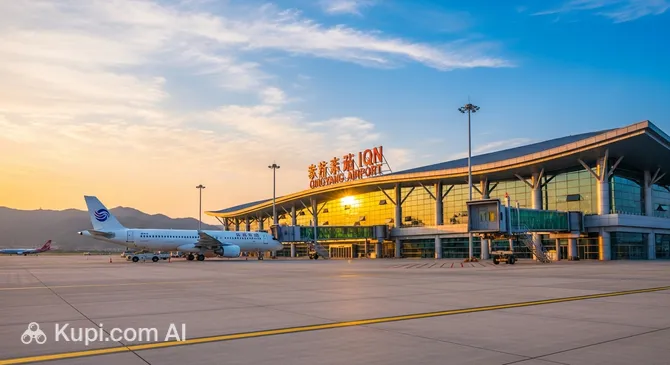
Qingyang Airport (IQN) is a modern and compact airport serving all flights in one passenger terminal. This structure makes it extremely convenient for passengers, as it eliminates the need for complex transfers and long walks. This terminal handles all domestic flights, making navigation through it maximally simple and clear for travellers.
The terminal building has a logical and intuitive layout, generally divided into two main levels. On the first floor, you will typically find check-in counters, the baggage handling and claim area, as well as the arrivals hall. After collecting their belongings, arriving passengers can immediately exit to the taxi and bus stand. On the second floor is the departure zone: here passengers pass through security control, after which they enter a comfortable waiting lounge with boarding gates.
Registration and screening procedures at Qingyang Airport are significantly faster than in major international hubs. Despite this, it is recommended to arrive at the airport 1.5–2 hours before the departure of a domestic flight. This time is more than sufficient to check in luggage without rushing, complete all formalities, and find your boarding gate. Queues are generally small, and the staff work efficiently.
To navigate the airport, simply follow the standard signs, which are duplicated in English. Thanks to the compact size and the fact that all operations are concentrated in one building, it is practically impossible to get lost here. The clear separation into arrival and departure zones helps passengers orient themselves quickly immediately upon entering the terminal.
The history of Qingyang Airport (IQN) is not just a chronicle of a single facility, but a tale of revival and rapid development. The current aviation hub serving the city is a modern successor to its historical predecessor, built to open new horizons for the region and connect it with the rest of China.
The first airport in Qingyang was built in 1976 and received its first flights as early as 1977, becoming one of the pioneers of civil aviation in Gansu Province. However, its location directly within the city limits and modest size eventually became serious limitations for growth. Due to the impossibility of further expansion, its operations were completely ceased in 1993, and the city was left without an air gateway for nearly two decades.
The decision to revive air connectivity was made in the early 2000s, and in April 2010, construction began on a completely new airport at a new, more spacious location. The project was implemented in an impressively short time. On 21 November 2012, the grand opening of the modern airport complex, built to 4C standards, took place. This event became a powerful impetus for the economic and tourism development of the entire region.
Since its second birth, Qingyang Airport has been constantly gaining momentum. It is a key transport hub for the northeast of Gansu Province, facilitating the growth of business activity and attracting tourists to the city. The airport continues to expand its route network, connecting Qingyang with the country's major metropolises and ensuring a comfortable and safe journey for passengers.
Qingyang Airport (IQN) offers passengers all necessary services for a comfortable wait for their flight. Although it is a small regional airport, conditions have been created here to ensure your journey begins and ends without unnecessary hassle.
Before departure or after arrival, you can have a snack in one of the cafes or small restaurants offering both local cuisine and familiar snacks. Shops are also available in the terminal where you can purchase souvenirs, travel goods, and reading materials. For a more comfortable wait, VIP lounges with comfortable seating and additional services are available to passengers.
Free Wi-Fi is available throughout the airport, and charging stations for mobile devices are installed in the waiting halls. ATMs and currency exchange points are provided for financial matters. In case of necessity, passengers can visit the medical post for first aid.
Qingyang Airport cares for all categories of travellers. Mother and child rooms are equipped for passengers with children. Travellers with reduced mobility can count on special assistance from staff, and the terminal infrastructure includes ramps and adapted restrooms. Although there are no hotels directly on the airport grounds, several hotels are located nearby, which are easily accessible by taxi. Basic business services may be available for business travellers.
Qingyang Airport (IQN), being a regional air hub, offers passengers a basic but sufficient selection of establishments for a snack or a full meal. Dining options are mainly concentrated in the main terminal and focus on Chinese cuisine.
Most cafes and small restaurants are located in the public area before security control (landside). Here you can find establishments offering hot dishes such as noodle soups, rice with various toppings, and traditional snacks. This is the best place for a leisurely lunch or dinner. After passing through inspection, in the sterile departure zone (airside), the choice is usually limited to one or two cafes where you can buy beverages, sandwiches, pastries, and light snacks.
Travellers wishing to experience local cuisine should look for noodle dishes characteristic of Gansu Province. Although the airport may not have famous restaurants, you are likely to find authentic and hearty equivalents. For a quick snack, steamed baozi buns or a small convenience store selling packaged snacks and drinks are ideal.
For passengers with special dietary needs (vegetarians, vegans, or those following a gluten-free or Halal diet), finding suitable dishes may be difficult. It is recommended to check ingredients directly with staff or carry necessary snacks with you. Prices in airport establishments are generally higher than average for the city, which is standard practice for air hubs. The opening hours of most cafes and restaurants are linked to the flight schedule: they open in the morning before the first departures and close after the last plane has left.
When planning a trip through the airport of Qingyang city, use our tips to make your journey as comfortable as possible and avoid unpleasant surprises. These recommendations will help you save time, nerves, and money.
When to Arrive at the Airport
For domestic flights within China, it is recommended to arrive at the airport at least 2 hours before departure. This time will be sufficient to calmly check in, drop off luggage, and pass security control without rushing. If you are travelling on peak dates or holidays, it is better to add another 30–60 minutes.
Check-in and Screening
Many airlines offer online check-in, which saves time. If you only have hand luggage, you can go straight to security screening. Be prepared to present your passport and boarding pass at security. All electronics (laptops, tablets, power banks) and liquids must be removed from your bag and placed in a separate tray.
Choosing a Seat on the Plane
If you want to admire the views, choose a window seat. If comfort and the ability to stretch your legs or exit quickly are important to you, your choice is an aisle seat. Seats in the front of the cabin usually allow you to leave the plane faster upon arrival, while emergency exit seats often offer more legroom but may have restrictions.
Hand Luggage Rules
Pay special attention to restrictions. Liquids can be carried in containers of no more than 100 ml each, packed in a single transparent bag. Power banks and spare lithium batteries are carried only in hand luggage; their capacity must not exceed the established limit (usually 100–160 Wh), and they must be clearly marked. Sharp objects, weapons, and flammable substances are prohibited.
Passengers with Connections
If you have a connecting flight, check in advance whether you need to collect and re-check your luggage in Qingyang. Leave a sufficient time margin between flights — at least 1.5–2 hours for domestic transfers.
How to Save Time and Money
Book tickets and hotels in advance, especially during the tourist season. Use online check-in. To save on food and drinks, you can take an empty water bottle with you and fill it at special water fountains after passing security.
If the Flight is Delayed
In case of a flight delay, first contact your airline's counter for information. Depending on the duration of the delay, the airline is obliged to provide drinks, meals, and for long delays, hotel accommodation. Keep all receipts for unforeseen expenses and monitor the departure boards for information.
Have you reached the end of the page?
So the route has been studied inside and out