| IATA Code | XIY |
| ICAO Code | ZLXY |
| City | Xi'an |
| Distance to Centre | Approx. 40 km |
| Status | International |
| Annual Passengers | Over 41 million (2023) |
| Schedule | Available on the online flight board |
Xianyang International Airport
About the Airport
Contact Information
- Official Airport Website: www.xxia.com
- Information Service and Passenger Support: +86 29 96788 (Hotline)
- Airport Address: Dizhang Town, Weicheng District, Xianyang, Shaanxi, China.
- Email: service@xxia.com (Inquiries), complaint@xxia.com (Complaints and suggestions).
- Social Media: News and announcements are available on official pages on WeChat and Weibo (search for the account Xi'an Xianyang International Airport).
- Lost & Found Information:
- Terminal 2 (T2): +86 29 8879 6107
- Terminal 3 (T3): +86 29 8879 6675
- Medical Service: +86 29 8879 6120
How to Get to the Airport
Getting to the Airport and Parking
The transport system connecting Xianyang International Airport with the city is excellently developed. Travellers can choose an option to suit any budget and comfort level — from the ultra-modern metro to classic taxis. The journey from the centre of Xi'an usually takes from 40 minutes to 1.5 hours depending on traffic and the chosen mode of transport.
Public Transport: Metro and Buses
The most time-predictable way to get to the airport is by using the metro. A dedicated line connecting the terminals to the urban transport network has been operational since 2019.
- Metro (Line 14): The line connects the airport (stations Airport West T1/T2/T3) with Xi'an North Railway Station. The trip takes about 35 minutes. At the railway station, you can transfer to Line 2 (running through the city centre from north to south) or Line 4.
Cost: Approximately 16–20 CNY for the entire trip to the centre. - Airport Shuttle Buses: This is a convenient option if your hotel is located near one of the stops. There are several routes, the most popular of which go to the Bell Tower, the South Gate, and the East Railway Station. Buses depart every 20–30 minutes.
Cost: 25 CNY. Tickets are sold at counters in the arrival hall.
Taxi and Transfers
For those who value comfort or are travelling with heavy luggage, a taxi remains the best choice. Taxi ranks are located at the exits of the arrival zones of all terminals (T2 and T3).
- Travel Time: About 40–60 minutes to the city centre, provided there are no serious traffic jams.
- Cost: A metered trip to the centre will cost approximately 120–150 CNY. Please note that the fare may be higher at night, and an expressway toll (about 10 CNY) is payable additionally.
- Recommendation: Be sure to have the name of your hotel and its address written in Chinese characters. Most drivers do not speak English.
Car Rental and Parking
Car rental in China has its own specifics: international driving licences are not valid here; one must obtain a temporary Chinese permit. Therefore, renting a car with a driver is more popular among tourists.
If you are meeting someone or arriving by car, the airport offers extensive parking zones:
- Indoor Parking (GTC): Located next to Terminal 3, convenient for long-term parking and protecting the car from the weather.
- Outdoor Parking: Located near Terminal 2.
- Rates: The first 30 minutes are usually free. Thereafter, the cost is calculated by the hour (about 3–5 CNY per 30 minutes) with a daily limit (about 50–80 CNY, depending on the zone).
Nearest Alternative Airports
If direct tickets to Xianyang are sold out, you might consider flying to neighbouring cities from where it is convenient to travel by ground transport. Within a radius of 250 km, there are several regional airports:
- Qingyang Airport (IQN) — located approximately 183 km away.
- Ankang Airport (AKA) — located 193 km away, serving the southern part of Shaanxi province.
- Hanzhong Airport (HZG) — 204 km away, convenient for travelling to historical sites in the region.
- Yuncheng Airport (YCU) — a major hub in the neighbouring Shanxi province, the distance is about 221 km.
- Yan'an Nanniwan Airport (formerly Ershilipu) (ENY) in Yan'an city — located 234 km to the north.
Terminals and Map
Terminals: Structure and Navigation
Xianyang International Airport (XIY) is a massive complex divided into two main operational zones. In total, there are three passenger terminals functioning at the airport: T1, T2, and T3. Despite its size, navigation here is intuitive thanks to a well-thought-out layout and signs in English.
The airport is divided as follows:
- Terminals 1 and 2 (South Zone): These two buildings are physically connected by a long corridor. They exclusively serve domestic flights within China.
- Terminal 3 (North Zone): The newest and largest terminal. It serves all international flights, flights to Hong Kong, Macau, and Taiwan, as well as domestic flights of major airlines (China Eastern, China Southern).
Features of Each Terminal
Each terminal has its own specifics, which are important to consider when planning your time:
- Terminal 1 (T1): The oldest and most compact. It is mainly used by budget airlines (e.g., Spring Airlines, 9 Air) and for some regional flights. The infrastructure here is basic but sufficient for comfortable waiting.
- Terminal 2 (T2): Serves a wide range of domestic airlines (except those based in T3). Check-in counters for many national carriers are located here. The building is connected to T1, so passengers can walk between them.
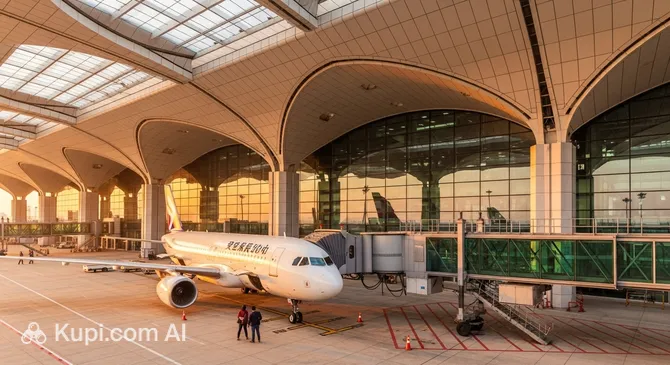
- Terminal 3 (T3): The architectural gem of the airport. This is a modern four-level building with spacious halls, numerous Duty Free shops, VIP lounges, and restaurants. This is where the main centre for international departures is located.
Zone Map and Transfers Between Terminals
If you need to transfer or have mistaken the terminal, getting from one zone to another is not difficult, although distances can be significant.
- On Foot: You can walk between T1 and T2 via an internal corridor (about 5–10 minutes).
- Shuttle Bus: Free shuttle buses run between the T1/T2 complex and the separate T3 building. They depart every 10–15 minutes. Stops are located at the exits of the arrival zones. The trip takes about 5 minutes.
- GTC (Ground Transportation Centre): Terminal 3 is connected to the Ground Transportation Centre, where the metro station, bus ticket counters, and parking are located.
Departure and Arrival Zones
The floor structure in Terminal 3 (as the most complex one) is as follows:
- Level 4: Flight Check-in Hall.
- Level 3: Departures Zone, customs, and passport control for international flights.
- Level 2: Arrivals Zone and transit corridors.
- Level 1: Baggage claim and exit to the city, access to transport.
Check-in, Security, and Useful Tips
Security procedures at Chinese airports are notably thorough. To avoid stress, follow these recommendations:
- Arrival Time: For domestic flights, it is recommended to arrive 2 hours before departure, and for international flights — 3 hours. Queues for security checks in T3 can be long.
- Security Check: Be prepared for strict checks. Power banks must have a clear marking of capacity (usually no more than 100 Wh or 20,000 mAh); they cannot be checked in with luggage — only carried in hand luggage. Lighters and matches are strictly prohibited.
- Wi-Fi and Connectivity: Free Wi-Fi is available in all terminals, but connecting often requires receiving a code via SMS to a Chinese number or scanning your passport at a special kiosk (Wi-Fi Kiosk).
- Hot Water: Dispensers with free hot and cold drinking water are installed in the waiting lounges of all terminals — an indispensable amenity for those wishing to make tea or noodles before their flight.
Airport History
History and Development: From Local Airfield to Gateway of the Silk Road
The history of aviation in Xi'an is inextricably linked with the development of the city itself as the main tourist and logistical centre of Northwest China. The current Xianyang Airport is a relatively young facility that replaced outdated infrastructure to meet the growing demand for travel to the Terracotta Army.
The official birth date of the air harbour is considered to be 1 September 1991. It was on this day that Xianyang Airport received its first flights, completely replacing the old Xi'an Xiguan Airport. The previous airfield was too close to the city centre, which hindered high-rise construction and created significant noise pollution, so moving the aviation hub to a plateau in the neighbouring city of Xianyang was a strategically sound decision.
Stages of the Great Journey: Expansion and Modernisation
The airport's development proceeded at a rapid pace, reflecting China's economic growth:
- 2003 (Phase 2): Just 12 years after opening, the airport could no longer cope with passenger traffic. In September, Terminal 2 was put into operation. This allowed for increased capacity and significantly improved service quality.
- 2012 (Phase 3): A key moment in the history of the hub. In May, the grandiose Terminal 3 and a second runway were opened. From this moment, Xianyang received the 4F class rating, allowing it to accommodate the largest passenger liners in the world, including the Airbus A380.
- 2020s: A massive expansion project (Phase 3) began, including the construction of the East Terminal and new runways. The goal of this stage is to turn the airport into a giant hub capable of serving over 80 million passengers a year.
- Archaeology on the Runway: Xi'an is an ancient capital, and any construction here involves historical discoveries. During the airport expansion in 2020–2021, builders discovered over 3,500 ancient tombs and thousands of artefacts from various dynasties. The joke that in Xi'an "wherever you dig, you find history" was literally confirmed here.
- Regional Leader: Xianyang consistently holds the title of the largest airport in Northwest China. It serves as a major transfer hub for flights to Tibet (Lhasa) and the Xinjiang Uyghur Autonomous Region.
- Fate of the Predecessor: On the site of the old Xi'an Xiguan Airport, which was closed in 1991, a beautiful city park has now been laid out, with only the layout of the alleys reminding visitors of the runways.
- Architectural Code: The design of Terminal 3 is inspired by elements of traditional Tang Dynasty architecture, symbolising the connection of times. The roofs and interiors are reminiscent of the palaces of ancient Chang'an (the old name for Xi'an).
Services and Amenities
Services and Amenities in the Terminals
Xianyang International Airport (XIY) ensures a high level of comfort, befitting the status of a major aviation hub. Passengers can count on developed infrastructure, especially in the modern Terminal 3, where most services for international travellers are concentrated.
Restaurants, Cafés and Shops
Departure zones offer a rich selection of gastronomy: from familiar international chains (Starbucks, KFC, Pizza Hut) to restaurants offering authentic Shaanxi cuisine. This is an excellent opportunity to taste local dumplings or famous noodles one last time before departure. In the international departure zone of Terminal 3, there is a Duty Free shop offering cosmetics, perfumes, and other goods. The airport also hosts numerous souvenir shops where you can purchase Chinese tea, silk products, and high-quality replicas of Terracotta Warriors.
Connectivity, Wi-Fi and Finance
Free Wi-Fi is available throughout the airport. An important detail: a Chinese phone number is often required to receive an SMS for connection. International tourists can use special automated kiosks (Wi-Fi Kiosks) that scan a passport and issue a temporary access code. Charging stations for gadgets and USB ports are located at most gates and in waiting lounges.
Currency exchange points are located in international arrival and departure zones (mainly in T3). ATMs of major Chinese banks are also available. It is recommended to have a supply of cash Yuan (CNY), as cards from international payment systems are not accepted at all retail points, and payment via WeChat or Alipay requires prior card linking.
Lounges and Business Services
For comfortable flight waiting, VIP lounges and airline lounges (First Class & Business Class Lounges) are available after passing security control. They offer soft armchairs, a buffet, beverages, press, and sometimes shower cabins. For business people, business centres are provided, offering photocopying, fax services, and meeting room rentals for urgent meetings.
Hotels and Rest
If you have a long layover or an early flight, you can use accommodation services without leaving the terminal area:
- Regal Airport Hotel Xi'an: A high-class hotel directly connected to Terminal 3 by a covered walkway. Guests have access to comfortable rooms, an indoor pool, a spa, and several restaurants.
- Capsule Hotels (Sleep Pods): Compact sleeping cabins are installed inside the terminals (specifically in T3 and the corridor between T2 and T3). This is a budget-friendly and convenient option allowing you to rest for a few hours in silence and privacy.
Medical Services and Facilities for Passengers with Children
The airport is attentive to family travellers. Terminals are equipped with Nursing Rooms with changing tables, sinks, and comfortable chairs for feeding. In case of illness, passengers can visit Medical Centres, which operate around the clock and are ready to provide first aid.
Accessibility
The infrastructure of Xianyang is fully adapted for passengers with reduced mobility. Buildings are equipped with ramps, wide elevators, and specialised restrooms. The airport provides free escort services and wheelchair rentals. To guarantee assistance, it is recommended to submit a request through your airline no later than 48 hours before departure or contact the information desk upon arrival.
Where to Eat
Dining at the Airport: From Fast Food to Gastronomic Discoveries
A gastronomic journey through Xi'an shouldn't end upon arrival at the airport. Since the city is famous for its unique cuisine combining Chinese and Muslim traditions, Xianyang International Airport (XIY) offers passengers an excellent choice of venues. Here you can grab a quick bite of familiar fast food or enjoy a full meal with local flair.
Local Delicacies: What to Try
If you missed tasting the main hits of Shaanxi cuisine in the city, you have a chance to catch up in the terminals. Look for establishments with signs saying Local Food, Shaanxi Cuisine, or Old Xi'an.
- Roujiamo (Chinese Burger): Chopped meat (beef in Halal versions, or pork in others), stewed in spices and served in a hot crispy flatbread. An ideal option for a quick and filling snack.
- Biangbiang Noodles: Wide, long hand-made noodles served with garlic, chilli, and hot oil. Be careful: the dish can be spicy.
- Liangpi: Cold noodles made from rice or wheat flour with a refreshing sauce — an excellent choice in hot weather.
- Dumpling Soup: Hot broth with wontons or traditional Jiaozi dumplings will warm you up before a long flight.
Restaurant Locations and Terminal Features
Dining establishments are located both in the public zone (Landside — before security) and in the secure zone (Airside — near boarding gates). However, the assortment differs across terminals:
- Terminal 3 (T3): The widest selection is concentrated here.
- Departure Zone (Level 4, Landside): A large selection of restaurants where those seeing off passengers and travellers can dine. Major chain establishments are located here.
- Commercial Street (GTC): In the Ground Transportation Centre connected to T3, there is also a food court with more democratic prices.
- Airside (after control): Many coffee shops (Starbucks, Pacific Coffee) and Asian cuisine restaurants.
- Terminal 2 (T2): The selection is more modest than in T3. The main focus is on small cafés and Chinese fast food. If you have plenty of time, it is recommended to dine in the connecting corridor or walk over to T3 (before passing special control).
International Chains and Familiar Food
For those who prefer proven classics or miss European food, global brands are represented at the airport. This is also the safest option for travellers with sensitive digestion.
In both main terminals (T2 and T3) you will find:
- Fast Food: KFC, McDonald's, Burger King, Pizza Hut.
- Coffee Shops: Starbucks and Costa Coffee — sandwiches, pastries, and familiar coffee are always available here.
Dietary Requirements: Halal and Vegetarian
Xi'an is a centre of Muslim culture in China, so finding Halal food here is easier than in other airports in the country.
- Halal: Look for establishments with green signs or crescent symbols. Many Beef Noodle restaurants are Halal by definition. The menu will not contain pork, and dishes are prepared according to Islamic dietary laws.
- Vegetarians and Vegans: There are no specialised vegan restaurants in the airport. However, in Chinese establishments, you can always order vegetable dishes (for example, smashed cucumbers, tofu with spring onions, or noodles with vegetables).
Important: Check if meat broth or animal fat is used for frying, even if there are no visible pieces of meat in the dish. - Gluten-Free: In China, this is a challenging task, as soy sauce contains wheat. The safest option is steamed rice, boiled vegetables without sauce, or fruit which can be bought in mini-markets (convenience stores like FamilyMart).
Prices and Opening Hours
- Opening Hours: Most restaurants open around 06:00–06:30 in the morning. Establishments in the general zone (Landside) usually close at 22:00–23:00. In the secure zone (Airside), some cafés work until the departure of the last flight. Only select fast-food outlets (e.g., some KFCs) or vending machines may operate around the clock.
- Price Range: Prices at Xianyang Airport are 20–30% higher than in the city.
- Light snack (coffee + bun): 40–60 CNY.
- Fast food set: 40–55 CNY.
- Full meal (noodles/rice + drink): 60–90 CNY.
Recommendations for Passengers
For a quick snack before a flight, chain coffee shops or stalls with Roujiamo are best — it is tasty, filling, and convenient to eat on the go. If you wish to dine quietly, head to the 4th floor of Terminal 3 (before control) or to national cuisine restaurants after passing security — the atmosphere there is calmer with comfortable seating.
Tips for Travellers
Useful Tips and Hacks for Passengers
Travelling through a major Chinese hub like Xianyang International Airport can be an easy and pleasant adventure if you know the local specifics. Chinese aviation security and logistics rules have their own peculiarities, which often differ from European or American standards.
Time Planning: When to Arrive
Xianyang is a busy airport, and procedures here may take longer than you are used to.
- International Flights: It is recommended to arrive at the airport 3 hours before departure. Queues for passport control and security checks can be unpredictable, especially during holidays (Chinese New Year, "Golden Week" in October).
- Domestic Flights: Arrive at least 2 hours in advance. Although check-in is often quick thanks to kiosks, security screening is always thorough and unhurried.
- Peak Hours: Morning hours (07:00 to 09:00) and evening hours (17:00 to 19:00) are the busiest. Factor in an extra 30 minutes if you are flying at this time.
Check-in and Security Screening Specifics
Security screening at Chinese airports is among the strictest in the world. Knowing the rules will save you a lot of stress.
- Power Banks: This is the most important point.
- Power banks can be carried only in hand luggage. They are strictly prohibited in checked baggage.
- The device casing must have a clear factory marking indicating the capacity (no more than 100 Wh or 20,000 mAh without approval; up to 160 Wh with airline permission). If the inscription has worn off, the device will be confiscated.
- Lighters and Matches: Bringing any flammable items into the departure zone and on board is completely prohibited. They cannot even be placed in checked baggage. Baskets are often placed at the entrance to the screening zone where passengers discard lighters.
- Electronics: During screening, you need to remove not only laptops and tablets from bags but often cameras, umbrellas, and all cables as well.
Hand Luggage: Do's and Don'ts
Besides the standard rule of "liquids in containers up to 100 ml in a transparent 1-litre bag", pay attention to the following points:
- Alcohol: Strictly prohibited in hand luggage, even if purchased in Duty Free at another airport (rules vary, but it is often confiscated during transfer). A limited amount can be carried in checked suitcases.
- Cosmetics: The volume must be clearly visible on cosmetic bottles. If the bottle is large (e.g., 150 ml) but there is only a little cream at the bottom, it will still not be allowed through.
- Food: You can take snacks, nuts, chocolate, or biscuits with you. However, fruits with a strong odour (such as durian) are prohibited.
Choosing a Seat on the Plane
If you are flying to Xi'an during the day and the weather is clear, choosing a Window Seat will offer unforgettable views.
- Mountain View: When approaching from the south, a panorama of the majestic Qinling mountain range often opens up — the natural border between northern and southern China.
- City View: The airport is located northwest of the city. Upon landing approach, you can see the geometrically precise layout of fields and suburbs of Xi'an, and sometimes the outlines of ancient burial mounds which this land is rich in.
Tips for Transit Passengers
Xi'an is often used as a transit point. Consider the following nuances:
- Visa-Free Transit: Xianyang Airport participates in the 144-hour visa-free transit programme. If you have a ticket to a third country (e.g., Dubai — Xi'an — Bangkok), you can exit into the city and visit the Terracotta Army. To apply, look for the 24/144-hour Transit Visa Exemption counter upon arrival.
- Luggage during Transfer:
- International -> International: Usually, luggage is checked through to the final destination (confirm at the counter during the first departure).
- International -> Domestic: You will almost certainly have to collect your luggage, pass customs, and check it in again at the domestic departures counter, even if on a single ticket.
Customs Control
Chinese customs closely monitor the import and export of certain goods.
- What to Declare: Cash currency exceeding 5,000 USD (or equivalent) and valuable items for personal use worth over 2,000 CNY that you plan to leave in China.
- Prohibited for Import: Fresh fruits, vegetables, meat products, seeds, and plants. If you have an apple or a sandwich with meat left in your backpack after the flight, it is better to eat them on the plane or discard them before crossing the border.
- Export of Antiques: Be careful when buying "antiquities". Genuine antiques (pre-1949 and older) are prohibited from export without a red wax seal from an official store and permit documents.
Saving Time and Money
- Drinking Water: Do not buy water before departure. Take an empty bottle or thermos with you. In the departure zone (Airside), there are many free dispensers with hot (boiling), warm, and cold water. This is a national tradition allowing you to make tea or noodles.
- Souvenirs: Prices at the airport for tea, silk, and replicas of Terracotta Warriors are significantly higher than in the city. It is better to shop in advance at the Muslim Quarter in central Xi'an. Buy at the airport only if you forgot gifts.
- Internet: To save time, download maps, a translator (offline Chinese language package), and films in advance. Wi-Fi speed can be unstable, and access to familiar western services and social networks in China is limited without roaming or special technical solutions.
What to Do in Case of Flight Delay
Flight delays in China are not uncommon due to busy airspace and weather conditions.
- Watch the Board: Information in the airline app may update with a delay; rely on screens in the terminal and announcements.
- Meals and Hotel: If a delay due to the airline's fault exceeds a certain time (usually 2–4 hours), you are entitled to free meals, and for overnight delays — a hotel. Feel free to approach the airline counter.
- Insurance: Keep your boarding passes and request a Flight Delay Certificate from airport or airline staff. This document will be needed to claim compensation from your insurance company upon returning home.
Reached the end of the page?
That means the route is fully explored