Support

Rafael Nunez International Airport

About the Airport

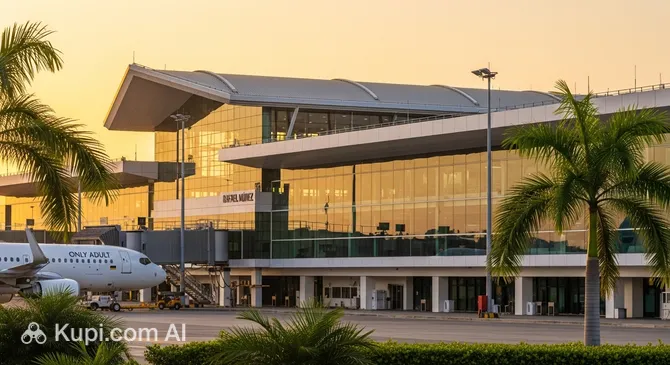
Rafael Nunez International Airport. Source: Kupi.com Binoculars

Rafael Núñez International Airport (IATA: CTG) is not just an air gateway to Cartagena, but a true portal to the vibrant world of the Caribbean coast of Colombia. As the largest airport in the country's northern region, it welcomes millions of travellers annually who are eager to experience the history, culture, and beaches of this famous resort city. The airport is named after Rafael Núñez, a Cartagena native, former President of Colombia, and author of the national anthem. Its terminal, located in the Crespo neighbourhood, is situated in close proximity to major tourist locations, making it the ideal starting point for an unforgettable journey.

IATA Code CTG
ICAO Code SKCG
City Cartagena
Distance to Centre About 5 km
Status International
Passengers per Year Over 6.4 million (based on 2023 data)
Popular Airlines Avianca, LATAM Airlines, JetSMART
Schedule online board "Rafael Núñez International Airport"

The main advantage of Rafael Núñez Airport is undoubtedly its unique location. Only a 10–20 minute taxi ride separates you from the famous Walled City (Old Town) and modern districts like Bocagrande. This allows tourists to immerse themselves in the city's atmosphere almost immediately, without spending precious time on long transfers. The terminal itself is quite compact and easy to understand: it is divided into zones for domestic and international flights, which simplifies navigation. Passengers have access to duty-free shops, cafes, ATMs, and Wi-Fi access points.

Contact Information

For your convenience, we have compiled the main contact information for Rafael Núñez International Airport (CTG).

  • Official Website: You can find flight schedules, service information, and news on the airport's official portal: www.aeropuertocartagena.com.co.
  • Help Desk Phone: For immediate information, you can call: +57 605 6931351.
  • Airport Address: Crespo, Cartagena de Indias, Bolívar, Colombia.
  • Email: For general inquiries and feedback, you can use the email: atencionalcliente@sacsa.com.co.
  • Social Media: The airport is present on major platforms such as Facebook and Instagram, where current updates are published.
  • Lost Luggage Information: If your luggage was lost during the flight, please contact your airline representative first. For items left within the terminal, please contact the airport's Lost and Found service.
  • Passenger Support Contacts: For assistance with special needs or to resolve other issues, please use the help desk phone or email.

Getting to the Airport

Getting to Rafael Núñez International Airport (CTG) from the centre of Cartagena or major tourist areas is quite simple, as it is located just a few kilometres from the historic centre. The journey usually takes between 15 to 30 minutes, depending on traffic and the chosen mode of transport.

Taxi and Transfers. This is the most popular, convenient, and relatively affordable way to get to or from the airport. Right in the arrival terminal, you can find an official taxi counter where you will be issued a ticket with a fixed fare to your destination. This helps avoid overpriced rates. A trip to the Old Town (Centro Amurallado) or the Bocagrande district takes about 15-20 minutes. Popular ride-hailing apps also operate in the city, offering another convenient alternative. For maximum comfort, you can book a private transfer in advance.

Public Transport. The most budget-friendly option is city buses (busetas). Routes passing by the airport can take you to different parts of the city for a minimal fee. However, please note that buses are often crowded, lack dedicated luggage space, and navigating the routes without knowledge of Spanish can be difficult. This method is more suitable for experienced travellers travelling light.

Car Rental and Parking. Offices of several international and local rental companies are present at Cartagena Airport. Renting a car is a great option if you plan to explore the city's surroundings and the Caribbean coast. However, for moving around the city itself, especially its historic part with narrow streets and limited parking, a car is not always convenient. The airport offers both short-term and long-term parking for those arriving in their own or rented vehicles.

Terminals and Map

Rafael Núñez International Airport (CTG), serving Cartagena, is an example of a compact and functional transport hub. Contrary to the expectations of travellers accustomed to giant airports, there is one main passenger terminal operating here, which serves both international and domestic flights.

The terminal structure is very simple and intuitive, making navigation easy even for first-time visitors. The building has two main levels:

  • Ground Floor — This is the arrival zone. Here, passengers go through passport control (for international flights), collect baggage, and pass through customs inspection. Car rental counters, official taxi services, and currency exchange points are also located on this level.
  • Second Floor — This is the departure zone. Airline check-in counters, baggage drop-off points, and the pre-flight security screening area are located here.

Although there is only one terminal, after passing security control, passengers are directed to different waiting halls: for domestic and international flights. The International Sector offers passengers Duty-Free shops, while both zones have cafes, restaurants, and souvenir shops. Since everything is in one building, there is no need to worry about transferring between terminals — you simply walk from one zone to another, which takes just a few minutes.

Regarding processing times, Cartagena Airport is quite efficient. However, during the high tourist season (December-January, Easter week), it can be busy. It is recommended to arrive 2.5-3 hours before an international flight and 1.5-2 hours before a domestic flight within Colombia. This time will be sufficient to check in, drop off luggage, and pass through security without rushing.

Overall, navigating Rafael Núñez Airport is not difficult. Signs are in Spanish and English, and the small size of the terminal allows you to quickly orient yourself and find the necessary boarding gate or service. Thanks to well-thought-out logistics, it is practically impossible to get lost here.

Airport History

The history of Rafael Núñez International Airport is closely linked to the birth of aviation in Colombia. Its predecessor, the "Campo de Crespo" airfield, opened in 1920, making it one of the oldest in the country. The first flights were operated by the legendary airline SCADTA (the future Avianca), connecting Cartagena with other key cities and initiating regular air service in the region. Initially, it was a simple runway, but its strategic location quickly made it an important transport hub.

The airport began to acquire its modern appearance and name in the mid-20th century. It was named after Rafael Núñez — a Cartagena native who served as President of Colombia four times and authored the national anthem. Between 1979 and 1982, a major reconstruction took place: the runway was extended, a new passenger terminal was built, and modern navigation equipment was installed. This allowed for the reception of larger aircraft and laid the foundation for its future international status.

A key moment in the airport's recent history was its transfer to private concession management in 1996. This triggered another wave of modernisation aimed at improving service quality and increasing capacity. Waiting halls were renovated, the commercial zone was expanded, and security systems were improved. These changes coincided with the growth of Cartagena's popularity as a tourist destination and allowed the airport to effectively handle the constantly increasing flow of passengers, especially from North America and Europe.

Today, Rafael Núñez International Airport is a modern and efficient transport complex that regularly ranks among the busiest airports in Colombia. It has repeatedly received awards for service quality and is an excellent example of successful infrastructure development. Its history reflects the journey Cartagena has taken: from a historic port city to one of the main tourist centres of the Caribbean.

Services and Amenities

Despite its compact size, Rafael Núñez International Airport offers passengers all necessary services for a comfortable wait. Here you will find several cafes and restaurants where you can enjoy both local cuisine and familiar international food. In duty-free shops and souvenir stalls, you can purchase Colombian coffee, local sweets, emerald jewellery, and other memorable gifts.

For those who value enhanced comfort, VIP lounges operate at the airport, such as the Avianca Sala VIP and The Lounge Cartagena. They offer a cosy atmosphere, complimentary snacks and beverages, press, and work areas. Free Wi-Fi is available throughout the terminal, and special stands and power outlets are provided in waiting areas for charging gadgets.

Financial matters can be handled at bank branches or by using ATMs and currency exchange points. In case of necessity, passengers can visit the medical point for first aid. For travellers with children, mother and child rooms equipped with changing tables are available.

The airport is fully adapted for passengers with reduced mobility: there are ramps, elevators, and specially equipped restrooms. Staff are always ready to provide necessary assistance with movement around the terminal and boarding. There are no hotels directly on the airport grounds, but many accommodation options are located in the immediate vicinity, in the Crespo district, as well as a few minutes away by taxi. Although separate conference rooms are absent at the airport, basic business services, such as workspaces and internet access, are provided in the VIP lounges.

Dining

At Rafael Núñez International Airport, travellers will find various dining spots capable of satisfying any taste and budget. Whether you are looking for a quick snack before departure or a full meal, there is plenty to choose from. Most establishments are concentrated in the main terminal, both in the public zone (landside) and in the departure zone after passing security control (airside).

For those looking for a quick energy boost, coffee shops are the ideal choice. Naturally, you will find famous Colombian coffee here at places like Juan Valdez. Along with a cup of aromatic coffee, you can grab fresh pastries, sandwiches, or local treats such as empanadas (stuffed pastries) or arepas (corn cakes). Such cafes are located both before and after passport control, which is very convenient.

If you have time for a more substantial meal, several restaurants and food courts are at your service. They serve both international cuisine and traditional Colombian dishes. This is a great opportunity to enjoy the flavours of Colombia one last time by ordering, for example, fresh seafood or a hearty local dish. There are also lounges in the departure area where you can relax with a refreshing beverage while waiting for your flight.

Prices at the airport are generally higher than in the city and vary from moderate at fast-food outlets to higher at full-service restaurants. Regarding dietary preferences, many establishments offer vegetarian options. Finding certified Halal or gluten-free dishes might be challenging, however, corn-based dishes (arepas) or rice are naturally gluten-free. We recommend clarifying ingredients with the staff. Main cafes and restaurants operate according to the flight schedule, opening early in the morning and closing late at evening.

Travel Tips

Planning a trip through the airport of Cartagena is an important stage of your journey. To ensure everything goes smoothly, use our tips to save time, money, and stress.

Arrival Time at the Airport. Rafael Núñez International Airport is not very large, but it can get quite crowded during the high season. We recommend arriving 3 hours before an international flight and 2 hours before a domestic one. This will give you enough time for check-in, luggage drop-off, and security control without unnecessary haste.

Check-in and Security Control. To save time, use online check-in, which is offered by almost all airlines. This allows you to proceed immediately to baggage drop or, if you are travelling light, to the security checkpoint. The screening procedure is standard: be prepared to remove laptops and other large gadgets from your hand luggage, as well as your liquids bag.

Seat Selection. Want to take a beautiful farewell photo? When departing from Cartagena, try to choose a window seat on the left side (A, B, C...). Depending on the takeoff direction, you might have a chance to enjoy a magnificent view of the Caribbean Sea and the old city.

Hand Luggage. Rules for carrying liquids are standard: containers up to 100 ml, packed in a transparent bag. Sharp objects, flammable substances, and other dangerous goods are prohibited. Always check the current requirements of your airline, as they may differ slightly.

Transfer Passengers. If you have a connection in Cartagena, note that the airport is compact. For a short layover, there are several cafes and shops here. For a long layover (more than 8 hours) and with appropriate visa permissions, you might consider a short trip to the city, but do this with plenty of spare time for travel and passing through security again.

Customs Control. When entering Colombia, you will need to pass customs control. Have your passport, boarding pass, and completed declaration ready. The customs officer may ask standard questions about the purpose and duration of your visit. Be polite and answer clearly.

How to Save Money. Prices for food and drinks at the airport are traditionally higher. Bring an empty reusable water bottle and fill it after passing security. You can also book a transfer to the city in advance via online services — this is often more economical than taking a taxi on the spot.

If Your Flight is Delayed. In case of a delay or cancellation, contact your airline representative immediately. Inquire about your rights to beverages, meals, or even hotel accommodation in case of a long wait. The airport has Wi-Fi and comfortable waiting areas where you can pass the time.

Reached the end of the page?

That means the route is fully explored