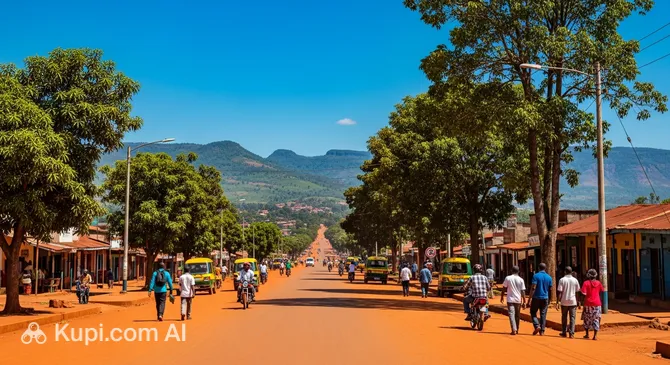
Beni is a dynamic administrative and trade center located in the eastern part of DR Congo, in the North Kivu province. The city has the unique atmosphere of a major transit hub, where the daily lives of local residents are closely intertwined with trade and movement along one of the continent's main transport arteries. Situated at the crossroads of various cultural influences, it serves as a gateway to the region's majestic natural landscapes.
Geographically, the city occupies a strategic position west of the famous Rwenzori Mountains and Virunga National Park, practically on the edge of the Ituri tropical forest. The population of Beni is estimated to be over 332,000 people. Beni. Illustration.
Source: Kupi.com AI
Life here revolves around markets and administrative institutions, and the history of this settlement is inextricably linked to its development as a key point on the Lagos–Mombasa Trans-African Highway.
While the city is not a classic tourist destination with an abundance of historical monuments, its appeal lies in the authenticity of Congolese daily life. Its proximity to unique nature reserves and the opportunity to see life in the "Heart of Africa" from the inside make Beni an interesting destination for researchers and those seeking off-the-beaten-path routes. Visiting this city allows you to feel the true rhythm of life in the developing North Kivu region.
Weather Overview
Beni is governed by a classic equatorial climate, characterized by consistently high temperatures and significant humidity throughout the year. Average daily temperatures typically range between a comfortable +22°C and +24°C, with daytime highs often reaching +30°C. Due to the proximity of the dense Ituri rainforest, the air here is saturated with moisture, creating a distinctive tropical atmosphere.
Precipitation in the region is abundant and distributed throughout the year; however, periods of peak rainfall occur in April–May and September–November. During these times, tropical downpours can be short but very powerful. The driest months are considered to be January and February, when the number of clear days increases. Those planning a visit should check the detailed weather in Beni to choose the most suitable time for their trip.
Average monthly temperature
Average monthly precipitation
Interesting Facts
Beni is located at a unique geographical point—almost right on the equator, just 30 minutes of latitude north of the zero parallel.
The famous Lagos–Mombasa Trans-African Highway passes through the city, connecting the Atlantic Ocean to the Indian Ocean across the entire continent.
The city is an important transport hub between the Democratic Republic of the Congo and neighboring Uganda, the border of which is less than 100 kilometers away.
The city's airport has the international code BNC and is a key link for connecting this remote region with Kinshasa and other parts of the country.
Despite its administrative status, the city maintains a close connection with nature, sitting on the edge of the legendary Ituri tropical forest.
How to Get There
The transport accessibility of Beni is defined by its position as a major transit hub in the North Kivu province. Despite its distance from the capital, the city is connected to the rest of the country by air and road. Travelers should keep in mind that logistics in this region require careful planning and extra time for unforeseen delays related to weather or road conditions. To plan your route in advance, it is helpful to study the ways to get to Beni in more detail.
The main air hub is Beni Airport (IATA: BNC). It primarily serves domestic flights, connecting the city with Kinshasa, Goma, and other regional centers. Flying is the fastest and most comfortable way to arrive, as overland travel across the country can be extremely long. From the airport to the city center, it is most convenient to take a taxi or a pre-booked hotel transfer.
You can arrive in Beni by land via the Trans-African Highway. Regular bus services and private minibuses connect the city with Butembo (the journey takes about 4–8 hours) and other settlements in the province. The road surface is unpaved in places, so during the rainy season, travel time can increase significantly. There is currently no rail service in this area, so the main emphasis is on roads and aviation.
Main Attractions
The city of Beni is perceived by travelers more as an important transit hub and a starting point for regional exploration than as a place with a traditional set of sights. The main center of attraction here is daily life, focused on the local markets and central squares. These are the best places to witness the authentic way of life in Eastern Congo, observe the bustling trade, and get acquainted with local crafts.
For nature lovers, the city serves as a base before visiting the outskirts of Virunga National Park and the Ituri Forest. Although the city itself lies outside the protected zones, its surroundings offer impressive views of wild vegetation and landscapes characteristic of equatorial Africa. The proximity of the Rwenzori mountain range adds majesty to the landscape, especially on clear days.
The architectural appearance of the city is shaped by administrative buildings and road junctions, emphasizing its status on the Trans-African Highway. A stroll through the central streets allows you to see how traditional daily habits and a modern drive for development intertwine. Beni is a place for those who appreciate the real, unvarnished atmosphere of an African provincial center.
Local Cuisine
The culinary traditions of Beni reflect the natural bounty of Eastern Congo and are based on the use of fresh tropical products. The staple of the diet is fufu—a thick mash made from cassava or corn flour, which serves as a side dish for almost any meal. Pondu is also very popular—a fragrant dish made from crushed cassava leaves stewed with palm oil and spices.
The city's gastronomy is unthinkable without fish brought from local rivers and lakes. It is often grilled or stewed in rich sauces. You should definitely try likula—stewed meat with vegetables, the flavor of which is enhanced by a combination of local herbs. The gastronomic scene here is simple and honest: food is prepared from what was harvested or caught that morning, making the dishes truly authentic.
The food culture in Beni centers around street cafes and hotel restaurants. Locals often eat at markets, where you can find freshly prepared plantain snacks and roasted meat. Notable drinks include palm wine and local sorghum beer, which are integral parts of social gatherings. This is a hearty and calorie-rich cuisine, perfect for those who want to experience the true taste of Central Africa.
Travel Tips
Visiting Beni is an immersion into the real life of Eastern Congo, which requires some preparation. These tips will help make your trip more comfortable and safer.
Clothing and Essentials: Choose light clothing made of natural fabrics, as it is always humid and hot in the city. Be sure to bring closed-toed shoes for walking, as many roads are unpaved. Don't forget a universal power adapter and a good insect repellent.
Transport: The most convenient way to get around is by moped taxi. Always agree on the price before starting the ride. For longer trips outside the city, it is better to rent a car with a local driver.
Finance: The main currency is the Congolese franc, but US dollars are also in use (bills must be new and undamaged). ATMs in Beni are rare, so always carry a sufficient supply of cash with you.
Health and Safety: Drink only bottled water. It is recommended to carry a basic first-aid kit and have travel insurance. Avoid walking after dark in areas far from the center and always keep your valuables with you.
Communication: The official language is French, but most residents speak Swahili. English is not widely spoken, so learn a few basic phrases in French. A SIM card from a local operator can be bought at the central market.
Local Etiquette: Greetings are very important—always say hello before asking for something. Congolese people are friendly, but always ask for permission before photographing people or their private property.
What to Avoid: Do not discuss political topics or photograph government or strategic objects (bridges, airport) to avoid misunderstandings with local authorities.
Pro Tip: Plan your visit during the dry season (January-February or June-July) so that movement around the region is as predictable as possible.
Following these simple rules will allow you to focus on the city's amazing atmosphere and get the most out of your trip to the heart of Africa!
Entertainment & Nightlife
Entertainment in Beni is low-key and primarily centered around daily life, which is typical for small provincial centers in the region. The main leisure spots for local residents are the central squares and markets, where socializing and sharing news replace the formats of relaxation familiar to Europeans. During the day, it is interesting simply to watch the flow of life or take a walk on the outskirts of the city, enjoying the proximity of the tropical forest.
Nightlife in the city is limited. A few venues at major hotels and small local bars may offer a basic selection of drinks and music, but they are mainly oriented toward a local audience. The atmosphere in such places is simple and relaxed, without a strict dress code. For those looking for larger events, clubs, or concert venues, it is recommended to plan trips to larger cities in the province.
Safety during evening leisure requires standard caution: it is better to move by taxi and choose central, well-lit streets. In Beni, relaxation is more focused on getting to know people and nature than on the entertainment industry. For tourists, this is a chance to spend an evening in a calm setting, trying local drinks and listening to the rhythms of Congolese music in cozy cafes.
Parks & Museums
The city of Beni does not have classic museums or art galleries, but its cultural and historical heritage lives on the streets and in the stories of its residents. Instead of enclosed exhibition halls, travelers find a living history of a developing African hub. The lack of museum institutions is more than compensated for by the authenticity of the urban environment, where every neighborhood can tell a story about the traditions and lifestyle of the North Kivu region.
Park infrastructure in the traditional urban sense is also limited here, but Beni is surrounded by incredible natural greenery. The city practically borders vast tracts of tropical rainforest. Residents and visitors use the natural areas on the outskirts for walks and relaxation. The proximity to the legendary Ituri forest creates a feeling that the wilderness is just a stone's throw away, which is more valuable than any manicured garden.
For those looking for major natural attractions, the city serves as a gateway to Virunga National Park, which is a few hours' drive away. In Beni itself, the green zones are primarily natural landscapes that have retained their original appearance. It is an ideal place for those who prefer wild nature and an authentic atmosphere over organized tourist sites.
Getting Around
The public transport system in Beni is simple and adapted to local conditions. The main and fastest way to get around the city is by moped taxis, known locally as "boda-boda." This is a versatile transport option capable of navigating narrow streets and dirt roads that can become difficult for cars to pass after rain. A moped taxi ride through the center usually takes no more than 10–20 minutes.
For longer trips or moving between districts, minibuses and small buses are used. They run along main routes and the Trans-African Highway. There is often no strict schedule for such transport—buses depart as they fill up with passengers. Fares are paid in cash Congolese francs directly to the driver or conductor, so it is always worth having small change with you.
An alternative to public transport is private taxis, which can be hired for trips to the airport or neighboring cities. Car-sharing or bicycle rentals are not developed in Beni, and renting a car without a driver is not recommended due to the specifics of traffic and road conditions. Tourists are advised to use the services of trusted taxi drivers, who can often be called through the hotel administration, especially in the evening.
Accommodation
The accommodation market in Beni is primarily geared toward business travelers, employees of international organizations, and transit passengers. You won't find luxury international hotel chains here, but the city offers a decent selection of mid-range hotels and cozy guesthouses. Most accommodations are concentrated in the central districts and near administrative zones, providing a basic level of comfort and safety.
For tourists, the most convenient option is staying in hotels near the airport or in the center, where there is access to basic services and transport. Conditions in such establishments usually include clean rooms, a secured area, and often small restaurants within the hotel itself. Budget options like hostels are less common, and their amenities may be minimal, so it is better to look for reputable guesthouses.
It is recommended to book accommodation in advance, especially if your visit coincides with a period of active business events in the region. The price range is fairly stable, but it is important to clarify the availability of amenities such as a reliable power supply and internet access, as these are not always standard in provincial Congolese cities. Using international booking systems can be difficult, so direct contact with hotels remains a reliable way to communicate.
Nearby Cities
Thanks to its location on a major transport artery, Beni is an excellent starting point for exploring other cities and settlements in the eastern part of DR Congo and neighboring Uganda. The region surrounding the city is rich in natural resources and trade traditions, making short trips to the outskirts an interesting experience for the curious traveler.
Just 45 kilometers to the south lies the city of Butembo. It is a large commercial center known for its active trade and cooler mountain climate. The road there passes through picturesque hilly landscapes, and the city itself offers more developed infrastructure and numerous markets where you can find unique goods from across the region.
If you decide to cross the border, you should look into Mpondwe and Bundibugyo in Uganda. These towns allow you to see how daily life and culture change when crossing the border, while remaining within the same natural landscape. A journey to these points usually takes a few hours and provides an opportunity to get acquainted with Ugandan hospitality and the natural beauty of the Rwenzori foothills.
Exploring the surroundings of Beni allows for a deeper understanding of the specifics of life in border areas and the diversity of African landscapes. Each of these directions will add new colors to your journey through the heart of the continent.
Shopping & Souvenirs
Shopping in Beni primarily means visiting local markets, which are the heart of the city's economy. You won't find the usual shopping malls with glass windows here, but there is plenty of local flavor and authentic African goods. The Central Market is considered the main place for shopping, where you can find everything from fresh tropical fruits to handmade items by local craftsmen.
Special attention should be paid to fabrics. Congolese fabrics with bright prints (pagne) are famous for their quality and unique patterns. This is one of the best souvenirs you can bring from Beni. You can also often find skillfully carved wooden items, woven baskets, and traditional jewelry handmade by artisans from surrounding villages.
Shops in the city usually operate from early morning until sunset, and payments are made primarily in cash using local francs. Bank cards are rarely accepted, so it is important for tourists to have a supply of cash. Bargaining at the markets is part of the local culture and is encouraged, turning an ordinary purchase into an engaging process of interacting with the locals.