Support

Antonio Maceo Airport

About the Airport

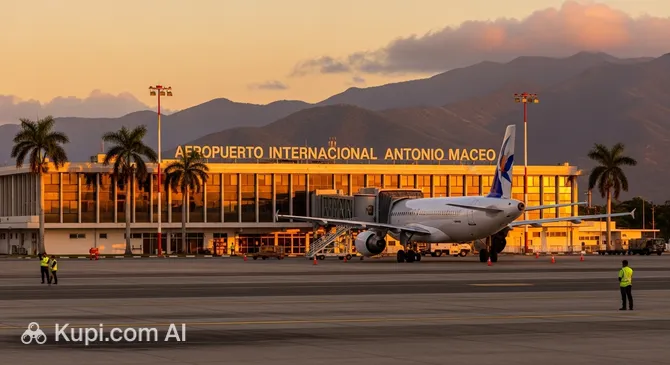
Antonio Maceo Airport. Source: Kupi.com Binoculars

Antonio Maceo International Airport is not just an air hub, but a true gateway to the heart of Cuba's most Caribbean city. Located just a few minutes' drive from the historic centre and the picturesque coast, it welcomes travellers with a relaxed atmosphere and the famous portrait of Che Guevara on the terminal façade. The airport serves as a starting point for those aiming to conquer the peaks of the Sierra Maestra or immerse themselves in the vibrant life of Santiago de Cuba.

IATA Code SCU
ICAO Code MUCU
City Santiago de Cuba
Distance to centre About 7-8 km
Status International
Annual Passengers About 400,000

Features and Advantages

Although Antonio Maceo Airport is smaller than the capital's hub, it possesses a unique charm and a range of advantages for tourists. The main architectural highlight is the portrait of Che Guevara on the exterior wall of the building, which often becomes the first subject for photographs by arriving guests.

The terminal was modernised in 2008 and equipped with necessary amenities, including duty-free zones, small cafes, and souvenir shops where you can purchase Cuban rum and cigars before departure. One of the characteristic features of the airport is the absence of jet bridges: passenger boarding and disembarking are carried out via mobile stairs, allowing you to immediately feel the warm tropical air.

Thanks to the airport's compactness, all procedures — from check-in to passport control — usually proceed faster and more calmly than in large air terminals. Furthermore, its convenient location allows you to reach popular beach resorts and the city centre in a matter of minutes.

Contact Information

Below you will find contact information for Antonio Maceo International Airport (SCU), which serves the city of Santiago de Cuba and its surroundings.

  • Official Website: The airport is managed by ECASA (Empresa Cubana de Aeropuertos y Servicios Aeronáuticos). It is recommended to check current information on their official website: www.ecasa.com.cu.
  • Inquiry Service Phone: +53 22 698 6140 / +53 22 698 6130.
  • Airport Address: Carretera del Morro km 2 1/2, Santiago de Cuba, Cuba.
  • Email: A dedicated email address for general passenger inquiries is not published. For urgent communication, it is recommended to use the telephone.
  • Social Media: The airport does not have its own verified pages on social networks.
  • Lost Luggage Information: For issues regarding lost or damaged luggage, you must contact your airline's representative directly. Staff at the airport information desk can assist with contact details.
  • Passenger Support Contacts: For consultations and assistance with general questions, please contact the airport inquiry service at the numbers listed above.

How to Get to the Airport

There are several ways to reach Antonio Maceo International Airport (SCU), located approximately 10 km south of the centre of Santiago de Cuba. The choice of transport depends on your budget, time, and comfort preferences. On average, the journey from the city centre to the terminal takes about 20–30 minutes depending on traffic conditions.

Taxi and Transfer — the most popular and convenient option for tourists. You can use the services of both official state taxis and private carriers in colourful vintage cars known as "almendrones". A taxi ride from the airport to the city centre will cost approximately 15–25 USD/EUR. It is strongly recommended to agree on the fare in advance, before getting into the car, as there are no fixed meters. Many hotels and travel agencies also offer a pre-booked transfer service, which ensures a fixed price and guaranteed vehicle availability.

Public Transport in Cuba is represented by local buses, referred to here as "guaguas". Although this is the cheapest way to travel, it may be inconvenient for tourists with luggage. Buses are often overcrowded, run without a strict schedule, and routes can be confusing for those who do not speak Spanish. There is no direct express bus to the airport, so this option is more suitable for experienced budget travellers.

If you prefer independence in movement, you can use a rental car. There are several rental points in the city, but it is better to book a car well in advance, especially during the high tourist season. The road to the airport is simple and well-marked. There is a parking lot at the terminal where you can leave a car for a short or long period, though the number of spaces may be limited.

Terminals and Map

Antonio Maceo Airport (SCU) is a small and functional aviation hub that is easy to navigate even for an inexperienced traveller. Its structure is simple and intuitive, which significantly reduces the time needed for orientation and movement.

The airport consists of one terminal that serves both domestic and international flights. Due to its compact size, all key areas are within walking distance of each other, and there is no need for transfers between terminals. Navigation is facilitated by standard signs that help you quickly find check-in counters, security screening, boarding gates, and the baggage claim area.

Departure and arrival zones are located in the same building but are logically separated. After entering the terminal, you find yourself in the main hall where the check-in counters are located. After completing check-in and dropping off luggage, passengers proceed to pre-flight security and passport control, and then to the departure lounge with several boarding gates. The arrival zone includes passport control, baggage claim belts, and customs inspection.

Despite its modest size, the terminal is equipped with everything necessary for a comfortable wait. There is a small Duty Free shop, several cafes and bars where you can have a snack, as well as currency exchange points. Given that the airport is not overcrowded, check-in and security procedures usually proceed quite quickly. Nevertheless, it is recommended to arrive at the airport in advance: 2.5–3 hours before an international flight and 1.5–2 hours before a domestic one, to avoid rushing in case of an influx of passengers.

Airport History

Antonio Maceo Airport (SCU), located in the city of Santiago de Cuba, is one of the key air hubs in eastern Cuba. Its history began in 1954, when it was opened to handle the growing flow of passengers and cargo in this strategically important region. The airport proudly bears the name of Antonio Maceo — a general and hero of the Cuban War of Independence, highlighting its national significance.

Since its foundation, the airport has gone through several stages of modernisation. Initially designed primarily for domestic flights, it gradually expanded its infrastructure to accommodate international aircraft. Key reconstructions included extending the runway and updating navigation equipment, enabling it to meet global safety standards and receive larger aircraft from Europe and Canada.

Antonio Maceo Airport has witnessed many important events in the country's history. It played a significant role in logistics and transport connections in the second half of the 20th century, contributing to the economic and social development of the eastern provinces. In recent times, it has repeatedly served as a hub for delivering humanitarian aid to regions affected by tropical hurricanes, confirming its vital role for the entire island.

Today, Antonio Maceo Airport represents a modern gateway connecting Santiago de Cuba with the world. One interesting fact is related to its location: thanks to its proximity to the coast, the approach for landing offers passengers breathtaking views of the Caribbean Sea and the majestic Sierra Maestra mountains. Although the airport does not set records for passenger traffic, its stable operation and continuous development make it an indispensable part of the tourism and economic life of eastern Cuba.

Services and Amenities

Antonio Maceo Airport in Santiago de Cuba offers passengers all necessary services for a comfortable wait. Despite its modest size, the terminal is well-equipped and ready to satisfy the basic needs of travellers arriving in Cuba or departing from it.

Dining and Shopping. Several cafes operate in the airport where you can have a snack, drink famous Cuban coffee, or enjoy refreshments. Duty Free shops are located in the departure zone, offering traditional goods: rum, cigars, souvenirs, and local crafts. This is an excellent opportunity to buy gifts before departure.

Lounges and VIP Service. For those who value enhanced comfort, a VIP lounge is available. Here, passengers can relax in a quiet atmosphere, enjoy complimentary drinks and snacks, and read the latest press. Regarding connectivity, the terminal has Wi-Fi access (the service is usually paid, provided via special cards), and there are areas for charging electronic devices.

Financial and Medical Services. Currency exchange points (CADECA) operate within the airport building, where you can exchange money at the official rate. ATMs are also available. In case of need, a medical point is open at the airport, ready to provide first aid.

Services for Passengers with Special Needs. The airport is equipped to serve passengers with reduced mobility — ramps and specially equipped toilets are available. It is recommended to notify the airline in advance regarding the need for assistance. A mother and child room is provided for travellers with small children.

Accommodation and Business Services. There are no hotels within the airport territory itself, but many accommodation options can be found in the city of Santiago de Cuba, located a few kilometres away. Specialised conference rooms or business centres are not provided in the airport; however, the VIP lounge can offer a secluded space for addressing urgent work matters.

Where to Eat

Antonio Maceo Airport in Santiago de Cuba offers basic dining options to help pass the time before your flight. It is important to understand that this is a small regional airport, so the choice of establishments here is limited, and they are designed primarily for a quick snack rather than a full lunch or dinner.

Typically, several small cafes or snack bars operate at the airport. One establishment is usually located in the general area before security control (landside), and another in the sterile departure zone (airside). This allows both well-wishers and passengers already waiting for their flight to have a bite. The assortment in both cafes is similar.

Here you can experience the final flavour of Cuba before departure. Be sure to try authentic Cuban coffee — strong and aromatic. The menu usually also includes simple sandwiches (bocadillos) with ham and cheese, pastries, crisps, and soft drinks. In the bar in the departure zone, you can often order famous Cuban rum or cocktails based on it.

Passengers with specific dietary requirements should be prepared for the fact that the selection for them will be extremely limited. Finding vegetarian dishes, aside from a simple cheese sandwich, may be difficult, and vegan, gluten-free, or halal options will likely be absent. If you have strict dietary restrictions, it is strongly recommended to bring food with you.

Prices in airport cafes are higher than in the city, which is standard practice for such places. The opening hours of establishments are directly tied to the flight schedule — they open a few hours before departure and close after the last plane leaves. Coffee and pastries are ideal for a quick snack, but if you are counting on a full meal, it is better to have it at one of the restaurants in Santiago de Cuba before travelling to the airport.

Travel Tips

Travelling through Antonio Maceo Airport in the city of Santiago de Cuba will be much more comfortable if you know a few key features. To avoid unnecessary stress, arrive at the airport in advance — at least 3 hours before an international flight departure. Check-in and control processes in Cuba may take longer than you are used to, so a buffer of time will certainly be useful.

During check-in, have all documents ready: passport, ticket, and tourist card (tarjeta de turista). Security screening is standard, but be prepared for possible manual luggage inspection. To speed up the process, remove all electronic devices from your hand luggage in advance. When choosing a seat on the plane, if possible, select a window seat — during take-off or landing, scenic views of the coast may open up.

International rules apply to hand luggage: liquids in containers up to 100 ml, no sharp objects. However, upon leaving the country, pay special attention to the export of souvenirs. To export more than 20 cigars per person, a receipt from an official shop and special packaging are required. Similar rules apply to rum and works of art. We recommend always having cash, a portable charger, and a light snack with you, as the selection within the airport itself may be limited.

Customs control upon arrival usually involves filling out a declaration, which is often distributed on the plane. Declare all imported valuables honestly. For currency exchange, use only official CADECA points within the airport building. Do not exchange money with private individuals to avoid fraud. To save time and money, it is better to arrange a transfer to the city in advance.

Antonio Maceo Airport is not a major transit hub, so long layovers here are rare. If you do have a connecting flight, check with your airline whether you need to collect and re-check your luggage. In case of a flight delay, please be patient. Waiting facilities at the airport are modest, so a book or downloaded films will be very handy. The main advice is to remain calm and positive, as you are in one of the most colourful corners of the Caribbean.

Reached the end of the page?

That means the route is fully explored