Support

Guantanamo Bay Naval Station

Airports in the city

About the Airport

Guantanamo Bay Airport (Naval Station Guantanamo Bay), also known as Leeward Point Field, is not an ordinary air hub but a unique facility with a special status. Located within the US Naval Base in Cuba, it primarily serves the logistics and transport needs of the base. For most travellers, this airport remains a restricted zone, which only adds to its mystery on the map of the Caribbean.

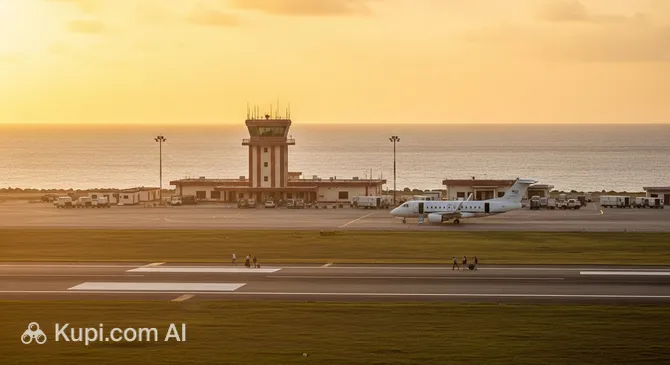
Guantanamo Bay Naval Station. Source: Kupi.com Binoculars
IATA Code NBW
ICAO Code MUGM
City Guantanamo
Distance to centre Approx. 25 km (restricted access)
Status Military
Annual Passengers Official data not published
Popular Airlines US military transport, government charters

The key feature of Guantanamo Bay Airport is its closed status. It is not a civil airport and does not accept scheduled commercial flights for tourists. Access to its territory, as well as the entire naval base, is strictly regulated and permitted only for US military personnel, their families, government employees, and accredited contractors. All flights arriving here are typically military transports or special charters commissioned by the US government.

Therefore, for travellers planning a trip to the city of Guantanamo or other regions of Cuba, this airport is not an arrival point. Tourists should consider other international airports in the country, such as José Martí Airport in Havana or Juan Gualberto Gómez Airport in Varadero. NBW Airport remains a specialised facility performing exclusively military and government tasks.

Contact Information

It is important to understand that Guantanamo Bay Naval Station Airport (NBW), also known as Leeward Point Field, is not a civil airport open to tourists. It is an active US naval air station located within the naval base in Guantanamo, Cuba. Access to the base, and consequently the airport, is strictly regulated and permitted only to authorised personnel.

Due to this, public contact details intended for ordinary travellers are not available. Below is information regarding the status of requested contacts:

  • Official Airport Website: There is no separate public website for the airport. Information about the naval base can be found on official US Navy resources, but it is not intended for tourism purposes.
  • Help Desk Phone: Public telephone numbers for inquiries are not provided. All communications are conducted via official channels.
  • Airport Address: U.S. Naval Station Guantanamo Bay, Cuba. Access to the territory without special permission is impossible.
  • Email and Social Media: There are no public email addresses or social media accounts for passengers.
  • Lost Luggage and Passenger Support: As the airport does not serve commercial civil flights, standard passenger support and lost luggage services do not operate here.

How to Get to the Airport

When planning a trip to the eastern part of Cuba, it is important to understand the region's transport infrastructure nuances. The airport known as Guantanamo Bay Naval Station (IATA code: NBW) is not a civil commercial airport accessible to tourists. It is an active US naval base, and access to its territory is strictly limited. Only military personnel, their families, and authorised staff with special permits can enter.

Due to the base's special status, standard methods of getting here from the city of Guantanamo or other Cuban settlements are not applicable. Public transport, such as buses or trains, does not run to the base. Regular taxi services or private transfers are also unavailable to the general public for entry into the territory. Renting a car will not provide access to the base. All movements to and from the station are carried out exclusively through official US military or government channels.

For tourists wishing to visit Guantanamo province and other areas of eastern Cuba, it is recommended to use the nearest international civil airports. The main air gateways to the region are:

  • Antonio Maceo Airport (SCU) in the city of Santiago de Cuba, located approximately 66 km away. This is the largest airport in the southeast of the country.
  • Frank País Airport (HOG) in Holguín, situated at a distance of about 151 km. It also receives many international flights.

From these airports, you can easily reach your desired resort or city by taxi, bus, or rental car to begin your journey through this picturesque region.

Terminals and Map

Guantanamo Bay Airport (NBW), located within the US Naval Base in Cuba, has specific characteristics that distinguish it from civil airports. All passenger activity is concentrated in one main terminal, which primarily serves charter and military flights.

The structure of the terminal is quite simple and functional. It is a single-story building where areas for arriving and departing passengers are clearly separated. Due to its compact size, navigation causes no difficulties — it is practically impossible to get lost here. Inside, you will find check-in counters, a security screening area, a small waiting hall for departing passengers, and a baggage claim area for arrivals.

Since this is the only terminal, no transfers between terminals are required. All procedures — from check-in to boarding — take place in one building. The departure zone includes check-in counters and a pre-flight security checkpoint. After passing control, passengers enter a waiting hall with basic amenities. The arrival zone consists of a hall where passengers await their luggage, followed by customs and border control.

It is important to note that the airport operates according to the schedule of military and charter flights, rather than on a 24-hour basis like major international hubs. Check-in and screening procedures here may be more thorough and take longer due to the strict security protocols of the military base. It is recommended to arrive at the airport well in advance and strictly follow the instructions of the staff. All processes are clearly organised, so the best strategy is to have all necessary documents with you and follow instructions.

Airport History

The history of Guantanamo Bay Naval Station Airport (known by the code NBW) is inextricably linked to the history of the US naval base of the same name located in Cuba. This is not a civil airport in the usual sense, but a military airfield, whose history reflects key moments in the geopolitics of the 20th and 21st centuries.

The base itself was founded in 1903 following the signing of the Cuban-American Treaty, but the aviation component appeared later. Initially, it was a coaling and repair station for the US Navy. The development of aviation began in the lead-up to and during World War II, when airfields on the base became key for anti-submarine patrols in the Caribbean Sea. The main airfield became Leeward Point Field, which is assigned the NBW code.

A key event in the airfield's history was the Cuban Missile Crisis of 1962. The base was brought to the highest state of combat readiness, families of military personnel were evacuated, and the airfield played a crucial role in conducting aerial reconnaissance and ensuring the rapid deployment of forces. In the 1990s, the airport became the centre of major humanitarian operations, receiving thousands of Cuban and Haitian refugees intercepted at sea.

After the events of 2001, the airfield gained worldwide fame as the main transport hub for delivering personnel and detainees to the detention facility created within the base. Throughout its history, the runways and infrastructure of the airfield have been regularly modernised to accommodate modern military aircraft, from fighters to heavy transport planes.

One of the most interesting facts lies in its location. Leeward Point Airfield is located on the western, less inhabited side of Guantanamo Bay, while the main residential and administrative part of the base is on the eastern side. Since overland travel through Cuban territory is impossible, the only way to get from the aircraft to the main part of the base is via a ferry crossing across the bay. This makes the base's logistics unique. Guantanamo Bay is the oldest overseas US naval base and the only one located in a country with which the United States has historically had complex diplomatic relations.

Services and Facilities

It is important to understand that Guantanamo Bay Naval Station Airport (NBW) is not a standard civil airport. It serves an active naval base, so access is strictly regulated, and the range of passenger services differs significantly from those offered in commercial air hubs. Services and amenities here are primarily oriented towards the needs of military and authorised personnel.

The selection of restaurants, cafes, and shops in the terminal is extremely limited. There are no familiar food courts, restaurants, or Duty-Free shops here. Passengers can expect vending machines with drinks and snacks, and possibly a small cafe or buffet with a basic assortment.

Standard waiting halls with seating are available; however, no special VIP zones or business lounges for civil passengers are provided. Access to Wi-Fi may be available but is likely to have restrictions characteristic of military facilities. At the same time, finding charging stations for electronic devices is usually possible in the waiting areas.

Financial services, such as banks and currency exchange points, are absent in the public zone. Passengers need to resolve all financial matters in advance. Medical assistance in emergencies can be provided by the base's medical unit. There are no specialised playrooms for passengers with children, although basic amenities, including access for passengers with reduced mobility, should be provided.

There are no hotels within the airport territory available for public booking. Accommodation is possible only in facilities on the naval base itself and only for persons with the appropriate authorisation. Similarly, public conference rooms or business centres for holding meetings are absent at the airport.

Dining Options

When planning a trip through Guantanamo Bay Naval Station Airport (NBW), it is important to remember that it serves an active US naval base. Consequently, the range of services, including dining outlets, differs from what one might expect at a major civil airport. Options here are primarily oriented towards the needs of military personnel and base staff, rather than commercial tourism.

Within the terminal building, you can typically find a few basic options for a snack. Usually, this is a small cafe or diner offering simple and filling meals: sandwiches, burgers, salads, and pastries. For a more substantial lunch, a canteen-style establishment may be available. Do not expect fine dining restaurants or a wide variety of gastronomic concepts here. Sometimes, outlets of well-known American fast-food chains are present at such facilities.

For a quick snack before departure, a sandwich or coffee from a local cafe is perfect. If you have more time, you can count on a hot meal in the main canteen or diner. Prices are generally moderate and calculated for base personnel. Opening hours are usually synchronised with the flight schedule and the internal routine of the base, so they may be closed at night or between flights.

Passengers with specific dietary requirements (such as vegetarian, gluten-free, or Halal meals) should be prepared for the selection to be extremely limited or non-existent. In such cases, the most reliable solution is to bring food with you. All main dining points are located in the main terminal building, and given the airport's compactness, finding them will not be difficult.

Travel Tips

Travelling through Guantanamo Bay Naval Station requires special attention to planning, as this airport has its own specificities and differs from standard civil aviation hubs. To ensure your trip goes smoothly and comfortably, we have prepared a number of useful recommendations that will help avoid unnecessary stress before departure.

Arrival Time and Check-in. It is recommended to arrive at the airport at least 3 hours before departure. This is because document checks and check-in procedures may take longer due to strict security protocols. Keep your passport and all necessary entry or exit permits close at hand, as they may be checked multiple times.

Security Screening. Expect a thorough inspection. Standard security rules are strictly enforced here. Ensure you remove your belt, watch, and metallic jewellery in advance so as not to hold up the queue. Electronic devices, such as laptops and tablets, must be placed in separate trays.

Hand Luggage and Baggage. It is prohibited to carry sharp objects, flammable substances, and liquids in containers exceeding 100 ml in hand luggage. Given the climate, many travellers carry souvenirs or local products — check the list of items permitted for export in advance to avoid confiscation at customs.

Choosing a Seat on the Plane. If you have the opportunity to select a seat in advance, choose a window seat. During takeoff and landing, picturesque views of the coast and the bay open up, which are worth seeing. However, remember the rules regarding photography: in certain zones of the airport and during flights over specific territories, the use of cameras may be restricted.

Passengers with Connections. If Guantanamo is a transit point, allow sufficient time for the connection (minimum 3–4 hours). In case of a delay with the first flight or lengthy customs formalities, this buffer time will be your insurance against missing the next plane.

Customs Control. Be prepared to fill out declarations. Honestly indicate the presence of currency if the amount exceeds established limits, and declare goods subject to control. Attentive handling of documents will help you pass customs without unnecessary questions and delays.

Saving Time and Money. The choice of shops and cafes in the terminal may be limited, and prices may be higher than average. Experienced travellers advise bringing an empty water bottle (which can be filled after screening) and light snacks. This will not only save your budget but also help if the wait for the flight drags on.

In Case of Flight Delay. The weather in the Caribbean region is changeable, and flight delays do happen. Download books, films, or music to your phone or tablet in advance to pass the time. Carry a portable charger (power bank), as access to power outlets may be limited during peak hours.
Reached the end of the page?

That means the route is fully explored