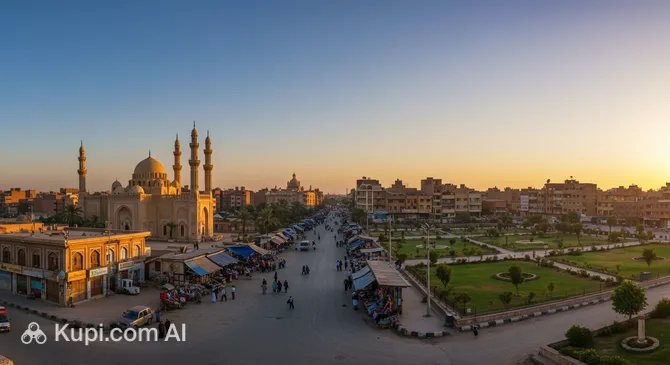
Zagazig is the lively and dynamic heart of the Sharqia Governorate, located in the fertile eastern part of the Nile Delta. Unlike the bustling tourist meccas of Egypt, this city offers travelers an authentic immersion into the daily life of a modern provincial center. Founded in 1830 as an important logistics hub, today it harmoniously combines the features of a major agricultural hub and an educational center, where life flows to the rhythm of traditional markets and student activity.
Geographically, Zagazig occupies an advantageous position on the Bahr Moweis canal, which historically predetermined its role as the main intermediary in the cotton and grain trade. With a population of over 300,000 people, the city maintains the atmosphere of a welcoming yet business-like space. There is no resort-style pretension here, but there is the sincerity of the Egyptian heartland, which is so valued by seekers of true discoveries.
Zagazig. Illustration.
Source: Kupi.com AI
The main treasure for lovers of antiquity is the ruins of ancient Bubastis, located a couple of kilometers from the modern quarters. Immersing yourself in the study of the history of Zagazig, it is impossible to ignore the heritage of the cult of the cat-goddess Bastet. The modern face of the city is defined by Zagazig University — one of the largest universities in the country, filling the streets with the energy of the youth.
Visiting this city is a unique chance to see Egypt without filters. We recommend a visit to those who want to feel the real flavor of the Nile Delta, walk along the canals, and touch thousands of years of history away from the crowds of tourists.
Weather Overview
The climate in Zagazig is typical for the Nile Delta region and is characterized as desert, with a clear division into hot and mild seasons. If you are planning a trip, keep in mind that summers here can be quite scorching: in July and August, the thermometer often rises to +35°C...37°C. Winters, on the contrary, are very pleasant and mild — daytime temperatures in January usually fluctuate around +20°C, although it can be chilly at night.
Precipitation in this region is a rare phenomenon; its annual amount is minimal and rarely exceeds 100 mm. Most rainy days occur between December and February, but even then, the rains are short-lived. An important feature to note is the dustiness of the air: due to active farming nearby and dense urban development, it can be dusty in dry months, especially when the wind picks up.
For the most comfortable experience in the city, we recommend checking the forecast on the detailed page about the weather in Zagazig. The optimal times for a visit are considered to be the spring months (March-April) and autumn (October-November), when the heat has not yet reached its peak and the air remains warm enough for long walks along the canals and exploring ancient ruins.
Average monthly temperature
Average monthly precipitation
Interesting Facts
Ancient Roots: Just a few kilometers from the modern center lie the ruins of Bubastis, once a great capital of Egypt, which housed the main temple of the cat-goddess Bastet.
Cotton Capital: Zagazig is a key hub for the trade of famous Egyptian cotton; it is here that the fate of crops destined for export around the world is decided.
A Young City: Unlike its ancient neighbors, the modern city itself was officially founded relatively recently — in 1830 — as a strategic trading post.
Student Hub: The local university is among the largest educational institutions in the country, making Zagazig an important intellectual center for Egypt.
Water Crossroads: The city stands at the intersection of several important canals, including the Bahr Moweis, making it a vital transport hub for the entire Nile Delta.
How to Get There
The transport accessibility of Zagazig makes it a convenient stop during a trip through the Nile Delta. Despite lacking its own airport, the city is closely connected to the country's largest logistics hubs. Most tourists prefer to plan their route and find out how to get to Zagazig by focusing on the Egyptian capital, located just 80 kilometers away.
Railway communication is the most popular and reliable way to travel. Trains depart regularly from Cairo's Ramses Station, with a journey time of between one and a half to two hours. This is a great opportunity to see the picturesque agricultural landscapes of the Nile Delta from the carriage window at a very affordable price.
Zagazig is also easily accessible by bus or taxi. Intercity buses depart from the Turgoman Bus Station in Cairo. A car trip can take from 1.5 to 3 hours depending on the traffic density, which can be quite intense in this region, especially during morning and evening rush hours.
Although Zagazig is primarily known as an agricultural and commercial center, it hides several surprising places capable of interesting the curious traveler. The main historical interest is concentrated a couple of kilometers southeast of the city, where the ruins of ancient Bubastis (Tell Basta) lie. This was the capital of Egypt during the 22nd and 23rd dynasties, and today you can see the remains of a majestic temple dedicated to the cat-goddess Bastet.
In the city itself, the center of attraction is Zagazig University. Its vast campus is considered a kind of landmark for the region: it is not only an educational hub but also a place where the cultural life of today's youth is concentrated. A walk through the university grounds allows you to feel the atmosphere of progressive Egyptian students.
For those who want to feel the pulse of real life, the Central Market and the embankments of the Bahr Moweis canal are a must-visit. There are no specially created tourist decorations here: you will see traditional trade in cotton, spices, and grain, and you can observe the slow flow of life on the banks of one of the Delta's most important waterways. Zagazig is a place for those who appreciate ethnographic tourism and an sincere atmosphere of everyday life.
Local Cuisine
The gastronomic face of Zagazig is a quintessence of traditional Egyptian flavors, with an emphasis on the freshest products from the fertile Nile Delta. The local diet is based on classic dishes such as ful medames (a hearty bean paste with oil and spices) and ta'ameya — the local version of falafel made from crushed mung beans, which is often served piping hot directly from street stalls.
Be sure to try koshary — an amazing mixture of rice, pasta, chickpeas, and lentils topped with a spicy tomato sauce and fried onions. Since the city is an agricultural center, fresh aish bread and unique flatbreads with the addition of various cereals, baked in small family bakeries throughout the city, are held in high regard here.
As for beverages, strong black tea, often brewed with a bunch of fresh mint, is the undisputed leader in Zagazig. Coffee lovers will be offered classic Arabic coffee (qahwa) with cardamom. Street stalls also delight with an abundance of freshly squeezed juices from seasonal fruits — mango, guava, or sugarcane. The food culture here is simple and democratic: the best taste discoveries await you in small eateries near the market and the canal, where the locals themselves eat.
Travel Tips
Preparing for your trip to Zagazig will help you make your journey as comfortable as possible and avoid surprises. This provincial city lives at its own pace, and here are a few tips that will be useful for every traveler:
Clothing and Dress Code: Choose modest clothing made from natural fabrics (cotton, linen) that covers shoulders and knees. This will not only help you cope with the heat and dust more easily but also show respect for conservative local traditions. Comfortable closed-toe shoes are a must for walking through dusty streets and archaeological zones.
Transportation within the city: Use taxis for long-distance trips and microbuses for short movements. During rush hours (from 7 to 9 AM and from 5 to 7 PM), traffic in the center is very difficult, so plan your movements in advance.
Finances: Always carry a sufficient supply of cash in Egyptian pounds. There are ATMs in the city, but international cards are not accepted everywhere, especially in small shops and cafes.
Health: Drink only bottled water. Due to the dry air and agricultural dust in the region, throat irritation can occur, so sunglasses and moisturizing eye drops will not be out of place.
Communication: English is mainly spoken among university students. Learn a few basic phrases in Arabic (“shukran” — thank you, “salam alaikum” — hello); this will instantly win over the locals.
Local Etiquette: Greet people politely. If you are invited for tea, it is a sign of hospitality; a polite refusal is also accepted normally. Try not to take photos of people without their explicit consent.
What to Avoid: You should not walk alone on the outskirts of the city late in the evening. Also, avoid discussing political topics and do not photograph government or official buildings.
Additional Tip: Visit the Central Market in the morning to catch the most vibrant trade and take the best photos of everyday life.
Zagazig will reveal itself to you as an honest and friendly city if you show a little patience and respect for its way of life. Have a pleasant journey to the heart of the Nile Delta!
Entertainment & Nightlife
Nightlife in Zagazig is traditional and quite low-key, reflecting the conservative lifestyle of provincial Egypt. You won't find loud nightclubs or bars in the Western sense here. Instead, locals prefer to spend their evenings in the numerous cafes and tea rooms located along the Bahr Moweis canal and in the central districts.
The main centers of evening activity are traditional coffee houses, where men gather to play backgammon, smoke shisha, and discuss the latest news accompanied by strong mint tea. The liveliest spots are usually found around Zagazig University and the central shopping squares, where window displays and the aroma of street food create a cozy, local atmosphere.
If you're looking for more vibrant entertainment, concerts, or modern cinemas, it's worth heading to Cairo, which is only 80 kilometers away. However, for those seeking a quiet break, Zagazig offers authentic evening walks by the water and the chance to enjoy the genuine hospitality of local establishments, where guests are always welcome to share a slow evening.
Parks & Museums
Green zones in Zagazig are not large-scale, but they play an important role in the life of citizens as places to escape the city's dust and bustle. One of the most pleasant locations for walks is the territory of Zagazig University. The campus is well-landscaped and offers quiet alleys that are filled with students during study hours and become an oasis of calm during rest hours.
For a leisurely promenade, locals most often choose the embankments of the Bahr Moweis canal. This is a kind of open-air linear park where you can have a picnic on the grass by the water or simply watch the passing boats. Although there are few specially equipped parks with attractions, the banks of the canal remain the city's main public space.
As for museums, there is no large-scale historical museum in the city itself. However, lovers of antiquity should pay attention to the archaeological exhibitions sometimes organized at the University. They are dedicated to finds from nearby Bubastis. The Tell Basta excavation site itself can also be viewed as an open-air museum where Egyptian history comes to life right under your feet.
Getting Around
The transport system of Zagazig is fully adapted to the needs of local residents and is characterized by high mobility. The main type of public transport within the city is microbuses and shared taxis. They run in all main directions, connecting the station, the university, and residential outskirts. A ride in them costs very little, but be prepared for the fact that during rush hours, the vehicles can be very crowded.
For more comfortable travel, it is best to use taxis. Both private carriers and (in a limited capacity) app-based ride-hailing services operate in the city, but local taxis remain the fastest option. You should agree on the price of the trip in advance if there is no meter in the car. Due to dense construction and active traffic in the city center, traffic jams often occur, so you should leave with time to spare for important meetings.
Zagazig's railway station is a vital transport hub connecting the city with Cairo and other towns in the Nile Delta. Traveling by train is not only practical but also the most comfortable way to reach neighboring regions. For movement within the city center itself, many prefer to walk, as the main shopping and administrative facilities are located quite compactly.
Accommodation
The hotel sector in Zagazig is primarily geared towards business travelers, students, and those passing through the city. You won't find luxury five-star resorts here, but the city offers a decent choice of budget hotels and guesthouses. Most of the available accommodation is concentrated in the area of the railway station and near the Zagazig University campus.
For those who prefer more space and independence, a popular option is renting apartments. Flats in the city center often offer a better level of comfort for reasonable money — the average cost of stay varies from $20 to $50 per night. When choosing accommodation, try to focus on the areas adjacent to the canal, as they are considered the most convenient for walking.
Given that Zagazig is not a mass tourist destination, booking a room in a local hotel is usually not difficult even at the height of the season. Nevertheless, if your trip coincides with major university events or holidays, it is worth taking care of your booking in advance through popular international services or directly.
Nearby Cities
Thanks to its location in the heart of the Nile Delta, Zagazig serves as an excellent starting point for exploring the lesser-known but charming corners of the region. The city's surroundings offer a unique look at Egypt's agricultural life and allow for several interesting day trips.
Very close by is the small town of Hehia, which you can visit to see life in a typical Egyptian settlement surrounded by date palms. Also noteworthy is Bilbeis — one of the oldest cities in Egypt, through which, according to legend, the path of the Holy Family lay. History buffs will find it interesting to visit Ismailia (50 km to the east) to admire the views of the Suez Canal.
City
Population
Distance
Hehia
66 702
13 km
Minya al-Qamh
43 157
17 km
Bilbeis
141 285
18 km
Al Qurayn
64 453
23 km
Kafr Shukr
23 390
23 km
A journey through nearby towns such as Minya el-Qamh or Al-Qurayin provides an opportunity to feel the rhythm of provincial life and see the endless fields that feed the entire country. We recommend not limiting yourself to the center and boldly exploring the hospitable Sharqia Governorate.
Shopping & Souvenirs
Shopping in Zagazig is primarily a trip to the traditional market, where the buying process turns into a small performance. The city does not have huge shopping centers with global brands, but it is famous for its cotton and fabrics. The central shopping rows, located near the Bahr Moweis canal, offer a huge selection of textiles, from towels to clothing, at very attractive prices.
The main shopping streets stretch from the railway station into the heart of the central quarters. Here you can find everything from small electronics to household goods. Of particular interest are the food markets, where stalls are bursting with fresh vegetables, fruits, and aromatic spices grown on local farms. This is the best place to buy authentic Egyptian tea or unique Oriental seasonings as a gift.
Shops in the city usually operate from morning until late evening, with a short break during the hottest time of the day. Payment in most outlets is made in cash in Egyptian pounds, so it is always worth having small bills with you. Bargaining in the markets is welcomed and is part of the local culture, so don't hesitate to discuss the price with the seller — this will not only help you save money but also strike up a friendly conversation.