Support

Annobon

About the Airport

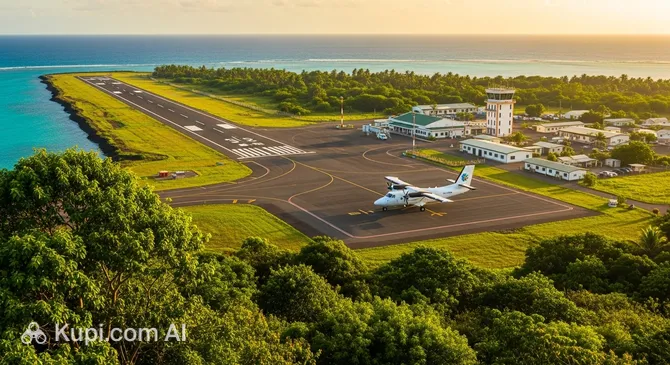
Annobon. Source: Kupi.com Binoculars

Annobon Airport is not merely a transport hub, but a true gateway to a secluded world of equatorial exoticism. Located on a remote volcanic island in the Atlantic Ocean, it offers travellers a breathtaking approach with views of the endless blue ocean and lush green slopes. This modern air harbour has become a vital artery connecting this isolated corner to the "mainland", turning the journey here into a comfortable start to your adventure.

IATA Code NBN
ICAO Code FGAB
City San Antonio de Palé
Distance to Centre ~1.5 km
Status International (predominantly domestic flights)
Annual Passengers No official data (low passenger traffic)
Schedule Check with the air carrier

Airport Features and Highlights:

  • Scenic Location: The runway stretches along the coast, providing passengers with incredible panoramic views of the ocean and the island during take-off and landing.
  • Modern Infrastructure: The airport underwent a massive reconstruction and reopened in 2013. It is now equipped with a concrete runway capable of handling modern jet aircraft and features a new passenger terminal.
  • Proximity to the City: The airport is just a few minutes' drive from the island's capital, San Antonio de Palé. If desired, one can even reach the city on foot while enjoying the sea breeze.
  • Key Importance: It serves as the only fast connection to the mainland of Equatorial Guinea (Malabo and Bata), significantly reducing travel time compared to sea transport.

Contact Information

  • Official Airport Website: There is no dedicated website. It is recommended to check current flight information and schedules on the official resources of the operating airlines (Ceiba Intercontinental and Cronos Airlines).
  • Information Desk Phone: There is no direct public number for the airport administration. For urgent enquiries, use the airline representative offices in Malabo:
    Ceiba Intercontinental: +240 333 099 393
    Cronos Airlines: +240 333 090 471
  • Airport Address: San Antonio de Palé, Isla de Annobón, Guinea Ecuatorial. (Located on the northern coast of the island, approximately 1.5 km east of the centre of San Antonio de Palé).
  • Email: There is no direct email for passenger enquiries. It is recommended to use the contact forms on the carriers' websites.
  • Airport Social Media: There are no official verified accounts.
  • Lost & Found Information: There is no centralised Lost & Found service in the terminal. In case of lost or damaged luggage, you must immediately contact your airline representative in the arrival area or contact their central office via email.
  • Passenger Support Contacts: Support is provided via airline call centres:
    Ceiba Intercontinental: info@fly-ceiba.com
    Cronos Airlines: info@cronosair.com

How to Get to the Airport

Transport logistics on Annobon Island have a unique character due to its compact size and remoteness. Since the airport is located just 1.5 kilometres from the island's capital, San Antonio de Palé, the transport schemes typical of large metropolises do not apply here. The journey from the terminal to any accommodation takes mere minutes.

Public Transport

There is a complete absence of a classic public transport system, such as buses, trains, or a metro on the island. There are no shared taxis or regular routes connecting the airport to the city. Given the short distances, there is simply no need for them. However, locals often show hospitality and may give tourists a lift in their private vehicles for a nominal fee or for free.

Taxis and Transfers

The most reliable way to reach your accommodation is a transfer. Most guest houses and hotels on Annobon (of which there are few) offer an airport meet-and-greet service. It is highly recommended to arrange this in advance when booking your accommodation, as finding a car spontaneously upon arrival can be difficult due to the limited fleet of vehicles on the island.

Taxi services are informal. There are no official services with meters here. Private drivers act as taxis. You must negotiate the fare before boarding. Usually, the price is a small amount in the local currency (Central African CFA franc), equivalent to a few dollars or euros. The travel time to the centre of San Antonio de Palé is about 5–7 minutes.

Walking

For travellers with light luggage, the most exotic and pleasant option is available — walking. The road from the terminal to the city runs along the picturesque coast, and the walk will take only 15–20 minutes. This is an excellent opportunity to immediately immerse yourself in the island's atmosphere.

Car Rental and Parking

There are no familiar international car rental services (Hertz, Avis, etc.) on Annobon. Renting a car is only possible through private agreement with locals; however, given the size of the island (only about 17 sq. km), tourists rarely require a car.

Parking in front of the airport building consists of a small open area. It is free and used mainly by those dropping off or picking up passengers. There are almost always spaces available due to low traffic.

Nearest Airports and Transport Hubs

Since Annobon is an extremely isolated point, it is important to know about the nearest aviation hubs for planning connections. The nearest international neighbour is Sao Tome Airport, located on the neighbouring archipelago. For connections with the mainland of Equatorial Guinea, the key hub is Bata Airport.

Airports in Gabon also operate in the region, which may be useful for complex route planning, such as Libreville Airport or the air harbour in the city of Port-Gentil. Another point on the map of the neighbouring state is the island of Principe, although there is usually no direct connection to it.
Terminals and Map

The infrastructure of Annobon Airport is distinguished by extreme conciseness and functionality. You will not find the confusing corridors or multi-level transitions typical of major international hubs here. The entire terminal complex is designed to make the arrival and departure process as simple and quick as possible for travellers.

Terminal Structure

The airport has one passenger terminal. It is a small but modern single-storey building, constructed taking into account the climatic features of the region. The terminal serves all flights — both arrivals and departures. Passenger flow separation is organised efficiently yet compactly.

  • Departure Zone: Located on the left side of the building (when viewed from the street entrance). Airline check-in counters are located here. After checking in luggage and receiving a boarding pass, passengers proceed through security to a small waiting hall.
  • Arrival Zone: Located in the opposite part of the terminal. The baggage claim procedure here is often simplified: suitcases may be unloaded onto a small belt or handed out by staff manually in a designated area immediately after entering the building from the airfield.

Features and Services Inside

The terminal is equipped with basic amenities for a comfortable wait. Air conditioning is in operation inside, which is a huge plus in the equatorial heat. The waiting hall is equipped with seats; however, it is worth noting that entertainment and retail infrastructure is practically absent.

Travellers should not count on the presence of Duty Free shops, cafes, or ATMs directly in the "secure area". It is recommended to ensure you have a supply of water and light snacks in advance, even before arriving at the airport, especially if waiting for a return flight.

Navigation and Transfers

The airport layout is intuitive, and getting lost here is impossible. The entire path from the terminal entrance to boarding the plane is a straight line. Transfers between terminals are non-existent as they are unnecessary. There is only one boarding gate, leading directly to the apron. Passengers are escorted to the aircraft on foot, as the planes park in immediate proximity to the terminal building.

Check-in and Formalities

Thanks to low passenger traffic, all pre-flight procedures take place in a relaxed mode. Queues rarely occur, but one should not be too complacent.

  • Arrival Time: It is recommended to arrive at the airport 1.5–2 hours before departure. Despite its compactness, check-in may close strictly according to schedule (usually 40–60 minutes before departure).
  • Security Check: Security staff conduct a standard inspection of hand luggage and personal items. The process usually takes no more than 5–10 minutes.
  • Passport Control: When flying to the mainland (to Malabo or Bata), your identification documents may be checked. Keep your passport and tickets to hand.

Navigation Tips

Since electronic boards and information kiosks may be scarce, listen carefully to announcements by airport staff. In the waiting hall, boarding is announced verbally. If you are travelling with bulky luggage, bear in mind that luggage trolleys may be in short supply, but the distances to cover with belongings are minimal.

Airport History

The history of Annobon Airport is an inspiring tale of how engineering ingenuity and modern technology managed to overcome the geographical isolation of one of Africa's most remote corners. For a long time, this volcanic island remained difficult to access for mass tourism, and it was the development of the air harbour that became a turning point in its destiny.

Era of Isolation and First Steps

Until the beginning of the 21st century, aviation connections with the island were sporadic. The old airfield consisted of a short dirt strip, suitable only for light aircraft. Flights were heavily dependent on the whims of the weather, and the main means of connection with the "mainland" remained ships, a journey which took several days. Such transport isolation hindered the economic development of the region and complicated the lives of the local population.

The Great Reconstruction and 2013 Opening

A new chapter in the island's history began with the government's decision to fully modernise the transport infrastructure. The official opening of the renovated airport took place on 15 October 2013. This date became historic for the residents of San Antonio de Palé, as it marked the end of the era of isolation and the beginning of regular air connections with the mainland.

During the massive construction works, key results were achieved:

  • A new paved runway was built with a length of about 1900 metres. This is sufficient to accommodate modern regional jet liners (such as the BAe 146 or Embraer), which radically improved the comfort and speed of transport.
  • A modern passenger terminal was erected, meeting necessary safety and comfort standards.
  • Navigation equipment was installed, allowing flights to be conducted in more complex weather conditions than was previously possible.

Engineering Feat and Logistics

The construction of the airport on Annobon was a real challenge for engineers. Due to the lack of necessary natural resources and production capacities on the volcanic island, practically all construction materials — from cement and reinforcement to heavy machinery — had to be delivered by sea from the mainland. This required the creation of a unique logistics chain and the preliminary construction of a port for unloading ships.

Interesting Facts from the Airport's History:

  • Independence Day Gift: The grand opening of the new airport was specifically timed to coincide with the 45th anniversary of Equatorial Guinea's independence, giving the event the status of a national holiday.
  • Battling the Terrain: To lay the runway, the landscape of the coastal zone had to be significantly altered. Builders literally had to "reclaim" a flat area from the rocky slopes of the volcano and the ocean.
  • Vital Necessity: Before the opening of the renovated airport, emergency medical evacuation from the island was an extremely difficult task. The appearance of a reliable concrete runway made it possible to save lives by ensuring the rapid transport of patients to clinics in Malabo.

Services and Amenities

The infrastructure and service at Annobon Airport (NBN) correspond to its status as a remote island harbour with low passenger traffic. You will not find the variety of services, boutiques, and entertainment zones typical of international hubs here. The terminal is designed exclusively for the basic servicing of arriving and departing guests, so travellers are advised to prepare in advance for minimalist waiting conditions.

Restaurants, Cafes, and Shops

There are no full-service cafes or restaurants within the terminal. The waiting hall lacks food outlets where one could have a proper lunch before departure. Additionally, there are no Duty Free shops, souvenir stalls, or newsstands.

  • Tip for Tourists: It is highly recommended to arrange a supply of drinking water and light snacks (sandwiches, fruit, biscuits) in advance, while still at your hotel or in the city of San Antonio de Palé. There will be nowhere to buy food or drinks after checking in.

Financial Services and Connectivity

The airport does not provide banking services, and passengers should note the following important points:

  • ATMs and Currency Exchange: There are no ATMs or currency exchange points in the terminal building. Paying by bank card on the island is practically impossible. Travellers must have a sufficient supply of cash (Central African CFA franc) before flying from Malabo or Bata.
  • Wi-Fi and Charging Stations: There is no public Wi-Fi network for passengers. Mobile internet on the island may work intermittently or at low speeds. Dedicated stands for charging gadgets are not provided in the waiting halls, so it is recommended to carry a fully charged power bank.

Comfort and Business Services

Due to the small size of the terminal, zoning here is minimal:

  • Waiting Halls: There is one general waiting hall for all passengers. It is equipped with standard seats and an air conditioning system, ensuring an acceptable level of comfort in the hot climate.
  • VIP Lounges and Business Centres: There are no separate business lounges, VIP rooms, or conference halls at Annobon Airport.

Medical Services and Safety

The terminal lacks a 24-hour medical centre or pharmacy. In case of minor indisposition, airport staff can offer a basic first aid kit. For serious health issues, transport to the hospital in San Antonio de Palé will be required.

Services for Passengers with Children

There are no specialised mother-and-child rooms or play areas in the terminal. Given the potential waiting time for the flight, parents should independently arrange entertainment, toys, and food for young travellers.

Services for Passengers with Reduced Mobility

Despite the lack of airbridges and complex mechanisation, airport staff are always ready to assist passengers with reduced mobility. Since the terminal building is single-storey, moving inside causes no serious difficulties. Boarding the aircraft takes place from the apron via stairs; if necessary, airline staff will help with boarding.

Hotels and Accommodation

There are no hotels directly on the airport territory or within walking distance of the runway. However, thanks to the island's compactness, this is not a problem:

  • The nearest accommodation options are located in the island's capital, San Antonio de Palé, just 1.5–2 km from the terminal.
  • Tourists usually stay in small private guest houses or mini-hotels. The transfer from the airport to any place of residence takes no more than 10 minutes by car.

Where to Eat

The issue of dining at Annobon Airport (NBN) requires special attention from travellers. Unlike major international hubs with food courts and restaurants, this small island airport operates at a different pace. Important to know: there are absolutely no cafes, dining facilities, restaurants, or even vending machines with snacks within the terminal.

To wait for the flight comfortably, passengers need to plan their "gastronomic experience" in advance. Since public catering infrastructure inside the terminal is undeveloped, the dining concept here is based on the principle of "bring your own" or "eat before you leave".

Where to Eat Before Departure

Given that the airport is located only 1.5 kilometres from the city of San Antonio de Palé, the best solution is to have a substantial meal in the city before heading to the airport. The island's capital has several small local establishments and home-style cafes attached to guest houses.

What to try (local specialities):

  • Fresh Seafood: Annobon cuisine is based on the gifts of the ocean. Grilled tuna, wahoo, or lobsters caught in the morning will make an excellent farewell lunch on the island.
  • Pisang (Fried Plantains): A popular side dish that is filling and convenient for a snack.
  • Tropical Fruits: Before going to the airport, it is recommended to visit the local market and buy mangoes, papayas, or coconuts. This is the best option for a light and healthy snack that you can take with you to the terminal (but remember the rules for carrying hand luggage and liquids).

Dietary Recommendations

Since you are entirely dependent on what you bring with you or eat in the city, control over your diet is in your hands:

  • Vegetarians and Vegans: The island is rich in plant-based food. Local fruits and vegetables are the most reliable option. Specialised vegan processed foods are difficult to find on the island.
  • Halal: Equatorial Guinea is a predominantly Christian country, and specific "Halal" certification is not common in local cafes. However, the abundance of fish and seafood makes the menu suitable for most Muslim travellers observing these dietary norms.
  • Gluten-Free Diet: Stick to natural products (fish, rice, fruit), as labelling on local products may be absent.

Drinks and Water

This is a critical point. In the "secure area" (after passing security), there are no shops where you can buy water. It is recommended to:

  1. Quench your thirst before passing security control.
  2. Carry an empty reusable bottle (although there may not be drinking fountains in the terminal, sometimes staff can assist with drinking water from a dispenser if one is available in the service area, but do not rely on this 100%).

Average Price Range

If you decide to have lunch in San Antonio de Palé before departure, the prices will pleasantly surprise you. A full lunch with fresh fish will cost approximately 3,000 – 6,000 XAF (Central African CFA francs), which is quite affordable by international standards. At the airport itself, there is simply nowhere to spend money.

Summary for the Passenger

To avoid going hungry, follow a simple rule: eat at your hotel or in the city an hour before check-in. If you are flying with children, be sure to pack a lunch box with familiar food and snacks for them in advance, as it is impossible to buy baby food at the airport.

Travel Tips

A trip to Annobon Island is a true adventure, and visiting the local airport (NBN) is an integral part of it. Given the isolation of the location and the specific operations of the air harbour, standard international flight rules are refracted here through the prism of "island time" and limited infrastructure. Here are some useful tips to help you avoid stress and make your departure as comfortable as possible.

Arrival Time Recommendations

Although the airport is tiny, do not arrive at the last moment. The optimal arrival time is 1.5–2 hours before departure. Check-in often closes strictly 45–60 minutes before departure, and staff may close the counter earlier if they consider that all passengers are already present. It is better to wait in the lounge than to miss the only flight for several days.

Check-in and Security Features

  • Paper Copies: Electronic systems may fail due to unstable internet. It is highly recommended to carry printed itinerary receipts and copies of passports.
  • Manual Mode: Be prepared for many procedures (checking tickets, weighing luggage) to be performed manually. Show patience and friendliness towards the staff.
  • Personal Search: There are metal detector frames, but a thorough manual search of hand luggage is often conducted. Treat this with understanding — it is a standard security procedure.

Choosing a Seat on the Plane

The flight to or from Annobon is a visual delight. Since online check-in is often unavailable, ask the staff at the airport counter for a window seat ("ventanilla" in Spanish). Upon take-off, a stunning view of the crater lake, the green slopes of the extinct volcano, and the boundless ocean opens up. This is the best opportunity to take panoramic photos of the island.

Hand Luggage: Do's and Don'ts

The rules for carriage are standard for international aviation, but there are nuances related to infrastructure:

  • Liquids: The "100 ml" rule applies. However, remember: inside the "secure area" there are no shops to buy water. Quench your thirst before passing control.
  • Prohibited Souvenirs: Do not attempt to export pieces of coral, rare shells, or local fauna in hand luggage (or checked luggage) without appropriate permits. This is strictly controlled.
  • Gadgets: Keep all valuables, cameras, and laptops with you. Checking them in on small aircraft is not recommended due to the risk of damage during manual loading.

Recommendations for Transit Passengers

Annobon is a terminal point, and there are no direct flights to Europe, the Middle East, or America from here. You will fly via Malabo or Bata. Critical advice: never plan an international connection "back-to-back" on the day of departure from Annobon. Ocean weather is changeable, and flights may be delayed or postponed to the next day. Leave a buffer of at least 24 hours between arrival in Malabo and your flight home.

Customs Control

Even on domestic flights (to Malabo), you may encounter a check of documents and belongings. Authorities closely monitor the movement of foreigners. Behave calmly, answer questions, and keep your passport to hand. If you are carrying professional photography equipment, be prepared to show your footage — photographing strategic objects in Equatorial Guinea is prohibited.

Tips for Saving Time and Money

  • Cash is King: There are no ATMs at the airport, and cards are not accepted. If you have excess baggage, you can only pay for it in cash CFA francs.
  • Bring Your Own Snack: Do not waste time looking for food in the terminal — there isn't any. Take sandwiches or fruit from the hotel with you. This will save your nerves and money, as an "emergency" transfer back to the city for food will not be cheap.

What to Do in Case of Flight Delay

Delays due to weather conditions are not uncommon for island airports.

  • Power Up: There may be few power sockets in the waiting hall (or they may not work). Be sure to carry a fully charged power bank to stay connected.
  • Contact with Accommodation: Do not delete your guest house's phone number immediately after checking out. In case of flight cancellation, you may need to return quickly, and it is better to arrange a transfer with a driver you know.
  • Entertainment: There may be no internet. Take a paper book or download films/music to your phone in advance.

Airports in nearby cities

Reached the end of the page?

That means the route is fully explored