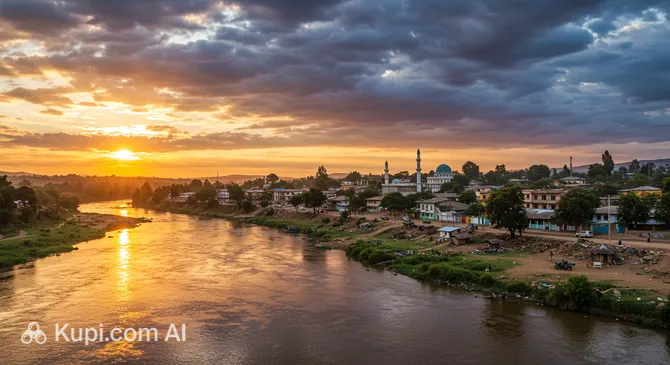
Exploring the cultural and natural landscape of Gode requires a shift in perspective. Unlike traditional tourist hubs filled with curated botanical gardens and ticketed galleries, this city in the Somali Region offers an experience rooted in raw nature and living history. The "parks" here are the fertile riverbanks that defy the desert, and the "museums" are the streets and structures that tell the story of the city’s unique foundation and development.
The most significant natural area in Gode is undoubtedly the Wabi Shebelle Riverbanks. This area functions as the city's primary green belt, offering a stark and beautiful contrast to the surrounding semi-arid scrubland. Visitors can walk along the paths near the water to see a thriving ecosystem of mango trees, banana plants, and local agriculture. It is a peaceful retreat from the dusty city center, where the sound of flowing water accompanies the sight of diverse birdlife, making it an ideal spot for nature enthusiasts to observe the region's flora and fauna.
Surrounding the city limits lies the vast Somali Savannah, which serves as an open, natural parkland for the adventurous. While not an enclosed park with gates, the outskirts of Gode offer a window into the wild beauty of southeastern Ethiopia. The landscape is dotted with acacia trees and termite mounds, home to hardy wildlife species. A guided drive into these areas provides a safari-like experience where one can appreciate the resilience of nature in a harsh climate, far removed from the manicured lawns of urban parks.
regarding museums, Gode does not currently possess formal institutions or art galleries in the Western sense. Instead, the city itself serves as an open-air museum of mid-20th-century urban planning. The city was famously designed with a master plan under Emperor Haile Selassie to be a new capital, and this history is visible in the wide grid-patterned streets and the layout of the older neighborhoods. For architecture buffs and history lovers, simply navigating the city reveals a narrative of ambition and development that is unique in the region.
A key site that reflects the city's past is the Former Palace of Emperor Haile Selassie. While it may not be a functioning museum with exhibits, the structure and its grounds are historically significant. It stands as a testament to the era when Gode was envisioned as a model city and a potential capital. Viewing the site offers a tangible connection to the political history of the Horn of Africa and provides context for why this city looks and feels different from other ancient trade towns in the area.
For an appreciation of local architectural art and culture, the Grand Mosque of Gode is a standout landmark. In the absence of art galleries, the mosque showcases the region's artistic expression through its geometric designs and minarets. It is the spiritual and cultural heart of the community. While entry for non-Muslims is restricted, the exterior architecture is well worth admiring, and the surrounding area is often buzzing with cultural exchanges, offering a glimpse into the traditions that define the local way of life.
Another engineering and historical landmark is the Wabi Shebelle Bridge. More than just a crossing point, this bridge is a critical artery connecting the region and a symbol of connection. It offers one of the best vantage points in the city for photography, allowing visitors to capture the river, the agricultural green belt, and the city skyline in one frame. It is a popular spot for locals to gather in the evening, making it a great place to observe the social dynamics of the city.
For a truly authentic experience, head to the riverbank near the bridge just before sunset. This is when the heat subsides, and the "golden hour" lights up the water and the surrounding greenery. It is a favorite time for locals to wash their cars, water their livestock, and socialize, offering a candid and unscripted look at the daily life of Gode that no museum display could replicate.