Support

Montoir Airport

About the Airport

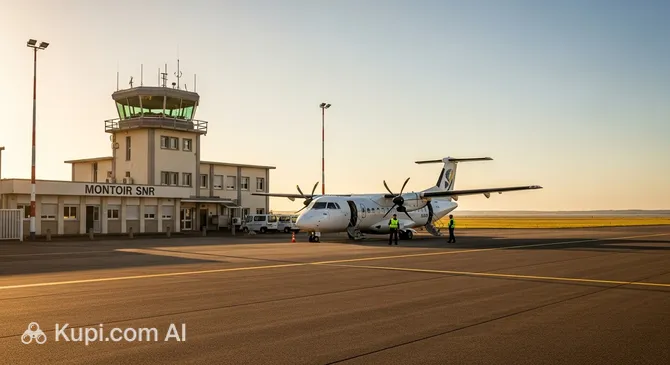
Montoir Airport. Source: Kupi.com Binoculars

Saint-Nazaire Montoir Airport (SNR) is not merely a regional transport hub, but a true intersection of civil aviation and high-tech industry. Located in the immediate vicinity of the Loire estuary, it serves as the aerial gateway to the famous shipyards and the picturesque Atlantic coast of France. Despite its modest size, this airport possesses a unique charm: a calm atmosphere reigns here, far from the hustle and bustle of giant hubs, and impressive cargo aircraft transporting parts for Airbus liners can often be seen on the runway.

IATA Code SNR
ICAO Code LFRZ
City Saint-Nazaire
Distance to centre 5 km
Status Regional / Industrial
Passengers per year Mainly charter flights and business aviation

Montoir Airport boasts a number of unique features that make it an important infrastructure facility in the region:

Unique Specialisation. This is one of Europe's key logistics centres. The airport plays a critically important role in aircraft manufacturing, regularly hosting the giant Beluga transport aircraft. For aviation enthusiasts (spotters), this is a rare opportunity to see these unusual machines in action, which gives the place a special character.

Speed and Comfort. Thanks to the compactness of the terminal and the focus on business aviation, all procedures here are completed as quickly as possible. Passengers do not need to spend hours going through formalities, which is especially appreciated by business travellers and those using private flights to access the resorts of La Baule and Guérande.

Strategic Location. The airport is located just a few minutes' drive from the centre of Saint-Nazaire and major industrial zones. It is an ideal arrival point for those who value time and are heading to the region for a business visit or planning to start a journey along the "Breton Riviera" without unnecessary transfers.

Contact Information

Below you will find contact information for Montoir Airport (SNR), which serves the city of Saint-Nazaire and its surroundings.

  • Official Website: The most up-to-date information on airport operations, schedules, and services can be found on the official portal: www.nantes.aeroport.fr.
  • Information Desk Phone: For general information and enquiries, you can call: +33 2 40 17 21 60.
  • Airport Address: Aéroport de Saint-Nazaire Montoir, Route de l'Aviation, 44550 Montoir-de-Bretagne, France.
  • Email: A direct email address for passengers is not published. It is recommended to use the contact form on the official website for communication.
  • Social Media: The airport does not maintain separate social media pages. Important updates may be published on the official channels of Nantes Atlantique Airport, which is under the same management.
  • Lost Luggage Information: If your luggage was lost or damaged during the flight, you must immediately contact your airline's counter at the airport. For items left in the terminal building, contact the information service via the main phone number.
  • Passenger Support Service: For all questions arising during your stay at the airport, please contact the information desk.

How to Get to the Airport

Montoir Airport (SNR) is located just a few kilometres north of the city of Saint-Nazaire, making the journey there quick and convenient. It is important to note that this is primarily an industrial and cargo airport, so public transport options may be limited compared to major international hubs. A trip from the centre of Saint-Nazaire usually takes 15–25 minutes depending on the chosen mode of transport and traffic conditions.

Public Transport is not the most direct way to get to the airport. There are generally no direct bus or rail routes to the terminal. You can use regional buses from the Aléop network or the urban STRAN network to get to the town of Montoir-de-Bretagne, but from there, you will likely need to take a taxi. Similarly, you can take a train to Montoir-de-Bretagne station and then complete the journey by taxi, which will take about 5–10 minutes.

Taxi or Pre-booked Transfer is the most reliable and comfortable option. A car can be found at stands in Saint-Nazaire or called by phone. The trip will cost approximately 25–40 Euros. Booking a transfer in advance guarantees a fixed price and timely vehicle arrival, which is especially convenient if you have an early flight or a lot of luggage.

Car Rental provides maximum freedom of movement, especially if you plan to explore the picturesque Atlantic coast and other corners of France. Offices of many international and local rental companies operate in Saint-Nazaire. The road to the airport is simple and intuitive. Parking is available at Montoir Airport; it is recommended to check current rates and conditions on the official airport website, although the cost is usually lower than at major aviation hubs.

It is worth considering that for most regular passenger flights, travellers more often use larger airports in the region. The nearest and most popular of these is Nantes Atlantique Airport, located approximately 45 km away. Other alternatives include Rennes Airport and Lorient South Brittany Airport (Lann-Bihoué), offering a wider choice of destinations.

Terminals and Layout

Montoir Airport (SNR), also known as Saint-Nazaire Airport, is a small regional airport, which defines its simple and passenger-friendly structure. There are no confusing layouts or long transfers here, making it ideal for a calm start or end to a journey.

The airport operates one compact passenger terminal that handles all flights — both departures and arrivals. Thanks to this, passengers do not need to worry about moving between different buildings. All infrastructure is located under one roof, making navigation intuitive. The departure and arrival zones are located in close proximity to each other, which significantly simplifies orientation.

Due to the small size of the terminal and moderate passenger flow, all pre-flight procedures, including check-in and security screening, take a minimal amount of time. Long queues are rare here, allowing passengers to avoid unnecessary stress. Nevertheless, it is recommended to arrive at the airport in advance, following standard airline recommendations.

Navigating the terminal is very easy. All key points — check-in counters, the security control zone, a small waiting area at the boarding gate, and the baggage claim area upon arrival — are within walking distance and equipped with clear signs. Essentially, it is practically impossible to get lost here, which is a great advantage for travellers who value their time and comfort.

Airport History

The history of Montoir Airport (SNR), located near the city of Saint-Nazaire, is closely intertwined with the aviation industry and key events of the 20th century. Its story began in the 1930s when an airfield was established on this site to support the region's growing aircraft manufacturing cluster. Initially, it served as a base for testing and dispatching aircraft produced at local factories.

One of the most dramatic periods in the airport's history occurred during the Second World War. After the occupation of France, the airfield was seized and significantly expanded by German forces. It became an important Luftwaffe base, from which long-range Focke-Wulf Fw 200 "Condor" bombers took off to attack Allied convoys in the Atlantic. This turned the airfield into a strategically important facility throughout the conflict.

After the war, the airport returned to civil and industrial use, becoming a key element of European aircraft manufacturing. Its modern history is inextricably linked with the company Airbus. It is here that large fuselage sections for the aircraft of this consortium are assembled and produced. To transport these giant components for final assembly in Toulouse or Hamburg, unique transport aircraft, the Beluga and BelugaXL, are used. Specifically for their reception and maintenance, the airport's infrastructure, including the runway, was significantly modernised.

Today, Saint-Nazaire — Montoir Airport represents a fascinating combination of an industrial giant and a regional aviation hub. Although passenger services here are limited, the airport attracts spotters and aviation enthusiasts from all over the world wishing to see the unusual Beluga transport aircraft. This unique symbiosis of production and logistics makes it one of the most interesting industrial airports in Europe.

Services and Amenities

Montoir Airport (SNR), serving the city of Saint-Nazaire in France, is a compact regional airport. Due to its size and specific nature, the range of services for passengers is focused on the essentials, ensuring a comfortable wait for the flight without the excesses typical of major international hubs.

Dining and shopping options in the terminal are generally limited. Passengers may find a small café or snack bar where beverages and light snacks can be ordered, as well as vending machines. There are no duty-free shops or a large selection of souvenir stalls here. regarding modern amenities, the waiting lounge usually provides access to wireless internet (Wi-Fi), and there are stations for charging electronic devices.

For passenger convenience, there are no bank branches or currency exchange points at the airport. It is recommended to settle all financial matters in the city beforehand. Medical assistance is limited to a first aid point. There are no specialised VIP lounges or business centres with conference rooms provided at Montoir Airport.

The airport is adapted for the needs of passengers with reduced mobility: there are ramps and specially equipped restrooms. However, one should inform their airline in advance about the need for special assistance, such as the provision of a wheelchair. For travellers with children, baby care rooms may be available, but separate play areas are absent.

There are no hotels directly on the airport complex grounds. The nearest accommodation options can be found in the city of Saint-Nazaire and its surroundings, which are a few minutes' drive from the airport. There, travellers have access to a wide selection of hotels to suit any taste and budget.

Where to Eat

When planning a snack at Montoir Airport (SNR), it is important to consider that this is a small regional airport. Unlike large international hubs, the choice of catering establishments here is quite limited and is designed primarily for the basic needs of passengers waiting for their flight.

Typically, there is one café-bar operating at the airport, located in the general hall before the security control zone (landside), making it accessible to both departing passengers and those meeting them. Here you can have a quick snack before your flight. The menu usually features classic French snacks: fresh pastries (croissants, pain au chocolat), sandwiches, as well as hot and cold drinks, including coffee, tea, and juices.

If you are counting on a full hot lunch or dinner, the best solution would be to eat beforehand at one of the numerous restaurants in the city of Saint-Nazaire. The airport café is more suitable for a light snack than for a substantial meal. Prices here, as in most airports, will be slightly higher than the average in the city.

Passengers with specific dietary requirements (for example, Halal, vegetarian, vegan, or gluten-free options) should be prepared for a very scarce selection. It is recommended to bring food with you. The opening hours of the café are directly linked to the flight schedule — it opens a few hours before departure and closes shortly after the departure of the last flight of the day.

Tips for Travellers

To ensure your journey through Montoir Airport in the city of Saint-Nazaire goes as smoothly and comfortably as possible, take advantage of our practical tips. These recommendations will help you save time, stress, and money.

Airport Arrival Time. Montoir Airport is a compact regional airport where all pre-flight formalities usually pass quickly and without long queues. As a rule, arriving 1.5 hours before departure is quite sufficient for most flights. Nevertheless, we strongly recommend checking your airline's requirements in advance, as they may differ, especially for international destinations.

Check-in and Security Control. The best way to save time is to complete online check-in on your airline's website. This way, you can either go straight to security screening (if flying with hand luggage) or drop off your luggage at a dedicated Drop-off counter. When going through security control, prepare laptops and other large electronic devices, as well as a transparent bag with liquids, for inspection in advance.

Seat Selection on the Plane. If the airline allows you to choose a seat, be guided by your preferences. Window seats will offer you picturesque views of the Atlantic coast of France, while aisle seats provide more freedom of movement and the ability to stretch your legs.

Hand Luggage. Remember the standard restrictions: all liquids must be in containers of no more than 100 ml and packed in one transparent resealable bag with a capacity of up to 1 litre. It is prohibited to carry sharp objects, weapons, and flammable substances in hand luggage. Be sure to check the exact hand luggage and baggage allowance rules on your airline's website, as regulations may vary.

Connecting Passengers. If you have a connecting flight, clarify when checking in for the first segment whether you will need to collect and re-check your luggage at the transfer airport. Upon arrival at the transit airport, follow the "Flight Connections" or "Transit" signs and check the information board to find the boarding gate number for your next flight.

Customs Control. When arriving from countries outside the European Union, you will need to pass through customs control. If you have no goods to declare, use the "Green Channel". If you are carrying goods exceeding duty-free limits or large sums of cash, you should pass through the "Red Channel".

Saving Time and Money. Book your transfer from/to the airport online in advance to avoid inflated prices on the spot. Bring an empty reusable water bottle with you — it can be filled at drinking fountains after passing security control. Light snacks brought from home will also help save money.

In Case of Flight Delay. If your flight is delayed, remain calm. All current information will be displayed on the departure boards. Contact your airline representative for clarification. Remember that for long delays on flights covered by European legislation (EU261), you have the right to drinks, meals, and, if necessary, hotel accommodation at the expense of the air carrier.

Reached the end of the page?

That means the route is fully explored