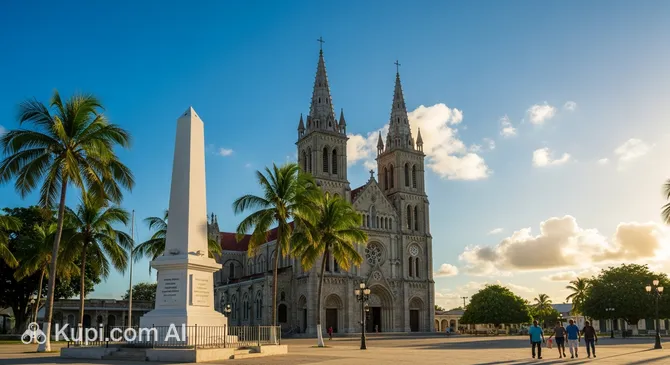
Gonaïves is a city of deep historical significance located on the northern coast of Haiti. As the administrative center of the Artibonite department, it stretches along the shores of the picturesque Gulf of Gonâve. While the city is not a typical postcard resort, it attracts travelers with its authentic atmosphere and its status as the "City of Independence."
Geographically, Gonaïves occupies a strategic position, linking the northern and southern regions of the country. With a population of over 324,000, it is a bustling transport and trade hub where life revolves around the seaport and central squares. The climate here is tropical, which dictates a slow pace of life during the hot daytime hours and a surge of activity with the arrival of the evening cool.
Gonaives. Illustration.
Source: Kupi.com AI
For those interested in the past of the Caribbean region, Gonaïves will be a true discovery, as it was here that an important page of the city's history and that of the entire nation was written—the proclamation of freedom in 1804. The main point of attraction is the central square, Place d'Armes, where daily life is concentrated and the city's major events take place.
Visiting Gonaïves is an opportunity to see Haiti without embellishment, to get acquainted with the local way of life, and to feel the energy of a port city. We invite you to explore this region to better understand the unique character and resilience of the Haitian people.
Weather Overview
The climate in Gonaïves is typical for tropical coastal areas, characterized by high humidity and consistently high temperatures throughout the year. The thermometer here usually fluctuates between +21°C and +32°C. The hottest months are July and August, when the daytime heat can feel quite intense due to the proximity to the sea.
If you are planning a trip, pay attention to the weather in the city by season. From May to November, the region experiences the rainy season. During this period, brief but very heavy tropical downpours are possible, most often occurring in the afternoon. September is traditionally the wettest month, while the period from December to March is considered relatively dry and the most comfortable for visiting.
The sea breeze in the port area helps make the daytime heat more bearable; however, the city center can be stifling due to dense buildings and traffic. It is recommended to choose morning hours for walks or the time after sunset, when the humidity becomes more pleasant and the temperature gradually drops to a comfortable +22–24°C.
Average monthly temperature
Average monthly precipitation
Interesting Facts
Gonaïves bears the honorary title of the "City of Independence" (Cité de l'Indépendance), as it was here on January 1, 1804, that Jean-Jacques Dessalines officially declared Haiti a free state.
The city is a crucial transport hub for the northern part of the country, linking the capital with major northern ports through mountain passes.
The population of Gonaïves has grown significantly in recent decades and, by modern estimates, exceeds 320,000 people, making it one of the largest cities in Haiti.
Located in the Gulf of Gonâve, the city has a unique flat terrain surrounded by mountains, which creates a specific microclimate in this region.
Gonaïves is home to the administrative center of the Artibonite department, which is considered the country's main "breadbasket" thanks to the fertile soils of the valley of the same name.
How to Get There
Getting to Gonaïves can be done in several ways, but it's worth considering the specific features of the region's transport system. The city does not have its own airport, so the primary link is the road network. When planning your trip, it is best to allow extra time for possible delays due to the terrain and the condition of the road surface.
Most travelers begin their journey in the country's capital. If you want to learn more about routes to Gonaïves, you should consider traveling by bus or taxi from Port-au-Prince. The distance is about 100 kilometers, and the travel time usually takes 2 to 3 hours. "Tap-taps"—minibuses that run between major population centers like Cap-Haïtien—are also popular.
Railway communication in the region is currently not developed, so land transport remains the only alternative for internal travel. The main bus stations are located in the central part of the city, with services departing to neighboring departments.
For those arriving by sea, the port of Gonaïves is an important facility. Although regular passenger services from other countries are limited, the port is actively used for connections with neighboring Caribbean ports. Traveling by sea can be an interesting experience, but the schedule of such voyages should be checked in advance directly with the carriers.
Main Attractions
Unlike major tourist centers, Gonaïves offers guests a chance to experience the country's historical heritage and daily life. The main point of interest is the central square, Place d'Armes de la Ville des Gonaïves. This is the heart of the city, where residents gather to socialize and tourists can feel the rhythm of local life. The spirit of history lingers in this area, reminding visitors of the great events of the past.
The Seaport of Gonaïves deserves special attention. It is not just a transport facility but a living organism where you can observe ships docking and lively trade. A stroll along the port facilities allows you to see the city from a different perspective and appreciate its importance as the trade gateway to the Artibonite region.
For those who value historical context, places associated with the proclamation of independence will be of interest. Although there are no large-scale museum complexes in the city, the streets themselves and the old administrative buildings preserve the memory of the events of 1804. A walk through the central quarters will allow you to see traditional architecture and feel the atmosphere of old Haiti.
To round off your sightseeing, a visit to the local markets is a must. These are spontaneous and colorful spaces where you can see the full variety of local goods and products. There are no organized tours here, but self-exploration of these locations will provide plenty of impressions and allow you to take unique photographs of everyday life.
Local Cuisine
The cuisine of Gonaïves is a vibrant reflection of Haitian traditions, where local products and spices take center stage. The foundation of the diet consists of rice and bean dishes, such as diri ak dò. Thanks to the city's coastal location, local restaurants always offer fresh fish and seafood, either grilled or prepared in spicy sauces.
One of the most popular dishes that is a must-try is griot—pieces of pork marinated in citrus juice and then fried until golden brown. It is often served with pikliz (a spicy cabbage slaw) and fried plantains. On Sundays in Gonaïves, as in the rest of the country, it is customary to prepare the famous soup joumou—a fragrant pumpkin soup that is a symbol of freedom.
The food culture here is closely tied to the street: in markets and along roadsides, you can find many vendors offering fresh juices made from mango and other tropical fruits. Among alcoholic beverages, local beer and rum are the favorites. Clairin, a traditional Haitian rum produced from local cane sugar, deserves special mention.
The city's restaurant scene is mainly represented by family-run establishments and small cafes near the central square and the port. You won't find haute cuisine here, but it is in these places that you can experience the true taste of Haiti, prepared according to home recipes passed down through generations.
Travel Tips
Planning a trip to Gonaïves requires some preparation to ensure your journey is as comfortable and safe as possible. These practical tips will help you better navigate the realities of this Haitian city.
Clothing and Essentials: Pack light clothing made of natural fabrics, as it is almost always hot in the city. Be sure to bring sunglasses, a hat, and insect repellent. For walks in the center, it is best to choose comfortable, closed-toe shoes.
Transport: Get around the city using moto-taxis or tap-taps, but always confirm the fare in advance. If you are unsure of the route, it is better to use taxi services recommended by your hotel.
Finances: The main currency is the Haitian gourde. It is recommended to exchange money at banks or official exchange offices. Credit cards are rarely accepted, so always carry cash with you.
Health and Safety: Drink only bottled water and avoid ice in drinks at street cafes. After dark, it is best to stay in well-lit central areas and avoid the outskirts of the port.
Communication: The main languages are Haitian Creole and French. English is not widely spoken, so learn a few basic phrases in Creole to win over the locals.
Local Etiquette: Haitians are very polite people. Always greet someone before asking a question. Dress modestly when visiting administrative buildings and churches.
What to Avoid: You should not openly display expensive equipment or large sums of money in crowded places. Avoid discussing political topics and always ask for permission before taking photos of local residents.
Additional Tip: Visit the central square, Place d'Armes, in the evening—it is the best time to see the city in its most vibrant and authentic state.
May your introduction to Gonaïves be a bright and memorable event, filled with new discoveries!
Entertainment & Nightlife
Entertainment in Gonaïves is primarily low-key and local. The city is not famous for an abundance of nightclubs or noisy discos, as it is oriented toward administrative and commercial activities. The main center for evening leisure is the central square, where locals and visitors gather in open-air cafes and bars.
The highlight of evenings in Gonaïves is often live music. In local establishments, kompa—the traditional Haitian dance rhythm—can frequently be heard. The atmosphere is friendly and relaxed, with the crowd consisting mostly of city dwellers unwinding after a working day. This is an excellent time to try the local Prestige beer at one of the bars in the port area.
For those seeking large-scale daytime entertainment or a vibrant nightlife, it's worth noting that the country's main entertainment centers are several hours' drive away. Nevertheless, Gonaïves can offer cozy evenings in portside cafes where you can enjoy the sea breeze and watch the sunset, creating a special, peaceful atmosphere.
Parks & Museums
Park infrastructure in Gonaïves is minimally developed, and the urban environment is predominantly built-up. Nevertheless, the main "green" zone and a place for residents to relax is the central square, Place d'Armes. Trees are planted here, providing shade on hot days, and benches are installed, making this an ideal spot for leisurely observing city life.
There are virtually no specialized museums in the traditional sense in Gonaïves. However, the city itself is often called an open-air museum due to its significance in the history of the struggle for independence. Small exhibitions dedicated to the founders of the state can sometimes be found in administrative buildings or educational centers near the central square.
Locals also frequently choose the coastal port area for walks. Although it is not a landscaped park, the sea air and the chance to see arriving ships make it a popular spot for an evening stroll. If you are looking for true wilderness, it is worth heading outside the urban area toward the Artibonite valley, where the region's natural landscapes are preserved.
Getting Around
The transport system of Gonaïves is primarily represented by informal types of public transport. The most popular way to get around the city and beyond is by tap-taps. These are brightly painted pickups or minibuses that run along specific routes. Payment is made in cash to the driver, and there are often no fixed stops—you simply wave your hand to flag one down.
For quick trips over short distances, locals and tourists often use moto-taxis. This is the most maneuverable type of transport, allowing for easy navigation through congestion in narrow streets. You should always agree on the price of the trip in advance, before getting on the motorcycle. In the city center, the roads are quite suitable for walking, though you should be mindful of the lack of sidewalks in many areas.
Traditional taxis are also available in Gonaïves, but it is better to call one through your hotel's front desk. Renting a car is an option for experienced drivers ready for heavy traffic and the peculiarities of local driving habits. The transport payment system is exclusively cash, so it is recommended to always carry small bills in the local currency.
Accommodation
The accommodation infrastructure in Gonaïves is primarily geared toward business travelers and visitors in transit. You won't find large chain resorts here; instead, the city offers a decent selection of small private hotels and guesthouses. Most of them are concentrated in the central quarters, which is convenient for quick access to administrative offices and markets.
A typical housing option is a functional mid-range hotel with a basic set of amenities: air conditioning, Wi-Fi, and breakfast. The cost of staying in such establishments is usually quite affordable, though the service level may be simpler than European standards. It is recommended to book rooms in advance, especially during local festivals or official holidays.
For those who prefer a more private format, apartments and rooms for rent are available through local services. Choosing the right area to stay plays an important role: it is better to prefer well-lit streets near Place d'Armes, where the safety level is higher and services are better developed. Overall, the hospitality of the locals makes staying in Gonaïves comfortable for those seeking an authentic experience.
Nearby Cities
Due to its location in the central part of the northern coast, Gonaïves is a convenient starting point for exploring the surrounding settlements and natural landscapes of the Artibonite department.
Just a few dozen kilometers away is the city of Dessalines, named after the nation's founder. This place is steeped in history and allows for a deeper dive into the country's heroic past. Also of interest for a short trip are Chapelle and the picturesque Ennery, the road to which passes through beautiful mountain stretches.
Not far from Gonaïves are also Terre-Neuve and Grande-Saline, each possessing its own unique provincial charm. Exploring these small towns will allow you to see the real life of the Haitian hinterland, get acquainted with local crafts, and enjoy the views of the Artibonite valley.
Shopping & Souvenirs
Shopping in Gonaïves is first and foremost about visiting bustling and colorful markets. There are no huge shopping malls with international brands here; instead, there is an abundance of locally produced goods. Commercial life is concentrated around the port and Place d'Armes, where numerous stalls offer everything from food to household supplies.
The main city market is the perfect place to buy authentic souvenirs. Be sure to look for handmade items: bright Haitian paintings, straw-woven baskets and hats, as well as carved wooden crafts. These items will not only decorate your home but also serve as a reminder of the country's unique culture.
In the shops of Gonaïves, it is customary to pay in the local currency, though larger outlets may accept dollars. Credit cards are rarely accepted, so it's always worth having cash on hand. Shops typically open early in the morning and close at sunset, following the natural rhythm of city life.