Support

High Court Museum

About

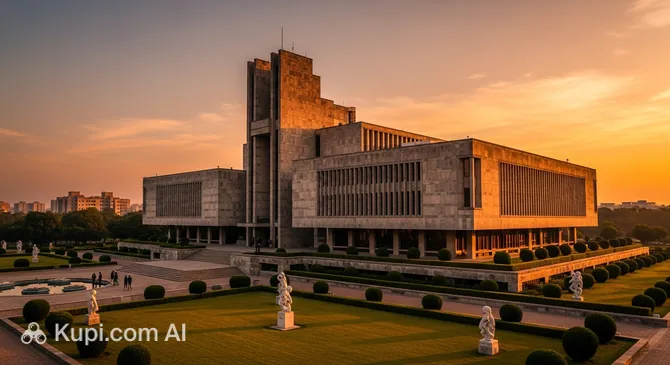
Imagine a place where the rigor of the law meets the genius of avant-garde architecture. The High Court Museum is not just a repository of documents, but a part of the legendary Capitol Complex in the city of Chandigarh. The building that houses it was designed in the 1950s by the great French architect Le Corbusier and is considered today one of the benchmarks of global modernism.
\n
High Court Museum
High Court Museum. Иллюстрация. Источник: Kupi.com AI
\n

This museum represents a unique synthesis of functional space and fine art. For the modern traveler visiting India, the site is of interest as a symbol of the country's new era, embodied in concrete, vibrant colors, and unusual geometric shapes.

The museum serves as an important educational center, telling the story of the development of the region's judicial system and the history of the "City of the Sun" itself—Chandigarh. Here, the architectural masterpiece becomes a backdrop for historical chronicles, turning a regular museum visit into a fascinating immersion into the past.

Contacts

To confirm information about potential changes to the schedule or visiting conditions, you can use the following contact details:

Address: QR44+93H, Capitol Complex, Sector 1, Chandigarh, 160001, India

How to contactContact
AddressQR44+93H, Кэпитол Комплекс, Сектор 1, Чандигарх, Чандигар 160001, Индия
Phone+91 172 504 2858
Websitehighcourtchd.gov.in

What to Do

Inside the museum, guests have a rare opportunity to examine archival materials that tell the story of the city's birth. Original drawings and plans by Le Corbusier are on display here, along with unique photographs of the construction process, showing how a city of the future rose from scratch in India.

Special attention should be paid to the architectural design of the building itself. It is impossible to miss the famous umbrella-shaped roof and the majestic entrance with three giant pylons. These columns are painted in the colors of the national flag—green, white, and orange—giving the austere building a ceremonial look.

Be sure to look into the courtrooms. Their interiors are decorated with massive, bright tapestries created by Kashmiri craftsmen based on sketches by Le Corbusier himself. These woven canvases serve not only as decorative elements but also perform an important acoustic function, absorbing excess sound in the spacious halls.

Getting There

The High Court Museum is located within the Capitol Complex in Sector 1. This part of the city was designed as an administrative center and intentionally separated from residential and commercial districts, giving it a unique monumental atmosphere.

The most convenient way to get here is by using a taxi or mobile ride-hailing apps from the city center. The trip will take very little time, as Chandigarh's road network is famous for its thoughtful design.

If you prefer public transport, you can use city buses heading to Sector 1; however, keep in mind that you will have to walk from the bus stop to the court building itself. For those using a navigator, the coordinates are: 30.7559483°N, 76.8052476°E.

Ближайший город: Chandigarh

History & Facts

The history of this site is inextricably linked to India's independence. After the partition of Punjab in 1947, the former state capital, Lahore, became part of Pakistan, creating an urgent need for a new administrative center. Chandigarh became the embodiment of the progressive ideas of the first Prime Minister, Jawaharlal Nehru.

The High Court building, also known as the Palace of Justice, was constructed between 1952 and 1956. The project was entirely designed by the great Le Corbusier, who saw it not just as a government institution, but as a symbol of the rule of law and the new aesthetic of modernism.

In July 2016, the significance of this architectural ensemble was recognized on a global level: the Capitol Complex, including the court building, was added to the UNESCO World Heritage list. This decision confirmed Chandigarh's exceptional contribution to the development of 20th-century world architecture.

Time Needed

To leisurely explore the museum's exhibits and appreciate the building's architectural scale, visitors are recommended to set aside 2 to 3 hours in their schedule. This time is sufficient for studying archival documents and walking around the surrounding complex grounds.

If you are an architecture enthusiast or a professional designer, you might want to spend more time here, examining the finishing elements and the play of light in the halls. Also, factor in time for security procedures, as the building is an active government facility.

Working Hours

When planning your visit to the High Court Museum, keep in mind the standard operating hours for government institutions in India. The museum is open to visitors from 09:30 to 17:00, Monday through Saturday.

Please note that Sunday is a day off. It is also worth checking the official website before your trip, as access to the building may be restricted on public holidays or during important court sessions.

DayWorking hours
понедельник09:30–17:00
вторник09:30–17:00
среда09:30–17:00
четверг09:30–17:00
пятница09:30–17:00
суббота09:30–17:00
воскресеньеЗакрыто

Nearby

Visiting the government quarter is just the beginning of discovering the city's unique layout. Exploring the surroundings will allow you to better feel the contrast between the strict geometry of modernism and natural spots for relaxation.

Located near the court complex and within a few minutes' drive are several interesting locations:

NameDistance
Nek Chand's Rock Garden0.3 km
Chandigarh Bird Park0.9 km
Sukhna Lake1.3 km
Government Museum and Art Gallery1.9 km
Natural History Museum2 km
Chandigarh City Hotel2.2 km
Indian Air Force Heritage Museum2.3 km

Reached the end of the page?

That means the route is fully explored