Support

Chhatrapati Shivaji International Airport

About the Airport

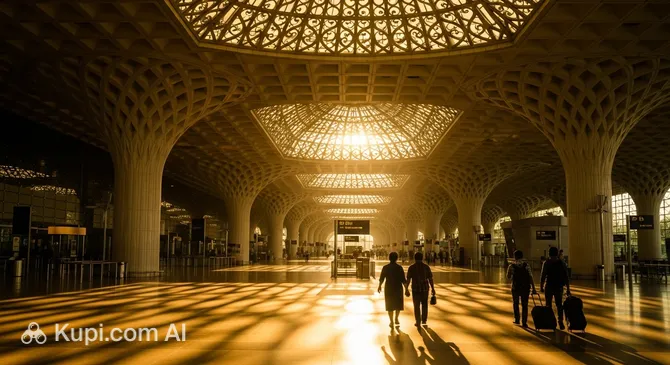
Chhatrapati Shivaji International Airport. Source: Kupi.com Binoculars

Chhatrapati Shivaji International Airport in Mumbai is not just an air gateway to the financial capital of India, but a true cultural phenomenon. Named after the legendary 17th-century warrior emperor, it immerses travellers in an atmosphere of grandeur and modern hospitality from the very first minute. This airport, the second busiest in the country, represents a unique combination of advanced technology and rich cultural heritage. Its terminals, especially the award-winning Terminal 2, are attractions in themselves that are well worth seeing.

IATA Code BOM
ICAO Code VABB
City Mumbai
Distance to Centre About 25 km
Status International
Annual Passengers Over 55.1 million (Financial Year 2024–2025)
Popular Airlines IndiGo, Air India, Vistara
Schedule online board "Chhatrapati Shivaji International Airport"

One of the main jewels of the airport is Terminal 2, opened in 2014. Its design is inspired by India's national symbol — the peacock — which is reflected in the roof shape and interior solutions. Inside the terminal lies the world's largest public art museum in an airport — the Jaya He GVK New Museum, featuring thousands of artefacts and works of contemporary Indian art. This turns waiting for a flight into a fascinating cultural excursion.

Mumbai Airport has repeatedly received high ratings for service quality. Notably, it was recognised as the best in the world in the category of airports serving over 40 million passengers per year by Airports Council International. For passenger convenience, a dedicated mobile app was created to help navigate the vast terminal, find shops and restaurants, and not miss flights. The airport also boasts modern infrastructure, including two runways capable of accommodating even the largest aircraft, such as the Airbus A380.

Contact Information

For your convenience, we have compiled the essential contact information for Chhatrapati Shivaji International Airport (BOM).

  • Official Website: You can always find the most complete and up-to-date information, including flight schedules, terminal maps, and passenger regulations, on the airport's official website: csmia.aero.
  • Helpline Phone: For immediate assistance, you can call the 24-hour number: +91 22 6685 1010.
  • Airport Address: Mumbai International Airport Ltd, Chhatrapati Shivaji Maharaj International Airport, Terminal 1, Santacruz East, Mumbai, Maharashtra 400099, India.
  • Email: For official enquiries and feedback, it is recommended to use the contact form on the official airport website.
  • Social Media: The airport maintains active pages on popular social networks (X/Twitter, Facebook, Instagram), where news, flight status updates, and useful travel tips are published.
  • Lost & Found Information: If you have lost items within the terminal building, please contact the airport's "Lost & Found" service. Information can be found in the relevant section on the website. For lost checked baggage, you should contact your airline directly.
  • Passenger Support Service: For general queries and consultations, you can contact the main helpline number or use the feedback form on the website.

How to Get to the Airport

Reaching Chhatrapati Shivaji International Airport (BOM), the main gateway to Mumbai, is possible via several methods, each having its own advantages depending on your budget, time, and amount of luggage. Given the intense traffic in one of India's largest metropolises, it is worth planning your journey in advance, allowing extra time for potential traffic jams.

Public Transport is the most economical option. The BEST city bus network offers many routes passing near the airport, but this can be slow and uncomfortable with luggage. A more convenient option is the Metro. Airport Road and Marol Naka stations on Line 1 (Blue Line) are within walking distance of International Terminal T2. This is a fast and inexpensive way to avoid traffic. Suburban trains are another budget method, but there is no direct rail link to the airport. The nearest stations are Vile Parle (for Domestic Terminal T1) and Andheri (for International T2), from where you need to take a taxi or auto-rickshaw to the terminals.

Taxis, Auto-rickshaws, and Transfers are the most convenient method, especially if you are travelling with a lot of luggage. Services like Uber and Ola are widely available in Mumbai, offering rides at fixed prices. You can also use traditional black-and-yellow taxis or book a prepaid taxi at special counters in the airport, which guarantees a trip at the official rate. Auto-rickshaws are a cheaper alternative to taxis for short trips, ideal for getting from the nearest metro or train station.

For those who prefer maximum independence, car rental is available. However, driving in Mumbai can be a real challenge due to chaotic traffic, so many tourists prefer to rent a car with a driver. The airport provides multi-level parking at both terminals (T1 and T2) for both short-term and long-term stays, though the cost is quite high.

On average, a trip from the city centre (e.g., from the Colaba district) to the airport takes from 45 minutes to 2 hours depending on the time of day and traffic situation. Key recommendation: always leave with plenty of time to spare, especially during morning and evening rush hours. For travellers on a limited budget, the metro is the optimal choice, while for those who value comfort, a taxi or pre-booked transfer is best.

Terminals and Map

Chhatrapati Shivaji International Airport in Mumbai is one of the busiest in India, and its structure has important features worth considering when planning your trip. The airport consists of two main terminals located at a significant distance from each other.

Terminal 2 (T2) is a modern integrated terminal that handles all international flights, as well as most full-service domestic flights (such as Vistara, Air India). Its architecture is inspired by the peacock, the country's national symbol. The terminal has several levels:

  • Level 4: Departure zone for international flights.
  • Level 3: Departure zone for domestic flights.
  • Level 2: Arrival zone for all flights (international and domestic).
  • Level 1: Taxi stands, bus stops, and parking.
Inside T2, navigation is intuitive thanks to clear signage. The terminal is also famous for the huge art collection "Jaya He GVK New Museum" housed directly within its walls.

Terminal 1 (T1), also known as the Santacruz terminal, serves primarily domestic flights of budget airlines (low-cost carriers) such as IndiGo, SpiceJet, and Akasa Air. It is significantly smaller and simpler in structure than T2 and consists of several sections (1A, 1B, 1C) that function as a single unit today.

Key point — moving between terminals. Terminals T1 and T2 are located about 5 kilometres apart and are not connected by a pedestrian walkway. For transit passengers and those who have mistakenly arrived at the wrong terminal, a free shuttle bus operates. The journey takes 20 to 30 minutes depending on traffic conditions. Always allow extra time for this transfer.

It is recommended to allow standard time for check-in and security control: 2.5-3 hours for international flights and 1.5-2 hours for domestic ones. Terminal 2 is very large, so it is better to arrive early to find your gate without rushing. Always check your ticket carefully to see which terminal — T1 or T2 — your flight departs from, as this is the most common reason for tourists running late.

Airport History

The history of Chhatrapati Shivaji International Airport is a reflection of the dynamic development of Mumbai itself. Its origins date back to the 1930s, when the Santacruz airfield was built on this site. During World War II, it served as an important airbase for the Royal Air Force (RAF Santacruz). After India gained independence, the airfield was transferred for civil use and quickly became the city's main aerial gateway.

The first significant phase of expansion occurred in 1958, when a new terminal for domestic flights was opened. This terminal, known today as Terminal 1, became the symbol of air travel in Mumbai for many years. In 1981, a new international terminal was opened, allowing for the separation of passenger flows and improvement in service quality. However, the real breakthrough happened later. In 1999, the airport received its current name in honour of the great Maratha warrior-ruler Chhatrapati Shivaji Maharaj, highlighting its national significance.

A key moment in the airport's modern history was the opening of the ultra-modern integrated Terminal 2 (T2) in 2014. This project became one of the most ambitious in India's aviation industry. The new terminal not only multiplied capacity but also became an architectural gem. Its design is inspired by the peacock, the national symbol, and inside lies the impressive "Jaya He" art museum, representing India's rich cultural heritage.

Mumbai Airport has repeatedly set records. For many years, it was considered the busiest single-runway airport in the world, handling over 900 flights a day. This achievement demonstrates the highest level of operational efficiency. An interesting fact: due to dense urban development, the airport could not expand horizontally, which prompted the creation of the multi-level and vertically integrated Terminal 2. Today, Chhatrapati Shivaji Airport is not just a transport hub, but a true symbol of the economic and cultural growth of modern India.

Services and Amenities

Chhatrapati Shivaji International Airport in Mumbai is a modern and comfortable hub offering passengers a full range of services for a pleasant wait for their flight. Here, you can relax in one of the numerous premium lounges, including VIP zones available for business class passengers and loyalty programme members. Free Wi-Fi is provided throughout the airport, and numerous charging stations are equipped for gadgets.

The gastronomic and shopping opportunities at the airport are impressive in their variety. At your service are dozens of restaurants and cafes, where you can try both Indian cuisine and international favourites. In the retail zone, you will find Duty Free shops, boutiques of global brands, as well as stalls with local souvenirs, tea, and spices, where you can buy gifts for loved ones.

For practical matters, bank branches and currency exchange counters operate within the terminals. In case of necessity, passengers can visit the 24-hour medical centres for first aid. Travellers with children will appreciate the presence of special baby care rooms with changing tables and play zones that help young passengers pass the time before departure.

The airport is fully equipped for the comfortable movement of passengers with reduced mobility: ramps, lifts, and special assistance upon request are provided. For those who need to work, business centres and conference rooms are open. And if you have a long layover, you can rest in hotels located both directly in the airport's transit zone and in its immediate vicinity.

Where to Eat

Chhatrapati Shivaji International Airport in Mumbai offers passengers a vast selection of establishments for every taste and budget. This is a wonderful opportunity to enjoy both international cuisine and authentic Indian delicacies before departure or while waiting for a connecting flight.

The bulk of restaurants, cafes, and lounges are concentrated in Terminal 2, which serves international and some domestic flights. Here, both in the pre-security zone (landside) and post-security (airside), you will find a huge food court and many individual establishments. Many of them operate 24/7, which is particularly convenient for passengers on night flights. Terminal 1, serving primarily domestic lines, also offers a good selection of cafes and eateries, though in smaller numbers.

Once at the airport, be sure to try local dishes. This is your chance to enjoy Mumbai's famous street food in a safe and clean environment — look for places offering Pav Bhaji (vegetable curry with a bread roll) or Vada Pav (potato fritter in a bun). Restaurants specialising in South Indian cuisine with crispy dosas or hearty North Indian thalis (a platter of several dishes) are also popular.

For those adhering to special diets, the airport offers many options. Thanks to the culinary traditions of India, vegetarian dishes are available in almost every establishment. It is also easy to find Halal food. Vegan and gluten-free options are also present on the menus of many restaurants, but it is recommended to check the ingredients with the staff. The price range varies from budget food courts to premium restaurants, however, it is worth remembering that airport prices are generally higher than in the city.

If you are short on time, international coffee chains like Starbucks, sandwich points, or the lively food court are ideal for a quick snack. For a full lunch or dinner in a calm atmosphere, it is better to choose one of the restaurants in the departure zone (airside) after passing passport control. This will allow you to relax and enjoy your meal without rushing, not worrying about the time until boarding.

Travel Tips

To ensure your journey through Chhatrapati Shivaji International Airport in Mumbai is as comfortable as possible, use our tips. This bustling aviation hub is one of the busiest in India, and a little preparation will help avoid stress. The main rule is to arrive well in advance. For international flights, it is better to arrive 3-4 hours before departure, and for domestic ones — 2-3 hours. Always allow extra time for the journey to the airport, as traffic jams in Mumbai can be unpredictable.

Before travelling, be sure to check which terminal your flight departs from. Terminal T2 serves all international flights and some domestic ones, while Terminal T1 (often called Santacruz) is used mainly by budget airlines for domestic flights. To enter the terminal building, you will need to present your passport and ticket. Be prepared for queues at security control. An important detail: a tag will be placed on your hand luggage and stamped. Do not remove or lose this tag, as it will be checked before boarding the aircraft.

When choosing a seat on the plane, be guided by your preferences. Window seats will give you the chance to see an impressive panorama of the city during takeoff or landing. Aisle seats are convenient if you plan to get up and stretch during the flight. Regarding hand luggage, standard international rules on liquids apply here, but there is a local peculiarity: power banks and spare lithium batteries can only be carried in hand luggage; putting them in checked baggage is strictly prohibited.

If you have a transfer planned, carefully plan your time, especially if a change of terminals is required (a shuttle runs between T1 and T2). Check if you need to collect and re-check your luggage. When passing through customs control, be honest and familiarise yourself with duty-free import allowances in advance to avoid unnecessary questions and delays. Use the "Green Channel" if you have nothing to declare.

To save time and money, check in for your flight online. At the airport, use official prepaid taxi counters or book a car via apps to avoid overpaying private drivers. In case of a flight delay, do not panic. Contact your airline's counter for information, meal vouchers, or accommodation. Airport T2 is an attraction in itself — here you can find many shops, restaurants, and even the impressive Jaya He GVK New Museum, which will help pass the time.

Reached the end of the page?

That means the route is fully explored