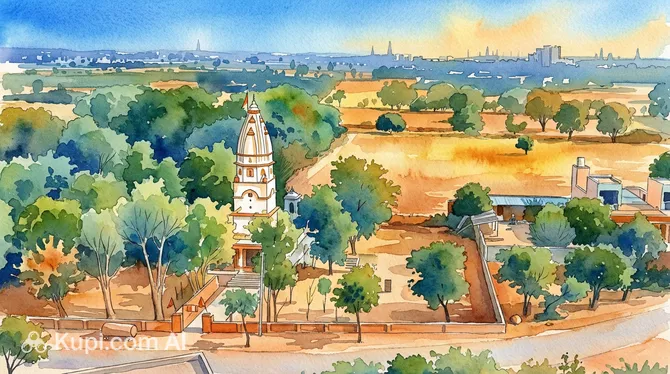
Sambhal is a colorful city in the Indian state of Uttar Pradesh, situated on a picturesque alluvial plain. It is steeped in the atmosphere of old India, where bustling bazaars and centuries-old traditions intertwine with the rhythm of everyday commercial life. The city serves as a significant administrative center and a vital hub for the agricultural region of Rohilkhand, attracting those seeking the authentic spirit of the Indian province.
Geographically, Sambhal is located just 32 kilometers from Moradabad, occupying a favorable position on the Indo-Gangetic Plain. The city's population exceeds 220,000 people, making it a lively and dynamic destination. The local landscape and historical heritage have shaped a unique urban environment here, where sugar trading and hand-weaving remain the backbone of the economy.
Sambhal. Illustration.
Source: Kupi.com AI
The city boasts ancient roots dating back to the 5th century BC and has served as an important stronghold for rulers from the Lodi and Mughal dynasties at various times. Key highlights include magnificent annual fairs that bring together representatives of different cultures and faiths. Visiting this city is an invitation to journey through the pages of living history, where every alleyway holds the memory of past grandeur and commercial prosperity.
Weather Overview
The climate in Sambhal is typical for the northern plains of India and is characterized by distinct seasonality. Summers here can be extremely hot: in May and June, temperatures often rise to +45°C. During this time, the air becomes dry and dusty, so travelers are advised to plan their walks for the early morning or evening hours.
From July to September, monsoon rains arrive in the city, bringing long-awaited coolness but also high humidity. Winter in Sambhal, lasting from November to February, is considered the most pleasant time for a visit. Expect mild and sunny days with temperatures around +15–20°C and fairly cool nights when the mercury can drop to +8°C. To better prepare for your trip, check the weather in the city by month.
Precipitation in the region is unevenly distributed: most of the moisture falls during the monsoon period, while spring and autumn remain dry. When planning a trip, consider that dust storms from surrounding fields are possible during the pre-monsoon period, affecting visibility and air quality. Overall, the most comfortable season for exploring attractions is from October to March.
Average monthly temperature
Average monthly precipitation
Interesting Facts
Sambhal is a city with a deep history and surprising features that make it stand out on the map of Uttar Pradesh.
In the late 15th and early 16th centuries, the city held the status of a provincial capital under Sikandar Lodi, highlighting its strategic importance during the Delhi Sultanate period.
Sambhal is the terminus of a railway branch line, turning it into a unique "dead-end" hub that has preserved a special atmosphere of seclusion and coziness.
The city is recognized as a major center for traditional crafts, particularly famous for its unique hand-weaving and skillful calico printing on fabric.
Geographically, the city is situated almost equidistant from major metropolises: about 158 km to New Delhi and 355 km to Lucknow.
How to Get There
The transport accessibility of Sambhal is determined by its role as an important regional trade hub. Most travelers arrive here by rail or by bus from major cities in the state. Getting to the city is not difficult if you plan your route through the key transport hubs of the country's north.
The nearest international aviation hub is in the capital — Indira Gandhi International Airport (DEL) in Delhi, located approximately 160 kilometers away. From there, Sambhal can be reached by taxi or intercity bus; the journey takes about 3–4 hours depending on traffic conditions. You can also use connecting flights to regional airports if they are more convenient for your route.
Railway communication is perhaps the most convenient way to travel. Sambhal Hatem Sarai station serves as the terminus for many regional trains. Tourists often use the station in Moradabad as an intermediate point, from where regular local trains and suburban buses run to Sambhal. The travel time from Moradabad is about one hour.
Station
Passenger traffic
Distance
Bareilly Junction railway station
7
87 km
Rudrapur City railway station
3
89 km
Aligarh railway station
6
92 km
Ghaziabad railway station
10
112 km
Anand Vihar Terminal
11
123 km
Main Attractions
While Sambhal is not a mainstream tourist destination, it hides the charm of authentic Indian antiquity. The main landmark and historical heart of the city is the ancient fort, whose walls remember the times of the Great Mughals. Travelers will find it interesting to stroll through the central districts, where architectural monuments of the Lodi era remain, reflecting the city's past glory as a provincial capital.
Special attention should be paid to the city's religious sites, which have become a magnet for pilgrims and history buffs. Here, you can see ancient mosques and temples that become centers of life during annual Muslim and Hindu fairs. These festivities transform Sambhal into a vibrant and noisy spectacle filled with colors, the aroma of spices, and the sounds of traditional music.
For those who appreciate ethnographic tourism, the local markets and artisan workshops will be a true discovery. Observing the process of hand-weaving or calico printing (traditional printing on fabric) allows you to touch a living craft passed down from generation to generation. The city is focused on sincere hospitality, offering tourists a chance to see India as it is, far from standard tourist routes.
Local Cuisine
The gastronomic face of Sambhal is the classic flavors of Uttar Pradesh with a notable influence from Mughal culinary traditions. The basis of the diet here consists of dishes made from wheat, rice, and legumes. You should definitely try the local dal (fragrant lentil soup), served with hot roti or naan flatbreads. Due to the significant Muslim population, meat dishes are prepared excellently in the city: spicy biryani and tender kebabs cooked over an open fire.
For those with a sweet tooth, Sambhal offers real street food treasures. Freshly prepared jalebi — syrup-soaked dough spirals — as well as various milk-based sweets can always be found in local markets. Traditional masala chai with spices and milk remains a favorite drink, while on hot days, refreshing yogurt-based lassi is the go-to choice.
The food culture in the city is centered around dhabas — small roadside or market eateries where the food is always fresh and inexpensive. It is in such places that you can feel the true taste of the city, dining side-by-side with local traders and residents. Although there are few specialized restaurants for tourists, the sincere hospitality and rich aromas of spices make every visit to a local stall a memorable event.
Travel Tips
A trip to Sambhal will give you unforgettable impressions if you prepare for it in advance. Here are some practical tips to help make your journey comfortable and safe.
Clothing and gear: Choose light clothing made of natural fabrics, as it can get very hot in the region. Given the prevalence of conservative traditions, tourists are advised to wear modest clothing that covers shoulders and knees, especially when visiting mosques or temples. Don't forget comfortable closed shoes and sunglasses.
Transport: For getting around the city, it's best to use auto-rickshaws. Avoid traveling during peak hours (7:00–10:00 and 17:00–20:00) to steer clear of traffic jams. For long-distance trips, it is more convenient to hire an air-conditioned taxi.
Finances: Only cash Indian rupees are mostly accepted in the city. ATMs exist, but they may be far from the markets, so always keep a supply of small bills for paying rickshaws and making purchases in stalls.
Health and safety: Drink only bottled water and avoid ice in street drinks. In crowded places like markets and fairs, keep a close eye on your belongings to avoid pickpocketing.
Communication: The main languages are Hindi and Urdu. English is understood by railway station staff and owners of larger shops, but it is useful to learn a few basic phrases in Hindi for communicating with rickshaw drivers.
Local etiquette: Greet people with a slight bow or the traditional "Namaste." Always ask for permission before photographing local residents or religious ceremonies.
What to avoid: You should not walk alone in poorly lit outskirts of the city late at night. Also, avoid public displays of affection, as this may embarrass local residents.
Additional tip: If you value comfort, it's better to base yourself in Moradabad and come to Sambhal for a day trip for sightseeing and shopping.
Come to Sambhal with an open heart, and this city will reveal its amazing history and genuine Indian hospitality to you!
Entertainment & Nightlife
The entertainment scene in Sambhal is characterized by tranquility and a traditional way of life. There are no noisy nightclubs or modern cinema and concert halls, as the city's evening life is centered around family values and socializing in cozy tea houses. Locals prefer to spend their leisure time at bustling evening markets, where life teems until late at night, offering passers-by sweets and hot tea.
The true centers of fun are the annual fairs, which turn into grand open-air festivals. During these days, the city streets are filled with temporary attractions, market stalls, and improvised stages where local artists perform. This is the perfect time to feel the spirit of community and joy characteristic of the residents of this region.
For more modern forms of nightlife or visiting large multiplexes, travelers usually head to neighboring Moradabad, located an hour's drive away. More cafes, restaurants, and amusement parks are available there. In Sambhal itself, it is safest to plan walks during daylight hours, enjoying the slow pace of a provincial Indian city.
Parks & Museums
Park areas and museums in Sambhal are limited in number, which is typical for many historical trading centers of the Indo-Gangetic Plain. The urban landscape here consists mostly of dense historical buildings; however, the public spaces around the central fort often serve as a place for strolls and community gatherings. These open areas allow you to feel the scale of the ancient fortifications and enjoy views of the city.
While there are currently no major state museums in the city itself, the space of Sambhal can be considered an open-air museum. Ancient buildings, ruins of the Lodi era, and traditional calico printing workshops tell the region's history better than any exhibition. For those specifically interested in museum collections and more extensive greenery, it is recommended to visit neighboring Moradabad, where the infrastructure for cultural leisure is more broadly developed.
The natural landscape around the city is represented by endless agricultural land. A walk through the rural outskirts during the cool season can be an excellent alternative to city parks, offering tourists peaceful views of sugarcane fields and traditional rural life that has remained unchanged for decades.
Getting Around
The public transport system in Sambhal is perfectly adapted for moving through the narrow and busy streets of the old city. The backbone of local transport consists of auto-rickshaws and cycle-rickshaws. This is the most accessible and fastest way to get from one district to another, especially given the density of the buildings. The fare is usually negotiable, so tourists are advised to clarify the price with the driver in advance.
Intercity and suburban communication is provided by buses. They connect Sambhal with Moradabad, Delhi, and other neighboring settlements. The bus station is always a noisy and bustling place. Although schedules can be unstable due to road traffic, buses run quite frequently. For more comfortable intercity travel, many travelers prefer to use taxis or private carriers.
Special attention should be paid to the railway station, which is a key transport hub. Walking through the central districts is possible but can be difficult during peak hours (morning and evening), when the streets fill with trucks carrying agricultural products and crowds of people. During the hot season and monsoon periods, it is better to rely on motorized transport to avoid dust and humidity.
Accommodation
Accommodation in Sambhal is primarily represented by budget options, which are ideal for low-maintenance travelers and business people. You can find many guest houses and traditional Indian dharamshalas located near the railway station and the main market squares. These establishments offer basic amenities at very affordable prices, usually ranging from 500 to 2000 rupees per night.
For tourists seeking a higher level of comfort or familiar Western service standards, it is recommended to consider staying in neighboring Moradabad. The choice of mid-range and business-class hotels is significantly wider there, and the infrastructure is more developed. In the heart of Sambhal itself, apartments for long-term rent are also available, which is convenient for those planning to stay in the city for several weeks.
It is best to book accommodation in advance, especially during large religious fairs or holidays, as the influx of visitors during these days can be very significant. At ordinary times, you can find a free room in a guest house directly on-site. Most local accommodation facilities operate on a cash basis, so it's worth having a sufficient supply of local currency.
Nearby Cities
The city of Sambhal is an excellent starting point for exploring the lesser-known but charming corners of the Rohilkhand region. The surroundings are rich in authentic settlements, each with its own unique character and craft traditions.
Just 34 kilometers away is Moradabad, famous worldwide for its brassware and developed urban infrastructure. It is also worth visiting the city of Amroha, which is renowned for its spiritual heritage and historical monuments. For lovers of a quiet provincial atmosphere, a trip to Hasanpur or Pursu is ideal, where you can observe rural life in India.
Exploring nearby cities allows for a deeper understanding of the diversity of Uttar Pradesh's culture. Most of these destinations are easily reachable within a day trip by bus or taxi, making your stay in the region even richer and more interesting.
Shopping & Souvenirs
Shopping in Sambhal is primarily an immersion in the atmosphere of traditional Indian bazaars. The city does not have large shopping centers with global brands, but it is famous for its unique handmade goods. The main treasure to bring back from here is textiles. Local hand-weaving and products with calico printing (hand-stamped patterns) are renowned for their quality and authentic designs.
The city's central markets are a labyrinth of narrow streets where each section specializes in something specific: from spices and sweets to agricultural tools and fabrics. This is the perfect place to find inexpensive and unique souvenirs. Besides textiles, pay attention to locally produced sugar products — Sambhal is a major sugar refining center, and local sweets here are always fresh.
Shops and stalls are usually open from 10 AM until late evening, though many close for a break during the hottest part of the day. Payments are made predominantly in cash rupees, as card terminals in small shops are rare. Bargaining in the markets is not only possible but necessary — it is part of the local culture that will help you not only save money but also strike up an interesting conversation with the seller.