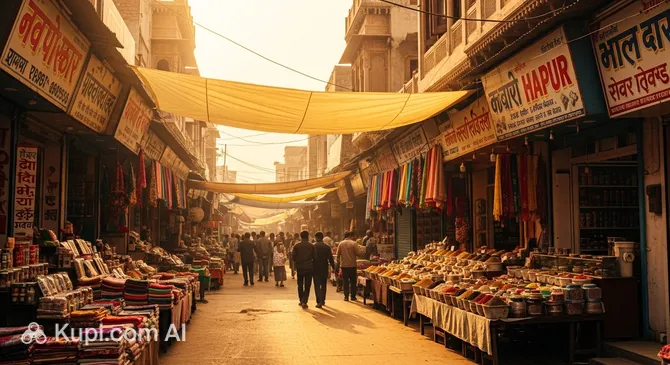
Located in the state of Uttar Pradesh, Hapur is a vibrant industrial and agricultural hub of India. The city is part of the National Capital Region and is situated just 60 kilometers east of New Delhi. Despite its proximity to the metropolis, it retains the atmosphere of a busy provincial town where modern production coexists with a traditional way of life.
Geographically, Hapur occupies a strategic position on the route between the capital and Lucknow. The city serves as the administrative center of the smallest district by area in the state, and its population is estimated to be rapidly approaching the 400,000 mark. The economic rhythm here is set by the trade of grain and jaggery (traditional unrefined sugar), as well as a powerful cluster for the production of stainless steel pipes.
Hapur. Illustration.
Source: Kupi.com AI
Interestingly, the rich past of Hapur dates back to the 10th century—it is believed to have been founded in 983 by Raja Hari Singh and was originally called Haripur, which translates to "place of many trees." Today, the city attracts tourists not so much with architectural delights as with its authenticity: it is a great opportunity to see the "real" working India, stroll through local markets, and observe the endless mustard fields in the outskirts.
We invite you to visit Hapur to feel the dynamics of Indian trade and the hospitality of the locals, as well as to try the country-famous crispy flatbreads—papads, which are considered the hallmark of this region.
Weather Overview
The climate in Hapur is classified as semi-arid and is characterized by pronounced seasonality. Residents and visitors to the city face extremely hot summers and fairly cool, dry winters. If you are planning a trip, it is important to consider the current weather in Hapur to choose the right wardrobe.
The hottest period occurs in May and June, when the thermometer often reaches +38°C...+40°C. From July to September, the monsoon season lasts: at this time, moderate to heavy rainfall occurs (up to 240 mm in July), which brings relative coolness but significantly increases humidity. Winter in Hapur is mild and comfortable: in December and January, the average daytime temperature is about +15°C...+19°C, but at night it can cool down to +7°C.
Expect a sultry summer with occasional dust storms and a humid monsoon season, followed by a sunny and dry winter. Due to the proximity to the Ganges River and active agriculture in the suburbs, winter months can be accompanied by thick morning fogs, which should be taken into account when planning car trips.
Average monthly temperature
Average monthly precipitation
Interesting Facts
Ancient Roots: The city was founded over a thousand years ago, in 983, under the name Haripur, which in Sanskrit means "place of many trees" or "forest region."
Record Compactness: The Hapur district is the smallest by area in the entire state of Uttar Pradesh, yet it has a high population density and significant economic importance.
Papad Capital: The city is widely known throughout India as the largest center for the production of papads—thin crispy flatbreads made from lentil flour, which are exported to many regions of the country.
Sweet Business: In addition to industry, Hapur is famous for its role in the trade of jaggery (traditional cane sugar), being one of the key distribution hubs for this product in northern India.
Strategic Crossroads: The major national highways NH-9 and NH-24 pass through the city, connecting the Indian capital, Delhi, with the state capital, Lucknow.
How to Get There
The transport accessibility of Hapur is due to its strategic position in the National Capital Region. The city is in close proximity to the country's main road arteries, making it a convenient transit point for travelers heading from Delhi to the east of Uttar Pradesh. Detailed information on how to plan a route to Hapur can be found in specialized transport guides.
The city does not have its own airport. The closest and most convenient international air hub is Indira Gandhi International Airport (DEL) in New Delhi. The journey from the airport terminals to Hapur by taxi or rented car takes an average of 2 to 3 hours depending on traffic, especially on busy sections of NH-24.
Railway communication is one of the most popular ways to get to the city. Hapur Junction station receives regular trains from Delhi, Lucknow, and Meerut. An express train journey from the capital takes about 1.5–2 hours, making this travel option very practical for tourists.
Station
Passenger traffic
Distance
Ghaziabad railway station
10
35 km
Anand Vihar Terminal
11
46 km
Hazrat Nizamuddin railway station
14
53 km
Delhi Junction railway station
11
54 km
New Delhi railway station
27
55 km
In addition, there is active bus service between Hapur and neighboring cities. Regular trips by the state transport company and private minibuses run to Delhi, Meerut, and Ghaziabad. However, keep in mind that public transport can be very crowded during peak hours.
Main Attractions
Since Hapur is primarily a major industrial and transit center, classic tourist routes are replaced here by an introduction to the local way of life and the region's economy. One of the main "attractions" of the city is its mustard fields, which during the flowering period paint the surroundings in bright yellow, creating a picturesque contrast with the industrial landscapes.
For those interested in culture and daily life, the central markets of Hapur are a must-visit. These are not just trading platforms, but real centers of life where you can see huge stocks of grain and traditional Indian sugar—jaggery. A walk through the narrow streets of the old quarters will allow you to appreciate the scale of production of the famous papads—crispy flatbreads that are made here by hand by entire families.
Although there are no monuments of global significance in the city itself, cozy Hindu temples reflecting the spiritual life of the local population can be found in its surroundings. For travelers, Hapur often becomes an interesting transit point on the way to larger cultural sites in Uttar Pradesh, offering basic amenities and the opportunity to see the unvarnished, hardworking side of Indian life.
Local Cuisine
The gastronomy of Hapur is the quintessence of Uttar Pradesh flavors, where the main role is given to vegetarian dishes and an abundance of spices. The absolute leader of local cuisine is the papad. These thin, crispy fried flatbreads made from lentil or chickpea flour are made here with special skill, adding black pepper, cumin, or chili.
Sweet lovers should try dishes using local jaggery—unrefined palm or cane sugar. It is added to porridges, desserts, and even consumed in its pure form. A characteristic addition to the meal are mustard-based dishes, as mustard is grown in abundance in the surrounding fields, and various types of dal (thick legume soups) served with hot roti flatbreads.
Food culture in Hapur is closely linked to street food. You can always find fresh samosas (pastries with potatoes and peas) and various chaats—savory snacks that awaken the appetite—at markets and by the roads. The traditional drink that no day goes without is hot masala chai with spices and milk, while in hot weather, locals prefer cooling lassi.
The city's restaurant scene is mainly represented by affordable "dhabas" along the highway and small cafes in commercial zones. Home-cooked taste and freshness of products are valued here, and lunch in the company of local traders at one of the bazaars will allow you to truly feel the culinary soul of the region.
Travel Tips
Welcome to Hapur! To ensure your trip to this industrial center of India is as comfortable as possible and brings only positive emotions, we have prepared a list of practical recommendations.
Clothing and Essentials: Choose light clothing made from natural fabrics, as summers in Hapur can be very hot. Given the industrial nature of the city and road dust, wearing a protective mask during the dry season will not be redundant. Comfortable closed shoes are essential for walking through the markets.
Transport: The fastest way to move around the city is by auto-rickshaws. Always agree on the price of the trip in advance, as meters are rarely used. For long-distance trips to Delhi or Meerut, it is better to choose the train.
Finances: Hapur is a city of cash. International cards are accepted only in large hotels. Have a sufficient supply of Indian Rupees in small denominations for paying rickshaws and making purchases at markets.
Health and Safety: Drink only bottled water from well-known brands. Avoid walking in sparsely populated outskirts and slum areas after dark, sticking to well-lit central streets.
Communication: The main language here is Hindi. English is limited, mostly among hotel staff. We recommend learning a few basic phrases in Hindi or using an offline translator.
Local Etiquette: It is customary to remove your shoes when entering private homes or small local shops. Greet locals with the traditional Namaste gesture—this always earns goodwill.
What to Avoid: You should not take photos of industrial facilities or people without their explicit consent. Also, refrain from eating street food that has not been heat-treated in front of your eyes.
Special Tip: If you find yourself in Hapur during the winter months, be sure to head out of town to see the blooming mustard fields—it is one of the most beautiful sights in the region.
May your introduction to Hapur be interesting and safe—this city will reveal to you the real, hardworking India!
Entertainment & Nightlife
Due to its status as an industrial city, Hapur does not have an extensive network of entertainment venues typical of major tourist centers. Nightlife here is quite quiet and is mainly focused on evening walks by locals through the shopping districts and visits to small eateries.
The main center of attraction in the evening is the street markets along the main roads and the NH-24 national highway. Here you can find lively cafes and tea stalls where people gather for leisurely conversations. The atmosphere of these places is democratic: no special dress code is required, and the average prices will pleasantly surprise the budget traveler.
If you are looking for more modern entertainment, such as cinemas, large shopping malls, or nightclubs, locals recommend heading to the neighboring cities of Ghaziabad or New Delhi, which are about an hour to an hour and a half away. Daytime leisure in Hapur itself is limited to visiting local parks or walking among the agricultural land in the suburbs.
To ensure safety in the evening, it is recommended to stick to central illuminated streets and use official taxis or trusted auto-rickshaw hailing services. Hapur is a city that wakes up early and goes to sleep early, following the working rhythm of its factories and markets.
Parks & Museums
The urban landscape of Hapur reflects its industrial and agricultural focus, so there are few classic parks and museums here. Unlike major cultural centers, the role of "green zones" in Hapur is often played by the vast agricultural fields surrounding the city. Walking along mustard plantations in winter is the best that nature can offer guests of the city.
There are currently no specialized museums in Hapur itself; however, local markets and old quarters, where craft traditions are passed from generation to generation, serve as keepers of history. The city's name itself, derived from the ancient Haripur ("place of forests"), recalls the times when this region was much greener.
City residents usually head to neighboring Delhi or Meerut for cultural leisure and large park complexes. Nevertheless, small municipal squares within Hapur serve as resting places for citizens after a working day, offering a simple and cozy atmosphere for a brief respite from the hustle and bustle of busy shopping streets.
Getting Around
The transport system in Hapur is typical of the dynamically developing cities of Uttar Pradesh. The main means of transportation for locals and tourists within the city are auto-rickshaws and cycle-rickshaws. They are ideal for navigating the narrow streets of shopping districts and residential areas where traffic can be extremely chaotic.
For travel between districts and to neighboring settlements, local buses are widely used. They run regularly, but tourists should be prepared for the lack of air conditioning and significant crowding during peak hours. The cost of travel on public transport remains very low, and payment is made in cash to the conductor or driver.
The Hapur Junction railway station is a vital transport hub connecting the city with key points in the country. If you are planning a trip to Delhi or Meerut, the train often turns out to be the fastest and most predictable option, allowing you to avoid traffic jams on the NH-9 and NH-24 highways.
For more comfortable movement, it is recommended to use taxi services or call a car through mobile apps (if they are available in the region). When planning trips around Hapur, always allow extra time for possible congestion caused by active freight traffic and the peculiarities of local driving.
Accommodation
The housing market in Hapur is primarily aimed at business travelers, industrial specialists, and transit passengers. You won't find luxury five-star complexes here, but there is a decent selection of budget guest houses and mid-range hotels.
Most convenient accommodation options are concentrated along National Highway 24 (NH-24) and near the central shopping areas. Staying near the highway is convenient for those planning a short stop on the way to Lucknow or returning to Delhi. These hotels usually offer basic amenities: air conditioning, Wi-Fi, and breakfast.
If you are planning a longer stay, you might consider renting apartments in modern residential blocks. Housing prices in Hapur are significantly lower than in neighboring Delhi, making it an attractive place for budget-conscious travelers. However, it is recommended to book your room in advance through popular online services, especially if your trip coincides with major religious holidays or trade fairs.
Nearby Cities
Thanks to its location in the center of a densely populated region, Hapur can serve as a convenient starting point for exploring nearby cities and cultural centers of the state. A developed road network allows for interesting day trips, returning by evening.
Just 30 kilometers away is Meerut—an ancient city with a rich history, known as the starting point of the 1857 Indian Rebellion. It is worth visiting the memorials and ancient temples here. Another important destination is Ghaziabad, a major industrial center where you can find modern shopping malls and amusement parks for family fun.
For more peaceful walks, the small town of Pilkhua, located just 12 kilometers away, is suitable. It is famous for its textile production and traditional fabrics. All these cities are easily accessible by commuter trains or buses running throughout the day.
Exploring the surroundings of Hapur will help you better understand the versatility of northern India, where industrial giants neighbor quiet craft settlements and historical monuments.
Shopping & Souvenirs
Shopping in Hapur is primarily about visiting traditional Indian bazaars, where trade in locally produced goods is in full swing. The city is not geared towards luxury brands but offers a unique experience of buying authentic products for which this region is famous.
The central markets located near National Highway 24 (NH-24) are considered the main shopping area. Here you should pay attention to stainless steel products: Hapur is a major manufacturer of steel pipes and kitchen utensils, which can be purchased at very favorable prices. The city is also known for its textiles, which are brought from neighboring Pilkhua.
As edible souvenirs, be sure to bring back the famous Hapur papads. At local markets, many types of these flatbreads with different spices are presented. An equally valuable purchase will be natural jaggery (cane sugar), which is sold here in various forms and is considered one of the best in quality in northern India.
Shops in Hapur are usually open from morning until late evening, though Sunday may be a day off in some areas. Most stalls in the markets only accept cash (Indian Rupees), although larger stores and hotels are beginning to implement electronic payments. Don't forget to bargain—in local bazaars, it is an integral part of the communication culture.