Support

Main Guard Gate

About

The Main Guard Gate is a significant historical structure located in the city of Tiruchirappalli, in the South Indian state of Tamil Nadu, India. These gates serve as silent witnesses to the region's rich past and attract those interested in history and architecture.
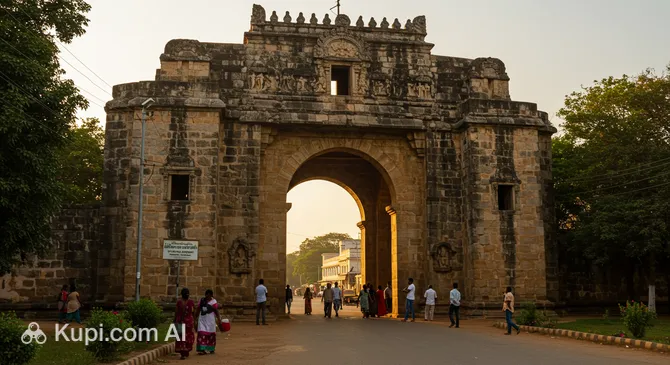
Main Guard Gate. Illustration.
Source: Kupi.com AI

Traveler photos:

The guard gates, also known as the Main Guard Gate, played an important role in the history of Tiruchirappalli, which was once a major power center. They were presumably part of the defensive or palatial structures associated with the palace of the Nawab of Arcot, whose residence was located in this very city.

The history of the city of Tiruchirappalli, also known as Trichy, is eventful. In the 1770s, it was at the center of complex political games and power struggles between three powerful forces: the British government in Madras, the Nawab of Arcot, and the King of Thanjavur. The Main Guard Gate witnessed these turbulent times when the city played a key strategic role in regional politics.

A visit to the Main Guard Gate allows you to touch a bygone era and better understand the historical significance of Tiruchirappalli. This place will be of particular interest to travelers seeking to explore the lesser-known but historically rich corners of India.

Contacts

To find the most current information about visiting the Main Guard Gate, including opening hours and access conditions, we recommend contacting the tourist information centers in the city of Tiruchirappalli or checking official tourism websites. As a rule, historical sites like this do not have a dedicated contact service, and all information is provided as part of the general tourism infrastructure.

How to contactContact
AddressRMGV+J8X, NSB Rd, Theppakulam, Tiruchirappalli, Tamil Nadu 620008, India

What to Do

Visiting the Main Guard Gate in the city of Tiruchirappalli is a unique opportunity to connect with the history of India during the colonial period. Once here, you can closely examine the architectural details of the structure, which are a striking example of the style of that era. A walk around the gate and the surrounding area will allow you to better imagine the important defensive and administrative role it played in the city's past.

This site is of particular interest to those fascinated by the history of India, especially the period when various political forces were vying for influence in the region. By studying the Main Guard Gate, visitors can gain a deeper understanding of the historical context and significance of this monument. It is not just an ancient building, but a silent witness to significant events that unfolded on this land.

Touring the Main Guard Gate can serve as an excellent starting point for further exploration of Tiruchirappalli and its surroundings. The city itself is known for its rich cultural heritage, numerous ancient temples, and other historical monuments. Many of these are linked to the reign of the powerful Chola dynasty, making Tiruchirappalli a true find for curious travelers.

Getting There

The city of Tiruchirappalli, where the Main Guard Gate is located, boasts a well-developed transport infrastructure, making it easily accessible for travelers. You can arrive by air: Tiruchirappalli International Airport accepts flights from major cities in India and several international destinations. An alternative way to reach the city is by rail. Tiruchirappalli is an important railway junction in South India, with trains connecting it to metropolises such as Chennai, Bangalore, and Coimbatore.

The Main Guard Gate itself is located in the central part of Tiruchirappalli, so reaching it is quite simple. Within the city, you can get around using local buses, colorful auto-rickshaws, or more comfortable taxis. Thanks to its convenient location, the journey from your hotel or any other point in the city to this landmark will be quick and easy.

Nearest city: Tiruchirappalli

History & Facts

The Main Guard Gate in Tiruchirappalli is more than just an architectural structure; it is a silent witness to the city's rich and turbulent history. Historically, Tiruchirappalli held a position as an important power center in South India. It was through gates like the Main Guard Gate that key routes passed and entries and exits were controlled, which was particularly vital during periods of political instability.

A particularly tense period for the city occurred in the 1770s, when Tiruchirappalli found itself at the epicenter of complex relations between three powerful forces: the British government in Madras, the Nawab of Arcot, and the Raja of Thanjavur. In 1773, an alliance between the Nawab of Arcot and the British led to the storming of Thanjavur and the capture of its ruler. During such times, the city's defensive structures, including the Main Guard Gate, played a paramount role in ensuring security and control over the strategically important Tiruchirappalli.

Against the backdrop of these military and political events in the region, the Christian missionary Christian F. Schwartz was actively working. When the storming of Thanjavur by the Nawab's forces brought suffering to many, Schwartz organized aid for those affected, striving to alleviate their plight. His humanitarian activities helped stabilize the situation, especially during periods of famine and unrest that often accompanied the military conflicts witnessed by the walls of the Main Guard Gate.

The historical roots of Tiruchirappalli go even deeper, back to the times of the powerful Chola dynasty, which ruled from neighboring Thanjavur. The first period of Chola rule, which began in 850 AD with Vijayalaya Chola establishing power in Thanjavur, laid the foundation for the region's centuries-long history as a significant political and cultural center. It is likely that the traditions of fortification construction were already being established then—precursors to structures like the Main Guard Gate that protected the city for centuries.

Time Needed

To visit the Main Guard Gate in the city of Tiruchirappalli, a traveler usually needs about 1-2 hours. This time is generally sufficient to leisurely explore the structure, appreciate its architectural features, and immerse yourself in the historical context of the site. During this period, you can take photos and feel the atmosphere of one of the city's iconic landmarks.

If your visit to the Main Guard Gate is part of a more extensive sightseeing program in Tiruchirappalli, it is worth noting that the city is rich in other interesting sites. In that case, to fully explore the city's main attractions, including the gate, it is recommended to set aside a whole day. This will allow you to move between sites without rushing and give each of them the attention they deserve.

Working Hours

Precise information regarding the opening hours of the "Main Guard Gate" attraction in Tiruchirappalli is currently unavailable. There is also no data on the need for advance ticket booking or registration for a visit.

To obtain the most up-to-date information on the schedule, possible seasonal changes, and visiting conditions, it is recommended to consult the official website of the "Main Guard Gate" (if one exists) or check details at local tourist information centers just before your planned trip to India.

Open 24 hours

Nearby

Visiting the Main Guard Gate is undoubtedly a memorable experience, but your introduction to Tiruchirappalli would be incomplete without exploring what lies nearby. Often, it is small walks to neighboring sites that allow for a deeper immersion into the city's atmosphere and the discovery of its hidden gems.

By expanding your itinerary, you can not only see more but also better understand the cultural and historical context of the Main Guard Gate. Nearby attractions—whether temples, markets, or interesting architectural structures—will complement your impressions and make your trip to Tiruchirappalli even more rewarding.

NameDistance
Pothys0.1 km
Our Lady of Lourdes Church0.1 km
Dodo Money Changer0.2 km
Shri Sangeethas Vegetarian Restaurant0.3 km
Hotel Deepam0.3 km
Thayumanavar Temple0.4 km
Uchi Pillaiyar Temple0.5 km

Have you reached the end of the page?

So the route has been studied inside and out