Support

Kujang Monument

About

The Kujang Monument (Monumen Kujang) is one of the most recognizable and significant symbols of the city of Bogor, located in Indonesia. This majestic 25-meter obelisk-shaped sculpture rises above a busy intersection and immediately draws attention with its unusual form. The monument is not just a decoration but an important cultural landmark reflecting the spirit and history of the region.
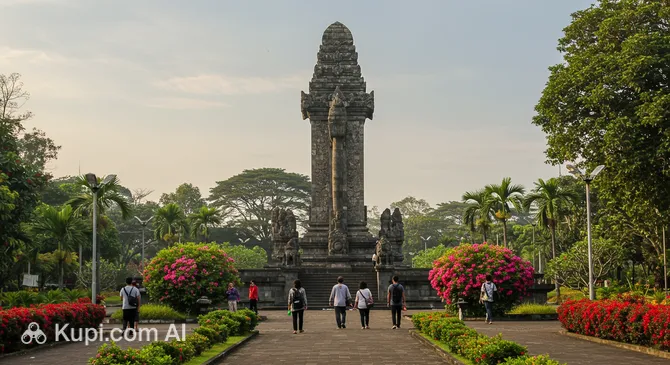
Kujang Monument. Illustration.
Source: Kupi.com AI

Traveler photos:

The monument is a giant version of the kujang—the traditional weapon of the Sundanese people who inhabit the western part of Java. This blade with its characteristic curve holds deep symbolic meaning for locals and was historically used for both agriculture and protection. The installation of the monument in 1982 was a tribute to the rich heritage and identity of Sundanese culture.

Today, the Kujang Monument is considered an iconic structure and a true landmark of the city. It embodies the pride of the residents of Bogor and all of West Java, serving as a reminder of their unique cultural heritage. For tourists, it is not only a great backdrop for photos but also an opportunity to touch the history of Pasundan—the ancient Sundanese kingdom whose capital was once located on these lands.

Contacts

Since the Kujang Monument is an open-air public monument, it has no specific contact details such as a phone number or an official website. Reaching it is very easy: it is located in the very heart of Bogor at a busy intersection near the entrance to the Botanical Gardens. Access to the monument is open 24 hours a day, allowing you to view it at any time that suits you.

How to contactContact
AddressJalan Raya Pajajaran Baranangsiang Bogor Timur, 9RX4+C2G, Tegallega, Kecamatan Bogor Tengah, Kota Bogor, Jawa Barat 16143, Indonesia

What to Do

Visiting the Kujang Monument is a wonderful opportunity to learn about the cultural heritage of the Sundanese people, for whom this monument is an important symbol. The main activity here is, of course, taking memorable photos against the backdrop of the majestic sculpture, which is especially striking in the evening thanks to the lighting. Additionally, the area around the monument often serves as a venue for various city events and cultural festivals. If you're lucky, you can immerse yourself in the atmosphere of local traditions by watching performances or visiting a themed fair.

Thanks to its central location, viewing the monument is convenient to combine with a walk to other iconic sites in Bogor. Just a stone's throw away is the city's main gem—the famous Bogor Botanical Gardens. This is a place with a rich history, founded back in the colonial era when the city, then named Buitenzorg, served as the summer residence of the Governor-General of the Dutch East Indies. Thus, a visit to the Kujang Monument becomes not just a tour of one attraction, but a starting point for a fascinating journey through the history and culture of all of Indonesia.

Getting There

The Kujang Monument is located in the city of Bogor, which is conveniently situated about 60 kilometers south of Jakarta, the capital of Indonesia. Getting here is easy. One of the most popular and reliable ways is the train, which runs regularly between Jakarta and Bogor. The train ride takes about 1–1.5 hours, allowing you to avoid the capital's traffic jams. You can also take a bus or order a taxi, though in this case, travel time can vary significantly depending on road conditions.

Upon arrival in Bogor, you can reach the Kujang Monument itself using local transport. At your service are angkots (local shared taxis), exotic bechaks (cycle rickshaws), or regular taxis, including those ordered through online apps. Since the monument is located in the heart of the city, many travelers prefer to reach it on foot. Bogor's center is quite compact, so a walk from your hotel or another attraction can be a pleasant part of exploring the city.

Nearest city: Bogor

History & Facts

The history of the Kujang Monument is closely linked to the events Indonesia experienced after declaring its independence on August 17, 1945. Shortly thereafter, the city of Bogor, like many other areas, found itself at the center of political changes. It came under the control of the returning Dutch, marking the start of a challenging period in determining the region's future.

In February 1948, Bogor was included in the quasi-independent State of West Java, which was renamed the State of Pasundan a few months later. This entity was established with the involvement of the Netherlands government. However, by December 1949, Pasundan joined the United States of Indonesia, and in February 1950, Bogor officially became part of the unitary Republic of Indonesia.

It was in memory of these complex times and to assert cultural identity that the Kujang Monument was erected. It became more than just an architectural object; it is a powerful symbol of cultural identity and the rich heritage of the Sundanese people who inhabit West Java. The choice of form is not accidental: the kujang—the traditional weapon of the Sundanese—represents their pride, resilience, and deep historical roots, serving as a reminder of the importance of preserving their unique heritage for future generations.

Time Needed

Viewing the Kujang Monument usually doesn't take much time. For most travelers, 30 to 60 minutes is quite sufficient. This is enough time to leisurely examine the monument itself, take impressive photos, and learn about its cultural significance to the region. Since the monument is a publicly accessible open-air site, visiting it can easily fit into even the busiest city walking schedule.

If you plan a deeper dive into local culture, it's worth setting aside more time. The area around the monument often serves as a venue for various events, and if you're lucky enough to catch one, the experience will be much more memorable. Additionally, a visit to the monument is convenient to combine with other attractions in Bogor, such as the nearby Botanical Gardens. In this case, your walk through this area could take several hours.

Working Hours

Since the Kujang Monument is a public open-air monument, it is accessible 24 hours a day, year-round. It has no specific operating hours, and no tickets or advance bookings are required to view it—entry is absolutely free. You can approach the monument at any time convenient for you, whether day or night, to admire its grandeur and take photos.

The evening hours deserve special attention, when the lighting turns on, making the monument even more impressive against the Bogor night sky. As it is a freely accessible attraction, no special preparations are needed—simply arrive and enjoy the view of one of the primary symbols of Indonesia.

Open 24 hours

Nearby

Visiting the Kujang Monument is an excellent starting point for exploring Bogor, but to truly feel the atmosphere of this amazing city, it is worth exploring the surrounding areas. Thanks to the monument's central location, many other interesting sites are literally just a few minutes' walk away. This makes it easy to create a busy full-day itinerary without needing transportation.

Walking to nearby attractions will enrich your experience, showing different facets of Bogor—from its rich colonial history and lush tropical nature to modern urban life. Below is a list of places located right next to the Kujang Monument that are worth including in your plan.

NameDistance
Botani Square Mall0.2 km
Bogor Botanical Gardens0.7 km
Gunting Lake, Bogor Botanical Gardens0.8 km
Museum of Zoology0.9 km
MidEast Shisha & Lounge1.1 km
Indonesian Museum of Ethnobotany1.2 km
Balai Kirti Presidential Museum1.2 km

Have you reached the end of the page?

So the route has been studied inside and out