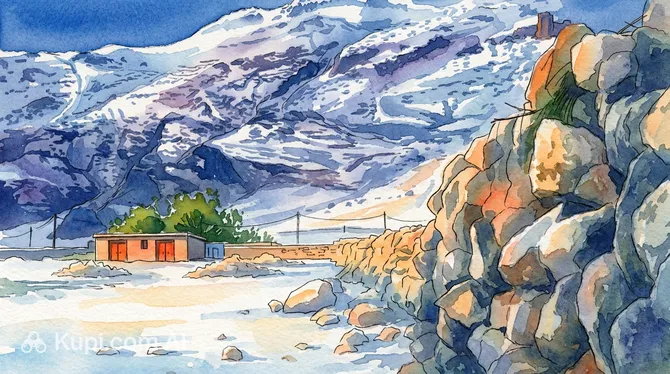
Located in the picturesque region of Yazd Province, Golmeh is a quiet and authentic settlement where you can feel the true spirit of central Iran. This corner attracts travelers seeking to escape the noise of large metropolises and immerse themselves in an atmosphere of peace and the traditional way of life characteristic of this arid but beautiful land.
Golmeh. Illustration.
Source: Kupi.com AI
Geographically, Golmeh is situated in an area where desert landscapes meet the foothills. According to research, the history of this region is inextricably linked with the development of ancient trade routes passing through Yazd. The small population contributes to the preservation of a unique atmosphere of solitude, where every guest is treated as a long-awaited friend.
One of the main features of the settlement is its traditional architecture and proximity to stunning natural landscapes. There are no large industrial facilities here, which guarantees fresh air and a clear starry sky at night. Tourists choose this place for hiking and the opportunity to see the real, non-touristic everyday life of the Iranian hinterland.
A visit to Golmeh is an invitation to peaceful contemplation and an introduction to a culture that has adapted to its environmental conditions over centuries. If you are looking for a place to reset and find inspiration, this modest but hospitable corner will be a true discovery for you.
Weather Overview
The climate in Golmeh is characterized as semi-desert continental, which is largely determined by its geographical position. This area is known for truly hot and dry summers, when average July temperatures reach +30.7°C, and cold winters with frosts down to 0°C and below. Such a contrast in temperatures requires travelers to carefully select their wardrobe depending on the season.
The bulk of precipitation falls in the winter months and early spring, while the summer period remains practically arid. The most comfortable times to visit are April and May, as well as October, when the weather is mild. Detailed weather in Golmeh will help you plan your trip to fully enjoy the beauty of the region without extreme temperatures.
Average monthly temperature
Average monthly precipitation
Interesting Facts
The settlement of Golmeh holds several curious features that reveal its modest but characteristic nature. Despite its small size, this place is an interesting example of preserving traditions in a changing world.
According to 2006 statistics, the population of this place was exactly 307 people, making it one of the most intimate and quiet settlements in its district.
The region around Golmeh is historically linked to the activities of nomadic tribes, whose way of life is still reflected today in local animal husbandry and crafts.
The settlement's location is characterized by a unique relief where traditional farming coexists with harsh mountain or desert landscapes that dictate the rhythm of life for the population.
Although international aviation directories sometimes attribute the code HDR to this area, Golmeh remains a place as far as possible from major transport hubs, preserving its pristine silence.
How to Get There
The transport accessibility of Golmeh reflects its secluded rural status: there are no direct flights or major railway lines leading directly to the settlement. Traveling here requires prior planning but rewards tourists with picturesque views along the way. The primary way to get here is by flying into one of the major regional hubs followed by a car journey.
The nearest significant airport often used for transit to this region is Kermanshah International Airport (IATA: KSH). It is located at a considerable distance, and the drive from there by car can take several hours along regional highways. The airport handles regular domestic flights, connecting the province with Tehran and other major cities in the country.
There is no direct rail service to the settlement. Those who prefer trains will have to travel to the nearest junction stations in neighboring provinces and then continue their journey by intercity buses or taxis. Due to the specific terrain, road transport remains the most reliable and flexible option for visiting these parts.
Station
Passenger traffic
Distance
Yazd Railway Station
2
88 km
Isfahan Railway Station
6
188 km
Isfahan Railway Station
6
188 km
Kashan railway station
3
269 km
Main Attractions
The main treasure of Golmeh is not grand architecture, but the surrounding nature and the unhurried pace of life. There are no typical tourist museums here, but the settlement itself serves as a living backdrop to the history of central Iran. Travelers value this place for the opportunity to see majestic landscapes in all their wild beauty.
One of the points of attraction is the local central square, where residents gather in the evenings. This is the best place to observe social interactions and feel the community spirit. Also of interest are the hills and pastures surrounding the settlement, which are ideal for light trekking and photo hunting for panoramic views.
For those seeking cultural immersion, a visit to the local chaikhanas (teahouses) is a must. In these modest establishments, over a cup of aromatic tea, you can hear stories about life in this region. Despite the absence of famous landmarks, every house in Golmeh, with its traditional masonry and garden, is part of the region's unique cultural landscape.
Local Cuisine
The gastronomy of Golmeh is based on the traditions of regional cuisine, which is famous for its heartiness and the use of natural products. The diet's foundation consists of dishes made from lamb, legumes, and aromatic herbs. One of the signature treats worth trying is kelele—a traditional dish of stewed meat with rice, prepared according to ancient recipes.
Also popular are thick, rich soups such as ash with added chickpeas, and meat and vegetable stews like doyu-ju. The local bread, baked in tanour ovens, has a unique taste and aroma. For drinks, residents prefer strong black tea and refreshing dough (a fermented milk drink with mint), which is excellent for enduring the heat.
The dining culture here is home-style, as classic restaurants are non-existent. Visitors usually dine in small teahouses or by invitation from local residents. In the markets of neighboring districts, you can purchase fresh mountain honey and homemade cheese. It is important to remember that alcohol is strictly prohibited in the region in accordance with national regulations.
Travel Tips
Visiting Golmeh will be a unique experience of immersion into the Iranian heartland if you consider a few practical nuances in advance.
Clothing and belongings: Choose modest and covered clothing in accordance with local traditions. For walks in the surroundings, comfortable closed shoes are mandatory, and in summer, a hat and sunscreen will come in handy.
Transport: The best way to get around is by renting a car or using private drivers. Public transport is rare, so mobility depends on having a car.
Finances: Be sure to have a supply of cash Iranian rials with you. International cards do not work here, and ATMs can only be found in large cities.
Health and Safety: The crime rate here is extremely low, but be careful when walking in the mountains at dusk. It is better to bring a basic first-aid kit with you.
Communication: English is almost not spoken in the settlement. Learn a few basic phrases in Persian or use offline dictionaries to communicate with residents.
Local Etiquette: It is customary to remove your shoes when entering homes. Be prepared for sincere hospitality and polite curiosity from the locals.
What to avoid: Do not photograph people (especially women) without their consent and avoid discussing political topics.
Additional advice: Stock up on drinking water and necessary small items in advance, as the range in local shops is very limited.
Your respect for local customs and thorough preparation will make this visit truly warm and memorable.
Entertainment & Nightlife
Traditional nightlife in its classic sense—with clubs and noisy bars—is completely absent in Golmeh. After sunset, the settlement sinks into silence, and the local teahouses remain the main centers of social activity. Here, residents spend time in long conversations, playing backgammon, and traditional tea drinking, creating an atmosphere of home comfort and peace.
If you desire more diverse entertainment, it is worth heading to the nearest major cities, where you can find modern cafes and cultural venues. However, most guests of Golmeh prefer night walks under the open sky. Thanks to the lack of strong urban lighting, the sky over the settlement is scattered with incredibly bright stars, making it an ideal place for astronomy enthusiasts.
Daytime entertainment focuses on outdoor activities. Walking in the surrounding hills, picnics, and getting to know rural life are what travelers come here for. From time to time, local festivals or weddings may take place in the village, which are celebrated on a large scale but within strict traditional rules and without alcohol.
Parks & Museums
In Golmeh, you won't find the usual city parks with paved paths or state museums. Nature itself serves as the recreation area here: the endless mountain meadows and picturesque hills surrounding the settlement provide natural spaces for walking. Every slope here offers breathtaking panoramas, which are valued by lovers of silence and photography.
There are no museums in the classic sense in the village; however, the daily life of the locals is a living ethnographic exhibition in itself. The architecture of the houses, tools for working the land, and everyday objects can tell more about the region's culture than any exhibition. For organized museum visits, travelers are recommended to head to Ilam or Yazd, where serious archaeological collections are presented.
The outskirts of the settlement are actively used by residents for picnics, which are an important part of the local culture. The absence of formal cultural institutions here is fully compensated for by the richness of the landscapes, allowing tourists to feel like explorers of wild and untouched corners of nature where time seems to have stood still.
Getting Around
The public transport system in Golmeh is minimal, which is typical for small rural settlements. Within the village itself, which consists of a few streets, residents move mainly on foot or by motorcycle. This creates a peaceful atmosphere without unnecessary noise and exhaust fumes, allowing you to enjoy the silence of the surrounding nature.
Connection with the nearest district center, Chardavol, is maintained by occasional minibuses that run once or twice a day. Fare is paid in cash to the driver, and the cost of the trip is very small. However, it should be noted that the schedule may change, so tourists are better off checking departure times with locals in advance.
For comfortable travel around the region and visiting attractions, tourists are strongly recommended to use a private car or hire a taxi. Given the mountainous or desert terrain of the roads, renting an off-road vehicle will be the optimal solution. Bicycle rental is not developed in this area, and car sharing is non-existent, so a traveler's mobility largely depends on having their own transport.
Accommodation
The hospitality industry in Golmeh is not represented by official hotels or chain guest houses, as the settlement is not a mass tourist destination. Travelers who decide to stay overnight often have to rely on the sincere hospitality of local residents or look for private accommodation options in the nearest large centers in advance.
More formal accommodation options, such as guesthouses and mid-range hotels, can be found in the district center of Chardavol or in the provincial capital. There, both budget apartments and quite comfortable rooms are available. It is recommended to book such accommodation in advance during the high season (spring and early autumn) through specialized services or local operators.
For those planning a long-term stay, it is possible to rent accommodation from local farmers, though such arrangements are usually made on the spot. Given the lack of standard infrastructure, Golmeh is ideal for a day visit from larger cities where the choice of accommodation is significantly wider and more diverse.
Nearby Cities
The settlement of Golmeh serves as an excellent starting point for exploring central and western regions, offering tourists the chance to see the contrast between the silence of a small village and the rich history of neighboring cities. Exploring the surroundings will allow you to form a complete picture of the diversity of the Iranian province.
Just 33 kilometers away lies the ancient city of Ardakan, known for its unique desert architecture and traditions. Here you can see old buildings and try local sweets. No less interesting is Meybod, located 36 kilometers away. This city impresses with its historical fortresses and ancient yakhchals (ice houses) that have survived to this day.
It is also worth visiting Ashkezar, located about 68 kilometers away. This city attracts visitors with its bazaars and the opportunity to get acquainted with traditional crafts. Each of these destinations is easily accessible for a day trip, making your stay in the region more fulfilling and interesting.
City
Population
Distance
Ardakan
75 271
33 km
Meybod
80 712
36 km
Ashkezar
19 123
68 km
Zarch
11 691
71 km
Shahediyeh
18 309
77 km
The region around Golmeh is full of hidden treasures, and every trip to neighboring cities will reveal new facets of this amazing land. Don't miss the chance to expand your itinerary and see the architectural masterpieces of ancient Iran.
Shopping & Souvenirs
Shopping in Golmeh is purely local and practical in nature, which gives purchases a special flair. There are no shopping centers or brand stores, but there is a small local market where you can buy the freshest farm products. This is the ideal place to buy homemade cheese, meat, seasonal vegetables, and fruits grown in environmentally friendly conditions.
If you are looking for authentic souvenirs, pay attention to the products of local craftsmen. The region is famous for its handmade carpets, as well as collections of medicinal mountain herbs and natural honey. For a wider selection of goods and gifts, it is better to go to the bazaars of the nearest large cities, such as Chardavol or Ilam, where trade is bustling from early morning.
Shops in Golmeh usually operate on a traditional schedule with a siesta break in the middle of the day. Payment is accepted exclusively in cash rials, so tourists need to take care of exchanging money in advance. Despite its simplicity, the shopping process here is always accompanied by friendly conversation with sellers, making it part of the cultural experience.