Support

Wakkanai Airport

About the Airport

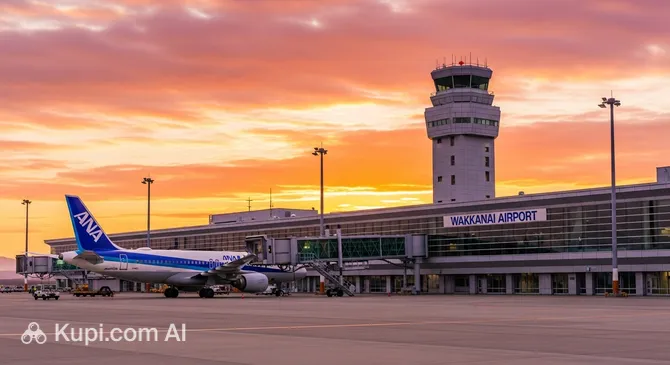
Wakkanai Airport. Source: Kupi.com Binoculars

Welcome to Wakkanai Airport (WKJ) — the northernmost air gateway of Japan capable of handling jet aircraft. This compact and cozy airport serves as the starting point for exploring the rugged yet breathtaking beauty of Hokkaido Island. Located on the shores of the Sea of Okhotsk, it offers travellers not just a flight, but a true immersion into the atmosphere of the country's northern edge from the very first minutes of arrival. It is from here that journeys begin to Cape Soya, the northernmost point of Japan, and to the picturesque Rishiri and Rebun islands.

IATA Code WKJ
ICAO Code RJCW
City Wakkanai
Distance to Centre approx. 10-13 km
Status Domestic
Annual Passengers approx. 147,700 (based on 2022 data)
Popular Airlines All Nippon Airways, Japan Airlines
Schedule Online Board "Wakkanai Airport"

Despite its modest size, Wakkanai Airport possesses everything necessary for passenger comfort. The three-storey terminal, built in 1998, includes departure and arrival zones, one boarding bridge, and several boarding gates. The ground floor houses check-in counters and car rental desks, while the first floor features a waiting lounge and souvenir shops where you can purchase local delicacies. One of the highlights is the observation deck on the second floor, offering views of the runway and the surrounding landscapes. Due to harsh winter conditions with strong winds and heavy snowfall, the airport is occasionally closed, and flights may be diverted to Asahikawa, so it is always advisable to check flight status during the cold season.

Contact Information

For your convenience, we have compiled the main contact information for Wakkanai Airport (WKJ). If you have any questions, we recommend reaching out via the contacts listed below.

  • Official Website: Generally, the most up-to-date information regarding flights, services, and regulations can be found on the airport's official website. Visit http://www.wkj-airport.jp/ for detailed details.
  • Information Desk Phone: For immediate information, you can call the airport management office at: +81 162-26-2080.
  • Airport Address: Koetoi, Wakkanai, Hokkaido 098-6642, Japan.
  • Email: A dedicated email address for general passenger inquiries is not provided. It is recommended to use the telephone for communication.
  • Social Media: At present, Wakkanai Airport does not have official pages on popular social networks. The official website remains the primary source of information.
  • Lost Luggage Information: Matters regarding lost or damaged baggage are handled directly by the airlines. Please contact the representative office of your carrier (e.g., ANA) at the airport.
  • Passenger Support: For general questions related to your stay at the airport, you may contact the main information desk phone number.

Getting to the Airport

Getting to Wakkanai Airport from the centre of the city of Wakkanai and back can be done in several convenient ways. The choice depends on your budget, time, and comfort preferences.

The most popular and economical option is the Soya Bus shuttle. The route connects the airport with key points in the city, including JR Wakkanai Station and the ferry terminal. The journey takes approximately 30–35 minutes, and the fare is around 600 yen. An important feature: the bus schedule is usually coordinated with flight arrival and departure times, making this method very convenient for air passengers.

For those who value speed and comfort, taxis are always available. A trip from the city centre to the airport will take about 20–25 minutes. This is the fastest method, though also the most expensive — be prepared to pay between 4000 and 5000 yen. A taxi is an excellent choice for small groups or travellers with a large amount of luggage. You can also book a private transfer in advance.

If you plan to explore the surroundings, for example, visiting Cape Soya, the best solution would be car rental. Several rental company offices operate at Wakkanai Airport. To drive in Japan, most international tourists will require an International Driving Permit (IDP). For those arriving at the airport in their own vehicle, paid parking is provided with zones for short-term and long-term stays.

Terminals and Map

Wakkanai Airport (WKJ) is a small and very easy-to-navigate aviation hub consisting of one compact terminal. This two-storey building serves all domestic flights — both arrivals and departures — which completely eliminates confusion and the need to move between different buildings.

The structure of the terminal is intuitive. On the ground floor, you will find airline check-in counters, the arrivals area with baggage claim belts, an information centre, as well as car rental desks and bus ticket counters. The entire process upon arrival — from disembarking the aircraft to retrieving your suitcase and exiting the building — takes minimal time.

On the first floor (second floor in US terms), the departure zone is located. After checking in on the ground floor, passengers proceed up here to pass through security screening. Beyond the security checkpoint lies a small waiting lounge with boarding gates. Also on this floor, you will find several souvenir shops where you can buy famous local delicacies, and a restaurant overlooking the runway. One of the airport's features is the observation deck, which offers beautiful views in clear weather.

Thanks to the modest size of the airport, completing all formalities, including flight check-in and security screening, is very quick. As a rule, this takes no more than 15-20 minutes. Nevertheless, it is recommended to arrive at the airport approximately one hour before departure. Navigation through the terminal is extremely simple: there are signs in Japanese and English everywhere, and getting lost here is practically impossible. All key zones are within walking distance of each other, making your journey as comfortable and predictable as possible.

Airport History

Wakkanai Airport (WKJ) has a rich and strategically important history closely linked to the development of the northernmost region of Japan. Its story began in 1960, when the first runway, 1200 metres long, was opened. This event was a real breakthrough for the isolated city, ensuring reliable air connectivity with the rest of the country.

Key stages of the airport's development were aimed at improving its all-weather capabilities and capacity to handle larger aircraft. In 1980, the runway was extended to 1800 metres, and in 1987 — to 2000 metres. Along with the latter extension, an Instrument Landing System (ILS) was installed, which significantly increased the safety and regularity of flights in the harsh winter conditions of Hokkaido.

One of the most dramatic moments in the airport's history occurred in 1983. Following the incident with the South Korean airliner (flight KAL 007), Wakkanai Airport became a vital international hub for search and rescue operations, hosting aircraft and specialists from various countries. This event underscored the airport's strategic importance on the international stage.

The modern era of the airport's history was marked by large-scale modernization. In 1998, a new, more spacious and comfortable passenger terminal was built. And in 2009, the runway was extended once again, this time to 2200 metres, allowing it to accommodate medium-haul jet aircraft, such as the Boeing 737 and Airbus A320, on a regular basis. The installation of the advanced ILS CAT-III landing system in 2007 made the airport one of the most reliable in Japan regarding flight operations in poor visibility conditions.

Today, Wakkanai Airport is not just a transport hub, but the "air gateway to the extreme north" of Japan. It is the country's northernmost airport capable of serving jet aviation year-round and plays an indispensable role in supporting tourism, the economy, and the life of the entire Soya region.

Services and Facilities

Wakkanai Airport (WKJ), serving Japan's northernmost city, provides passengers with a compact yet functional set of services for a comfortable journey. Despite its modest size, the terminal offers all the essentials for waiting for a flight.

Inside the terminal, you will find a small restaurant where you can experience local cuisine, and a cosy café for a quick snack. There is also a shop offering souvenirs from Hokkaido and travel goods. Although there are no separate VIP lounges at the airport, the general waiting areas are sufficiently comfortable.

Free Wi-Fi is available throughout the terminal, allowing passengers to stay connected. Special stands with power outlets are provided in the waiting halls for charging mobile devices. An ATM is installed in the building; however, there is no currency exchange bureau, so it is worth ensuring you have local currency in advance.

The airport is well-adapted to the needs of different categories of passengers. For travellers with small children, there is a nursing room. Passengers with reduced mobility are provided with a barrier-free environment, including ramps, specially equipped toilets, and staff assistance when moving through the terminal and boarding the aircraft.

There are no hotels or business centres within the airport itself, but various accommodation options and business services can be found in the city of Wakkanai, which is a few minutes' drive away. You can reach the city by regular bus or taxi. In case of necessity, a medical station is available at the airport to provide first aid.

Dining

Wakkanai Airport (WKJ) is a compact regional airport, so all catering establishments are located in the single terminal, in the public area before security control. The selection here is not vast, but quite sufficient for a comfortable snack or a full meal before departure.

The main place for dining is the restaurant, typically located on the first floor (second floor) of the terminal building. Here, travellers can enjoy a full lunch in a relaxed atmosphere. The menu often includes dishes for which Hokkaido is famous. Be sure to look for items featuring local seafood, such as scallops or sea urchins, as well as rich ramen — a hallmark of regional cuisine. This is an excellent opportunity to taste the authentic flavours of northern Japan.

For those short on time, a quick snack is the ideal option. Souvenir shops, such as ANA FESTA, often sell ready-made bento boxes (lunch boxes with rice, fish or meat, and vegetables), onigiri (rice balls with filling), and sandwiches. This is a convenient and tasty way to refuel without spending much time. Here you can also buy famous Hokkaido desserts and sweets as an edible souvenir.

Regarding prices, they are quite moderate at Wakkanai Airport and comparable to average prices in city cafes. A full lunch will cost approximately 1000–2000 yen. Opening hours are directly tied to the flight schedule: they open shortly before the first departure and close after the last aircraft leaves. It is important to remember that after passing security control (airside), food options are practically non-existent, so it is better to eat beforehand.

Passengers with specific dietary requirements should be prepared for limited choices. Specialized vegetarian, vegan, gluten-free, or halal dishes are extremely rare on the menu. In such cases, the most reliable solution is to bring food with you or clarify the composition of dishes directly with the restaurant staff, but be prepared for the possible presence of hidden ingredients, such as fish stock (dashi).

Travel Tips

When planning a trip through Wakkanai Airport, located in the city of Wakkanai, the northernmost corner of Japan, use these tips to make your journey as comfortable as possible. Wakkanai Airport (WKJ) is small and primarily serves domestic flights, so navigation here will not cause difficulties. For domestic flights, it is recommended to arrive 1–1.5 hours before departure. This time will be quite sufficient for check-in and passing security control without haste.

To save time, use online check-in if your airline provides this option. This allows you to head straight to baggage drop or, if you are travelling light, to the security checkpoint. Screening procedures at Japanese airports are organised and efficient, but the rules are standard: be prepared to remove electronics, metal items, and containers with liquids.

When choosing a seat on the plane, note that picturesque views of the Hokkaido coast and the La Perouse Strait open up from the window during takeoff and landing in clear weather. Aisle seats provide more legroom and ease of movement around the cabin. Regarding hand luggage, international standards apply: liquids are allowed in containers up to 100 ml, packed in a transparent bag. Sharp objects, weapons, and flammable substances are prohibited. It is always better to check the specific carrier's rules before flying.

If you have a connection at another Japanese airport to an international flight, clarify with the airline whether you will need to collect and re-check your luggage. Customs control is passed at the first airport of arrival in the country. If you are flying out of Japan, fill out the customs declaration in advance to speed up the process. Travellers arriving in Wakkanai on a domestic flight do not pass customs control.

To save money, you can take an empty water bottle with you and fill it after passing security at special drinking fountains. In case of a flight delay, which is particularly relevant in winter due to heavy snowfall in Hokkaido, contact your airline's counter for information on the new departure time and your rights as a passenger. Keep the airline's contact details at hand and monitor the flight status online.

Reached the end of the page?

That means the route is fully explored