Support

Yonaguni Jima

About the Airport

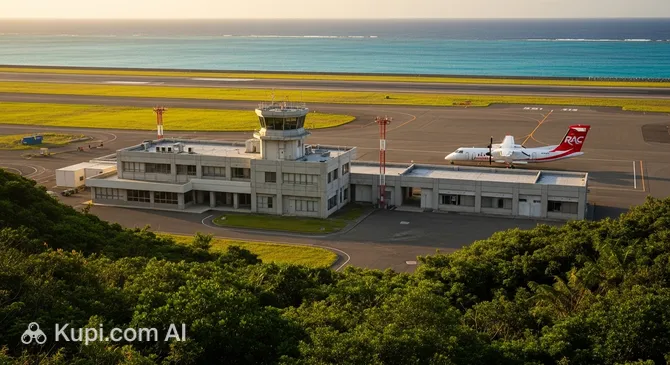
Yonaguni Jima. Source: Kupi.com Binoculars

Welcome to the westernmost aerial gateway of the Land of the Rising Sun, where the sunset arrives later than anywhere else in Japan. Yonaguni Airport is not merely a transport hub, but a welcoming gateway to a world of mysterious underwater ruins and hammerhead shark migrations. Here, just over a hundred kilometres from the shores of Taiwan, a warm tropical breeze greets travellers right at the gangway, promising a secluded retreat at the very edge of the Ryukyu Archipelago.

IATA Code OGN
ICAO Code ROYN
City Yonaguni
Distance to Centre 2 km
Status Regional (Domestic)
Annual Passengers ~100,000 people
Schedule Please check with the airline

Airport Features and Highlights

Despite its modest size, Yonaguni Airport possesses a special charm and a range of advantages that make arriving here a pleasant start to your journey:

  • Geographical Uniqueness. This is the westernmost airport in Japan. Travellers love taking commemorative photos at the corresponding signposts within the terminal grounds.
  • No Hustle and Bustle. Thanks to the small number of flights, there are almost never any queues here. Check-in and baggage claim procedures are completed as quickly and comfortably as possible.
  • Scenic Approach. As you approach the island, the view from the window reveals stunning vistas of the turquoise waters of the East China Sea and the rugged coastline, which is an excursion in itself.
  • Free Observation Deck. An open terrace is equipped on the terminal roof, where you can watch planes taking off and landing against the backdrop of the ocean. In good weather, you can sometimes make out the silhouettes of Taiwan's mountains on the horizon.

Contact Information

Below you will find contact information for Yonaguni Airport (OGN), which will help you plan your trip and navigate upon arrival.

  • Official Website: Yonaguni Airport does not have its own separate website. Official information about its operations is published on the Okinawa Prefecture portal: www.pref.okinawa.jp/site/doboku/kuko/yonaguni/. The site is available in Japanese.
  • Information Desk Phone: +81 980-87-2831. This is the main number for information regarding flights, terminal operations, and lost and found (items lost within the airport premises).
  • Airport Address: Yonaguni, Yonaguni-cho, Yaeyama-gun, Okinawa Prefecture 907-1801, Japan.
  • Email: A dedicated email address for passenger inquiries is not published. It is recommended to use the telephone for communication.
  • Social Media: This small regional airport does not maintain official social media accounts. The best way to check current flight status is via the airline websites.
  • Lost Luggage Information: In case of loss or damage to checked baggage, you must contact the representative of the airline you flew with directly. Their counters are located in the arrival hall.
  • Passenger Support Contacts: Main support for passengers is provided by airline staff at check-in counters and airport representatives, who can be reached via the general information desk phone number.

How to Get to the Airport

Getting to Yonaguni Airport (OGN) is very simple, as it is located on the small and westernmost island of JapanYonaguni. Thanks to the island's compact size, a trip from any corner, be it the main village of Sonai or the port of Kubura, will take very little time.

Public Transport
There are no trains or metro on the island, but a free municipal bus (Yonaguni Community Bus) operates. It connects the main settlements with the airport, making it an ideal option for budget travellers. The schedule may be infrequent, so be sure to check it in advance. The journey from the central village of Sonai to the airport takes about 10 minutes.

Taxi and Transfers
Taxis on the island are a convenient but more expensive method. The number of cars is limited, so it is strongly recommended to book a taxi in advance, especially if you have an early departure or late arrival. Many hotels and guesthouses offer transfer services to their guests or will assist with calling a car. A trip from Sonai will cost approximately 1000–1500 JPY and take 5-10 minutes.

Car Rental
Renting a car, motorcycle, or scooter is one of the most popular ways to get around the island, offering complete freedom. Several rental agencies are located right by the airport. This allows you to pick up a vehicle immediately after arrival to explore the island, and conveniently return it before departure. As with taxis, it is better to book transport in advance, especially during the tourist season.

Airport Parking
There is a car park next to the Yonaguni Airport terminal. Generally, it is free of charge and there are always plenty of spaces available. This is very convenient for those renting a car for the duration of their stay on the island.

Connections to Other Airports
Yonaguni Airport mainly serves domestic flights. Travellers most often arrive here via larger transport hubs. Direct flights connect the island with Painushima Ishigaki Airport. Other airports in the region include Hualien Airport, Taipei airports (Songshan and Taiwan Taoyuan International Airport), as well as Shimojishima Airport, however, there are no direct connections to them, and a transfer will be required.

Terminals and Map

Yonaguni Airport (OGN) is a small regional airport serving the westernmost island of Japan. Its structure is extremely simple and clear, making it very convenient for travellers. The airport has just one passenger terminal, which handles both arriving and departing flights.

The terminal layout is intuitive. The building is single-storey and compact. Immediately after entering, you find yourself in a general hall where the check-in counters of the few airlines flying to the island are located. A small waiting area is also situated here. Navigation will not cause any difficulties: all key zones — check-in, security screening, and boarding gates — are within sight of each other. Since there is only one terminal, the question of transfers between terminals is not relevant.

Departure and arrival zones are clearly separated but located in the same building. After check-in, passengers pass through a single security checkpoint, beyond which lies a small sterile waiting hall with a boarding gate. The arrival zone is even simpler: passengers walk from the aircraft to the terminal, enter the baggage claim hall with one belt, and immediately exit into the public area where they are met.

Check-in and security procedures at Yonaguni Airport are very fast thanks to the low passenger flow. Usually, all formalities take no more than 20-30 minutes. Nevertheless, it is recommended to arrive at the airport about an hour before departure to check in luggage and pass through control without rushing. The main advice for navigation is not to worry; it is practically impossible to get lost here. All signs and the compact layout make the stay at the airport as comfortable as possible.

Airport History

The history of Yonaguni Airport (OGN) is closely linked to its unique geographical position. It was founded in 1943 as a military airfield for the Imperial Army of Japan during World War II. After the cessation of hostilities, the airfield was converted for civilian needs, becoming a vital transport artery for the country's westernmost inhabited island.

A key stage in the airport's development was its modernisation. Initially, the runway was quite short, which limited the types of aircraft it could accommodate. In 1985, it was extended to 1500 metres, allowing it to receive turboprop liners. However, a real revolution occurred in 2007, when the runway was expanded to 2000 metres. This opened the doors for modern jet aircraft, such as the Boeing 737. A year later, in 2008, a new, more spacious and comfortable passenger terminal was opened.

One of the interesting facts in the airport's history is its role in regional connections. Due to its proximity to Taiwan (only about 111 km away), Yonaguni Airport became the site of a significant event in 2007 when it received the first post-war charter flight from the Taiwanese city of Hualien. This highlighted not only its transport significance but also its symbolic importance in the region. Today, the airport remains the main hub for tourists eager to see the mysterious Yonaguni underwater monument, and a vital link for local residents.

Thus, Yonaguni Airport has journeyed from a modest military facility to a modern regional aviation hub. Its history is a reflection of the development of Japan's remote islands and their integration into the global world, while its status as the country's westernmost airport makes it truly unique.

Services and Facilities

Yonaguni Airport (OGN) is a small regional airport serving the island of the same name in Japan. Given its compact size, the range of services here is basic but quite sufficient for a comfortable wait for your flight. The terminal is modern and clean, oriented towards domestic flights.

In the airport building, you will find a small restaurant where you can have a snack before departure and try local cuisine, as well as a souvenir shop. This is an excellent place to buy unique gifts from Yonaguni Island, local sweets, and products. There is not a wide selection of shops here as in international hubs, but everything necessary for a tourist is available.

A general waiting hall is equipped for passengers. There are no special VIP lounges at the airport. Free Wi-Fi is available throughout the terminal, so you can stay connected. You can also find power outlets for charging electronic devices in the waiting hall, although their number may be limited.

It is important to note that there are no currency exchange points or bank branches at Yonaguni Airport. It is recommended to settle all financial matters in advance in larger cities. Regarding medical services, there is no medical centre or pharmacy at the airport, however, like many public places in Japan, the terminal is equipped with Automated External Defibrillators (AED) for emergency situations. For the convenience of passengers with reduced mobility, ramps and specially equipped toilets are provided, and for travellers with children, there are changing tables in the restrooms.

There are no hotels within the airport building itself, however, the island hosts many accommodation options — from guesthouses (minshuku) to small hotels. Many of them are located a few minutes' drive from the airport and may offer transfers for their guests. Business centres and conference rooms are also not provided at the airport.

Where to Eat

Yonaguni Airport (OGN) is a very compact regional airport, so the choice of dining establishments here is limited. Nevertheless, passengers can find a few options to have a snack before departure. All establishments are located in the public zone before security control, as the departure area after screening is quite small and has no cafes.

For a full lunch or dinner, the airport has a single restaurant — Fuwadin (旅果報). It is located in the main hall of the terminal. Here you can experience the local cuisine of Japan, specifically traditional dishes of Okinawa Prefecture. We recommend trying Yaeyama Soba — a hearty noodle soup which is a hallmark of the region. This is the best place if you have time for a leisurely meal.

If you are looking for a quick snack, check out the souvenir shop, which is also located in the main hall. Besides gifts, it sells various packaged snacks, biscuits, local sweets, and beverages. This is a convenient way to take something with you for the journey or satisfy mild hunger.

Prices in the restaurant can be described as moderate, typical for small Japanese airports. Opening hours are usually tied to the flight schedule: they open shortly before the first departure and close after the last plane leaves. It is worth noting that special dietary menus (vegetarian, vegan, gluten-free, or Halal) are likely unavailable at Yonaguni Airport. Travellers with strict dietary requirements are advised to bring food with them.

Traveller Tips

To ensure your journey through the airport of the westernmost island of Japan goes smoothly, please make use of our tips. The airport in Yonaguni is small and mainly serves domestic flights, making it quite simple to navigate.

Arrival Time and Check-in: We recommend arriving at the airport at least 1.5 hours before your domestic flight departure. This time is sufficient to pass check-in and security screening without rushing. Procedures here usually go faster than in major airports, but it is always better to have a buffer of time.

Saving Time and Money: To save on taxi fares, use the free bus that circulates around the island and stops at the airport. It is also worth buying food and drinks in advance, as the selection at the airport itself is very limited, and prices may be higher than in town. To save time, use online check-in if your airline provides this option.

Seat Selection and Hand Luggage: When flying to or from the island, try to get a window seat. Stunning views of the ocean and coral reefs will open up to you. Liquids in containers up to 100 ml, packed in a transparent bag, are allowed in hand luggage. Sharp objects and other standard items prohibited for air travel are not allowed. The rules do not differ from those generally accepted in the country.

Passengers with Connections: Yonaguni Airport is rarely used as a transit hub. If you have a complex itinerary with a transfer at another airport (for example, in Naha or Ishigaki), allow more time between flights. Weather conditions, especially during the typhoon season, can cause flight delays or cancellations, so a connection time of at least 2-3 hours would be a sensible precaution.

Customs Control: Since the airport predominantly serves domestic flights, most passengers do not need to go through customs control. However, random checks may be conducted regarding the export or import of certain plants and animals as part of Okinawa Prefecture's quarantine control.

In Case of Flight Delay: Infrastructure at the airport is limited. If the flight is delayed, ensure you have a book, a charged power bank, or other entertainment with you. Airline representatives will provide information about the new departure time. It is recommended to check flight status online in advance, especially if the weather forecast is unfavourable.

Reached the end of the page?

That means the route is fully explored