Support

Sibu Airport

About the Airport

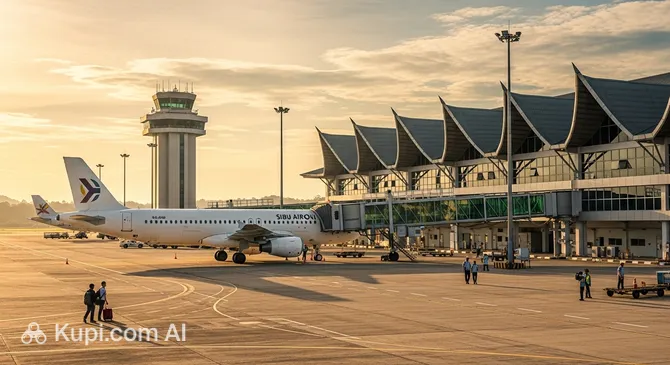
Sibu Airport. Source: Kupi.com Binoculars

Sibu Airport serves as the main air gateway to the central part of Sarawak state and to the banks of Malaysia's longest river, the Rajang. This modern transport hub not only connects the region with the country's major cities but also serves as a starting point for exploring the unique culture and nature of Borneo. Travellers are welcomed here by a spacious and bright terminal, setting the mood for a pleasant stay in the "Swan City".

IATA Code SBW
ICAO Code WBGS
City Sibu
Distance to centre ~23–25 km
Status International
Annual Passengers ~1.5 million people

Features and Advantages of the Airport

Following a large-scale reconstruction completed in 2012, Sibu Airport has transformed into a comfortable hub capable of serving a significant flow of passengers.

  • Convenient Navigation: The terminal building is designed with tourists' needs in mind: it features an intuitively clear layout of check-in counters and boarding gates, as well as aerobridges for comfortable access to the aircraft.
  • Transport Accessibility: One of the main "highlights" for arrivals is the Coupon Taxi system. This allows you to pay for your trip at a fixed rate at a dedicated counter, avoiding the need to haggle with drivers.
  • Gateway to Sarawak: The airport is ideally located for starting journeys deep into the island, including river cruises along the Rajang River and visits to authentic traditional longhouses.
  • Infrastructure: While waiting for a flight, passengers can purchase the famous Sarawak layer cake (kek lapis) at local souvenir shops or have a snack at a cafe.

Contact Information

  • Official Website: www.malaysiaairports.com.my
  • Information Desk Phone: +6084-307 707
  • Address: Sibu Airport, Jalan Sibu-Durin, 96000 Sibu, Sarawak, Malaysia
  • Email: care@malaysiaairports.com.my (General Customer Support for Malaysia Airports)
  • Social Media: The airport is managed by Malaysia Airports; you can follow their news on official pages on Facebook, X (Twitter), and Instagram.
  • Lost Luggage Information: If your luggage has been lost, you should first contact the Lost & Found service of your airline. For items left behind in the terminal, please contact the airport information desk or call the main phone number.
  • Passenger Support Contacts: For assistance and answers to questions, you can contact the airport information desk by phone or via the general Malaysia Airports email.

How to Get to the Airport

You can get to Sibu Airport (SBW), located approximately 25 kilometres from the city centre, in several ways. Depending on your budget, time, and preferences, you can choose public transport, a taxi, or a rental car. The journey from the city centre usually takes about 30–40 minutes.

The most economical way to reach the airport is to use the public bus. The route connects the air terminal with the city centre, and the cost of the trip typically does not exceed 3–5 Malaysian Ringgit (MYR). Although this is the most budget-friendly option, the journey may take a little longer due to stops along the way. It is recommended to check the current schedule in advance, as intervals between buses can be significant, especially on weekends.

For greater comfort and speed, you can use taxis or ride-hailing services, such as Grab, which is very popular in Malaysia. A trip from the city centre to the airport will cost approximately 45–60 Malaysian Ringgit (MYR). This is an ideal option if you are travelling with large luggage or a small group, as you will reach the terminal quickly and without unnecessary hassle. Cars can be found at designated stands in the city or ordered via a mobile app.

If you prefer complete freedom of movement, car rental is an excellent choice. Many rental companies have offices both at the airport and in the city, making it easy to pick up or return a car. For travellers with their own or rented vehicles, the airport provides convenient parking offering rates for both short-term and long-term stays.

When planning your trip, it is worth considering other airports in the region. The closest to Sibu are Mukah Airport (MKM) and Tanjung Manis Airport (TGC). For longer flights and connecting flights, you can consider Bintulu Airport (BTU) or the major transport hub — Kuching International Airport (KCH). Also relatively close is Putussibau Airport (PSU) in neighbouring Indonesia.

Terminals and Map

Sibu Airport (SBW) is a modern and compact aviation hub that handles all flights in a single passenger terminal. Such a structure makes navigation through the airport intuitively clear and convenient for both local and international travellers, eliminating the need to move between different buildings.

The terminal building features a simple and logical two-level layout. On the ground floor (Arrivals level), you will find check-in counters, the baggage claim area, customs control, as well as a public hall with cafes, car rental counters, and taxis. Passengers proceed to the first floor (Departures level) after check-in. The security screening area is located here, after which access opens to the waiting lounges at the boarding gates, small shops, and a food court.

Thanks to its compact size and well-thought-out organisation, completing all pre-flight formalities at Sibu Airport usually does not take much time. Check-in and security screening typically proceed quickly. Nevertheless, it is recommended to arrive at the airport 1.5–2 hours before a domestic flight and 2–2.5 hours before an international one to check in luggage and go through all procedures without rushing.

Navigating the terminal will not cause any difficulties. Clear signs in Malay and English are installed everywhere. Since all key zones — from check-in to boarding — are located in one building across two floors, it is practically impossible to get lost. For a comfortable wait, passengers can utilise the services of cafes and shops, mainly located in the departure zone after passing security control.

Airport History

The history of Sibu Airport (SBW) is inextricably linked to the economic growth of the central region of Sarawak state in Malaysia. Initially, the city was served by a small airfield in the Teku area, built back in the mid-20th century. It played an important role in connecting remote districts, but over time, its modest size and capabilities ceased to meet the requirements of the growing city.

A key moment in the region's aviation history was the opening of the new, modern airport on 1 June 1994. It was built 23 kilometres from the city centre to accommodate larger aircraft, such as the Boeing 737 and Airbus A320. This significantly expanded the route network and gave a powerful impetus to the development of business and tourism. An interesting fact: the runway of the old airfield in Teku was converted into a city road after its closure.

To cope with the growing passenger flow, the airport underwent a large-scale reconstruction. In 2012, a new, more spacious and modern terminal was commissioned. Thanks to this modernisation, the airport's capacity increased to 1.9 million passengers per year, telescopic aerobridges were added, and infrastructure for traveller comfort was significantly improved. Today, Sibu Airport represents an important air gateway that continues to play a strategic role in the life of all central Sarawak.

Services and Amenities

Sibu Airport (SBW) offers passengers all necessary amenities for a comfortable wait. Despite its relatively small size, the terminal is designed to meet the basic needs of travellers arriving in this corner of Malaysia or departing from it.

Several cafes and eateries operate within the airport premises, where you can have a snack before your flight, enjoying local and international dishes, or simply have a cup of coffee. There are also shops offering souvenirs, travel essentials, and press. This is an excellent place to buy memorable gifts for loved ones.

For a comfortable wait, passengers can use the free Wi-Fi, which is available throughout the terminal. Charging stations for electronic devices are provided in the waiting lounges. Business class passengers and loyalty programme members can relax in the VIP lounge, where additional services such as beverages, snacks, and a more private atmosphere are offered.

Basic financial services are available at the airport: there are ATMs for cash withdrawal and currency exchange counters, which is particularly convenient for foreign tourists. In case of need, there is a first aid station in the terminal.

The airport is equipped for the comfort of passengers with children — there are dedicated mother and child rooms. For travellers with reduced mobility, ramps, lifts, and specially equipped restrooms are provided. Airport staff are always ready to provide necessary assistance during boarding and disembarking.

Although there are no hotels directly within the airport building, several hotels are located in the immediate vicinity, which can be quickly reached by taxi. For business travellers, essential business services such as workspaces and meeting areas are available in the VIP lounge.

Where to Eat

Sibu Airport (SBW), despite its compact dimensions, offers passengers a decent selection of establishments where you can enjoy a delicious meal before your flight. It is important to note that practically all cafes and restaurants are located in the public zone (landside), before passport control and security screening. Therefore, we recommend setting aside time for lunch or dinner before you head to the departure zone (airside), where the selection will be extremely limited.

The food court is based on chains popular in Malaysia. Here you will find the local equivalent of KFC — Marrybrown, where you can order fried chicken, burgers, and set meals with an Asian flair. For those wishing to experience traditional Malaysian coffee culture, OldTown White Coffee is an excellent choice. Here, it is worth trying the famous "white coffee", traditional toast with coconut jam ("kaya toast"), and hearty dishes such as nasi lemak or curry noodles.

Prices at the airport are moderate, though slightly higher than in the city. A full lunch or dinner for one person will cost approximately 25–45 Malaysian Ringgit (MYR). Most establishments open early in the morning and operate until the last evening flight, typically between 6:00 and 22:00, allowing for a snack at almost any time of day.

Regarding dietary preferences, almost all establishments hold a "Halal" certificate, which is the standard for the country. Vegetarian dishes, such as vegetable curry or rice with vegetables, can be found on the menus of cafes serving local cuisine, though the selection may be limited. For a quick snack, sandwiches and pastries from coffee shops are ideal, while for a full meal, set menus at fast-food restaurants are perfect.

Travel Tips

To ensure your journey through Sibu Airport goes as smoothly as possible, take advantage of these proven tips. They will help save time, stress, and even money.

Arrival time at the airport. It is recommended to arrive at the airport at least 2 hours before departure for a domestic flight and 3 hours before an international one. This time will be sufficient to check in, drop off luggage, and pass through security control without haste, even if small queues arise.

Check-in and Security. The fastest way to check in for a flight is to do it online on your airline's website. This allows you to head straight to baggage drop or, if you are travelling light, to the security screening area. Security control is standard: remove laptops and other large gadgets from your hand luggage in advance, and keep all liquids in a separate transparent bag.

Seat Selection. If you enjoy admiring the views, choose a window seat. If the ability to stand up freely and stretch your legs is more important to you, your choice is an aisle seat. Emergency exit seats offer more space, but airlines often charge an extra fee for them and have specific requirements for passengers.

Hand Luggage. Remember the restrictions on carrying liquids: they must all be in containers with a volume of no more than 100 ml and packed in a single transparent bag. It is strictly forbidden to carry sharp objects, weapons, and flammable substances in hand luggage. It is better to check the weight and dimensions of hand luggage in advance on your airline's website to avoid extra charges at the airport.

Connecting Passengers. Sibu Airport is quite compact, so navigation here is simple. If you have a connecting flight, check with your carrier in advance whether your luggage will be transferred automatically or if you need to collect it and check it in again. Leave enough time between flights in case of delays and for passing through security again.

Customs Control. When entering Malaysia from another country, you will need to pass through customs control. Declare all goods subject to declaration and familiarise yourself with the rules for importing and exporting currency so that the process goes quickly and smoothly. There is no customs control on domestic flights.

Saving Time and Money. To save money, bring an empty reusable bottle and fill it with water at drinking fountains after passing security. Prices for food and drinks at airports are always higher, so you can take a light snack with you. Booking a taxi or transfer online often works out cheaper than finding a car on the spot.

In Case of Flight Delay. If your flight is delayed, first contact your airline's counter for the latest information. Know your rights: depending on the length of the delay, you may be provided with drinks, meals, or even hotel accommodation. Ensure your gadgets are charged so you can stay connected and entertain yourself while waiting.

Reached the end of the page?

That means the route is fully explored