Support

MUSA

About

Imagine a silent city resting on the seabed, where art and nature have merged into one. The Cancun Underwater Museum (MUSA) is a grand art installation located in the azure waters surrounding Cancun. It is the world's largest project of its kind, designed to protect natural reefs and create a unique space for divers and nature lovers.
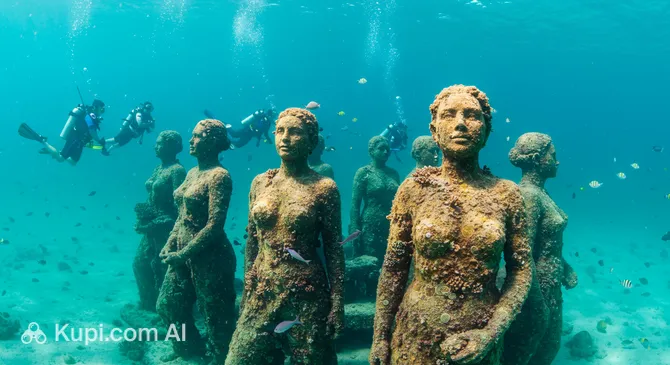
Cancun Underwater Museum. Source: Kupi.com AI

This extraordinary museum, a gift to the world from Mexico, features over 500 life-size sculptures. They are all made from specialized eco-friendly, pH-neutral cement that promotes the growth of artificial coral reefs. The centerpiece exhibit, titled "The Silent Evolution," is striking in its realism and scale, serving as a reminder of the importance of preserving the ocean's ecosystem.

The museum is divided into several galleries adapted for different skill levels. The Punta Nizuc gallery is located at a depth of just 4 meters, making it ideal for snorkeling, while the Machones gallery reaches a depth of 8 meters, attracting certified divers from all over the world.

Contacts

To organize a dive or book a spot on a boat, we recommend contacting the museum representatives in advance. Below are the current contact details for the Cancun Underwater Museum.

Phone+52 998 206 0182
Official Websitemusamexico.org
AddressQuintana Roo, Mexico
Google MapsView on map

What to Do

The main adventure here is diving into "The Silent Evolution." Divers can head to the Machones gallery to get a close-up look at hundreds of human figures frozen in movement. If you prefer snorkeling, the Punta Nizuc gallery offers equally breathtaking views at a shallower depth. For those who don't plan on getting into the water, glass-bottom boat tours are an excellent alternative.

Be sure to find the "Man on Fire" sculpture, where bright orange corals grow to mimic flames, or the mysterious "The Dream Collector." You can see how marine life—from colorful tropical fish to lobsters—claims the concrete statues, turning them into living reefs. The process of coral colonization is continuous, so every visit to the museum offers new visual experiences.

Photography enthusiasts should bring waterproof cases or underwater cameras: the play of light underwater and the realistic faces of the sculptures create incredibly photogenic scenes. The golden rule is to avoid physical contact with the exhibits to prevent damaging the fragile corals and to avoid stings or burns from certain types of marine life.

Getting There

Since the museum's main exhibits are located underwater within the boundaries of the National Marine Park, they can only be reached by sea. Boats and tour vessels regularly depart from piers in the Punta Nizuc area, the Hotel Zone (Zona Hotelera), or from the neighboring Isla Mujeres. The docks themselves are easily accessible from the city center by taxi or the popular tourist buses, routes R-1 and R-2.

If you are coming from Cancun International Airport, the trip to the tourist zone will take between 30 and 60 minutes. Most dive centers and tour operators, such as Mexdive, organize transfers directly from hotels. It is recommended to use the services of certified guides, as independent access to the museum's waters is restricted by environmental protection regulations.

For those who prefer snorkeling, the Punta Nizuc coast is the most convenient departure point—the sculptures here are closest to the shore; however, even in this case, the accompaniment of a professional instructor will ensure maximum safety and the best views.

History & Facts

The idea of creating this unique space originated in 2009 among a group of visionaries, including Dr. Jaime González Cano and British sculptor Jason deCaires Taylor. The project's main goal was to save natural coral reefs: the museum was intended to divert the massive flow of tourists, creating a new environment for coral growth. Taylor, an experienced diver, personally supervised the installation of each of his works, spending more than 120 hours underwater.

It took about 18 months and 120 tons of specialized cement to create the first collections. The first hundred sculptures were submerged in August 2009 off the coast of Isla Mujeres, and the complex officially opened in December 2010. The project received government support, and its cost was approximately $400,000.

Every figure in the museum has a real-life prototype among the local residents—the sculptor took casts of fishermen, students, and even office workers. Today, MUSA houses more than 500 permanent sculptures that reflect human history from the Mayan era to modern times. Over time, the sea takes its course: the statues become overgrown with algae and coral, becoming an integral part of the living Caribbean ecosystem.

Time Needed

To fully experience the museum, tourists are recommended to set aside 3 to 5 hours. This time includes the boat trip to the dive site, safety briefings, equipment fitting, and the time spent in the water. Typically, group tours include about one hour of active snorkeling or scuba diving.

If you choose a glass-bottom boat tour, the total time may be reduced to 1.5–2 hours. This is an excellent choice for families with children or those who do not wish to dive. Don't forget to factor in an additional 30–60 minutes for relaxing on the deck and a photo session against the backdrop of the azure Caribbean waters.

Working Hours

Visiting the museum is possible daily, as the underwater exhibits are accessible year-round. However, the operation of tour agencies and boat departures are tied to daylight hours and weather conditions. The official operating hours for organized groups are: Monday — Sunday from 09:00 to 14:00.

Keep in mind that most tours are booked for the morning hours when underwater visibility is at its peak and the sea is calmest. It is recommended to arrive at the marina at least 30 minutes before your boat's scheduled departure time.

Nearby

After diving into the amazing world of underwater sculptures, it is worth checking out other interesting places nearby. The variety of entertainment in this part of the Caribbean coast will allow you to fill your day with vibrant emotions.

Below are attractions and tour companies located near the main departure points for the museum:

Name Distance (km)
Caribbean Carnival - Tour to Isla Mujeres8
Marina Aquatours8.1
Catamaran Tour Isla Mujeres Cancun8.3
Explore Xcaret Xel Ha offices8.5
Off Road Games Cancun9.5
CANCUN TOURS & CANCUN EXCURSIONS10.3
Albercas Puerto12.4
Hotel Xcaret México14.7
Puerto Maya Cancún - Jungle Tour, Snorkeling & Mayan Experience + Jet Ski Rental14.9
Selva Natura17.9

Reached the end of the page?

That means the route is fully explored