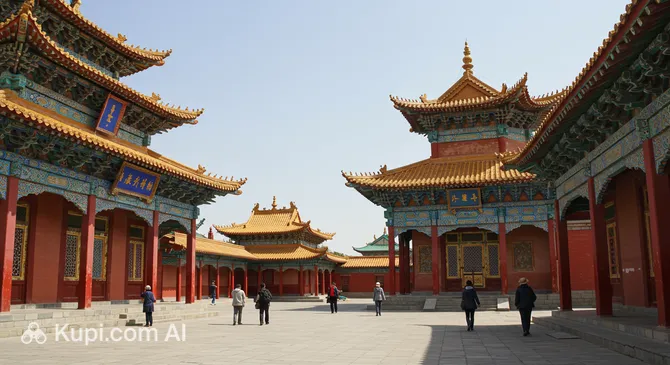
Surrounded by modern mirrored skyscrapers in the heart of Ulaanbaatar, the Choijin Lama Temple Museum is a remarkable island of antiquity. This temple complex, built in the early 20th century, served as the residence of the State Oracle and today stands as one of the most significant architectural monuments that Mongolia is proud of.
Choijin Lama Temple Museum. Illustration.
Source: Kupi.com AI
Traveler photos:
The complex consists of five magnificent temples, each striking with the elegance of its blue brick walls and carved wooden roofs. It is more than just a historical building; it is a treasure trove of Tibetan-Mongolian religious art. Here, you can see unique works by Zanabazar, authentic costumes for mystical dances, and statues of deities crafted with jewelry-like precision.
The interior murals and decorative elements, which required more than two tons of pure silver, are of particular value. Visiting this museum is a rare opportunity to see the authentic setting of a Buddhist monastery, preserved almost in its original state despite the turbulent historical events of the last century.
Contacts
To inquire about special exhibitions or organize group tours, you can use the official communication channels.
A visit to the museum is, first and foremost, an immersion into the mystical atmosphere of Eastern Buddhism. Begin your visit with a leisurely stroll through the complex's five temples. Pay attention to the main temple dedicated to the deity Yamantaka: its walls are decorated with vibrant Mongolian paintings, and the interiors have preserved the spirit of the time when state meditations were held here.
Be sure to find time to study the collection of masks and costumes for the Tsam ceremony. These fearsome and majestic vestments were used in ritual dances to exorcise evil spirits and still impress with their detail. Art lovers should take a close look at the bronze statues of deities and the works of the great Mongolian master Zanabazar, whose creations are considered the pinnacle of Buddhist sculpture.
The quiet courtyards of the monastery, connected by narrow passageways, are ideal for taking atmospheric photos against the backdrop of ancient carvings and modern high-rises. For a deeper understanding of the exhibits, it is recommended to use the services of a guide who will tell you about the secret practices of the oracle and the meaning of each sacred symbol displayed in the halls.
Getting There
Finding this architectural ensemble is easy: it is located right in the "heart" of the business center, near the central square. From Sukhbaatar Square, the entrance to the museum is just a 5–10 minute walk, making it a must-see on any walking route through the capital.
If you are in a more remote area, it is most convenient to take a taxi. Local services and mobile apps operate in the city, allowing you to quickly reach Genden Street. City buses also run frequently through the center; any routes going to the "Central Square" or "City Hall" stops will work for you.
For travelers arriving from Chinggis Khaan International Airport (UBN), the journey by car will take about 30–40 minutes, depending on traffic. The Choijin Lama Temple Museum is surrounded by modern office buildings, creating a striking visual contrast, so it is easy to spot from afar by its characteristic blue brick walls and curved roofs.
Nearest city: Ulaanbaatar
History & Facts
Construction of this unique ensemble began in 1904. The process was led by the talented architect Ombogiin, who harmoniously combined Mongolian traditions with elements of Chinese architecture. The entire complex was built on public donations and was intended for Luvsankhaidav — the State Oracle and the younger brother of the last Great Khan of Mongolia, the 8th Bogd Gegeen.
Until 1938, closed religious rites aimed at protecting the state were held here. However, during the period of political repression, the monastery was closed. Surprisingly, it was the status of a "museum of religious art", granted to the complex in 1942, that saved it from the complete destruction that befell many other Buddhist shrines. This allowed not only the walls but also priceless altars to be preserved in their original form.
Today, the Choijin Lama Temple Museum is considered one of the most important monuments of early 20th-century Mongolian history. It serves as a living testament to how faith and art survived the harshest of times, transforming from an oracle's private residence into a heritage site for the whole world.
Time Needed
To leisurely explore all five temples, study the intricate carvings, and soak in the silence of the courtyards, visitors usually need about 1.5 to 2 hours. If you plan to study the Tsam mask collection in detail or read the descriptions of rare Buddhist canons, you should allow for a bit more time.
The complex is quite compact but very densely packed with artifacts. A short visit will allow you to see the main halls, but it is thoughtful contemplation that helps you feel the special energy of this "island of tranquility" in the middle of a bustling metropolis.
Working Hours
The Choijin Lama Temple Museum operates on a fixed schedule during the week, but you should take weekends into account when planning your visit:
Monday: Closed
Tuesday — Saturday: 10:00 AM – 5:00 PM
Sunday: Closed
Day
Opening hours
Monday
Closed
Tuesday
10:00 – 17:00
Wednesday
10:00 – 17:00
Thursday
10:00 – 17:00
Friday
10:00 – 17:00
Saturday
10:00 – 17:00
Sunday
Closed
Nearby
The museum's location in the heart of the capital allows tourists to easily combine their visit with other iconic sites. A walk around the neighborhood will reveal the modern face of the city, where history is closely intertwined with modernity.