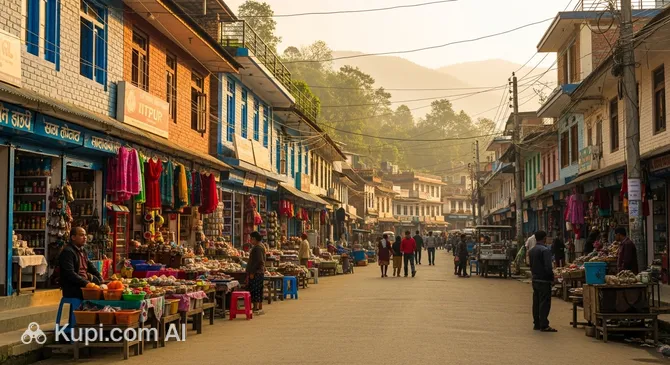
Jitpur is a vibrant and dynamically developing city located in the southern part of Nepal. It is situated in the Terai region, on the fertile lowlands often called the "breadbasket of the country" due to its agricultural significance. The city possesses a unique atmosphere as an important transit and trade hub, where the daily life of locals is closely tied to farming and commerce.
Geographically, the city holds a strategic position in Madhesh Province, forming part of a large urban agglomeration with a population of approximately 337,785 people. The climate here is subtropical, which defines the local landscapes: vast fields alternating with dense urban development. The history of Jitpur reflects the region's urbanization processes, which transformed it from a modest settlement into a significant industrial and residential center.
Jitpur. Illustration.
Source: Kupi.com AI
While the city is not a classic tourist destination with an abundance of ancient temples, it attracts visitors with its authenticity. Here, you can see the real Nepal without embellishment: bustling markets, street trade, and the vibrant life of the Terai region. For travelers, this location often serves as a starting point for exploring the country's southern borders or a convenient stop on the way to the border with India.
Jitpur invites those who want to look behind the scenes of tourist routes and feel the rhythm of life in a modern Nepalese city. It is a place for those who appreciate the energy of developing districts and seek new paths not yet explored by mass tourism.
Weather Overview
Jitpur is characterized by a typical subtropical climate of the Terai lowlands, which differs significantly from Nepal's high-altitude regions. Here, you can expect hot summers and moderately cool winters. The most challenging trial for travelers can be the high humidity during the monsoon period, which lasts from June to September. Heavy rainfall occurs during this time, peaking in July (about 472 mm).
Winter months, especially December and January, bring a pleasant coolness with daytime temperatures around +20°C; however, at night, the thermometer can drop to +8..+10°C, bringing thick fogs. Before your trip, we recommend studying the detailed climate of Jitpur to choose your wardrobe correctly. The hottest period is considered to be April and May, when temperatures often exceed +35°C.
Spring months (March–April) and autumn (October–November) are the ideal times to visit. During this period, dry and sunny weather sets in, and the air becomes clearer, making walks and trips to the surroundings as comfortable as possible. Keep in mind that due to the region's agricultural specifics, there may be dust in the air during the dry season.
Average monthly temperature
Average monthly precipitation
Interesting Facts
"Breadbasket of Nepal": Jitpur is located in the Terai region, which is officially considered the most fertile area of the country, providing the bulk of Nepal's agricultural products.
Major Hub: According to some estimates, the population of the urban agglomeration exceeds 300,000 people, making Jitpur one of the significant demographic centers in the south of the country.
Natural Oasis: Quite close by, 25 km away, is the Jitpur Jharna waterfall—a popular spot for "local tourism" that few foreigners know about.
Transport Specifics: During the monsoon season, due to soil characteristics and road conditions, 4x4 SUVs become the main mode of transport, capable of navigating washed-out gravel paths.
Trading Hub: The city's central office in Ward 4 is a key point for retail trade, where goods from all over the region can be found at very affordable prices.
How to Get There
Jitpur is an important transport hub in southern Nepal, making it accessible in several ways. The main connection to the outside world is through the Terai region's well-developed highway network. Most tourists arrive in the city by bus or private car from the capital or border areas. Detailed information on how to get to Jitpur will help you plan the optimal route.
If you are planning to fly, the nearest major airports are located in neighboring cities. The region is served by domestic flights connecting the southern lowlands with Kathmandu. The journey from the nearest airstrips to the city center usually takes about an hour by taxi. It is worth noting that during the monsoon season (June to September), flight schedules may change due to weather conditions.
Railway communication in Nepal is poorly developed; however, the proximity to the Indian border opens up opportunities to use stations in neighboring settlements. From there, you can reach Jitpur by regular buses or motorickshaws. The journey from Kathmandu (about 50–70 km) takes from 1.5 to 3 hours depending on traffic density, which can be quite heavy due to the large number of freight vehicles.
Station
Passenger traffic
Distance
Janakpur railway station
4
130 km
Nautanwa railway station
2
132 km
Gorakhpur Junction railway station
12
141 km
Darbhanga railway station
8
163 km
Patna Junction railway station
11
179 km
It is important to remember that roads in the region are mostly gravel-surfaced. In winter, bus services operate steadily, but during periods of heavy rain, four-wheel-drive transport may be required for travel. For a comfortable trip, it is recommended to choose morning departures to avoid peak-hour traffic jams.
Main Attractions
Jitpur is primarily a business and residential center, so it is difficult to find world-scale monuments here; however, the city and its surroundings offer several interesting spots for those wanting to get to know the local flavor. The centers of attraction here are the local bazaars, where life never stops for a minute. These are the best places for observing the daily life of the Terai region's residents.
The main natural attraction in the area is Jitpur Jharna Waterfall. Although it is located about 25 kilometers from the main urban neighborhoods, locals and the occasional tourist often choose this spot for outdoor recreation. The waterfall is particularly beautiful after the rainy season when the water flows become full, creating a refreshing contrast to the hot climate of the plains.
In the city itself, the central square in Ward 4 is worth noting. Most social activity is concentrated here: schools, administrative buildings, and many small retail shops. This is the heart of the city, where you can feel its true rhythm and see how modern infrastructure coexists with a traditional way of life. For a full immersion into the region's atmosphere, it is recommended to visit the local temples, which, though small, play an important role in the spiritual life of the community.
Local Cuisine
The cuisine of Jitpur is a bright reflection of the Terai region's gastronomic traditions, where Indian influence harmoniously intertwines with Nepalese classics. The main dish found literally at every turn is momo—Nepalese dumplings with various fillings, served with a spicy achar sauce. No less popular is the traditional dal-bhat: a hearty set of rice, lentil soup, and vegetable curry, which locals eat twice a day.
The city's gastronomic scene is concentrated in bustling bazaars and small family-run eateries. Street food culture thrives here, where you can try freshly prepared samosas, pakoras, and various flatbreads. A specialty of the Terai region is the abundance of juicy tropical fruits: during the season, be sure to try freshly squeezed mango and guava juices, which are incredibly flavorful and aromatic.
Among drinks, the absolute leader is masala tea—strong black tea with milk and spices, which warms you on cool winter evenings and invigorates you in the heat. Despite the lack of high-end restaurants, the food in Jitpur is always fresh and prepared from local products. For those seeking a more familiar setting, cafes at large resorts offer menus that combine local delicacies with popular international dishes.
Travel Tips
When planning a trip to Jitpur, remember that you are heading to an authentic region living by its own rules. These tips will help you feel confident and avoid minor inconveniences during your journey.
Clothing and gear: Choose light clothing made from natural fabrics, as it can be very hot and humid in the Terai. When visiting religious sites, shoulders and knees must be covered. Be sure to bring sunglasses and a dust mask—roads here are often unpaved.
Transport: Motorickshaws are best for getting around the city. Always confirm the price before the trip starts. If you plan to go to the mountains or waterfalls, it is better to book a 4x4 taxi, especially during the monsoon season.
Finances: The main currency is the Nepalese Rupee. ATMs are available in the center, but they do not always accept international cards, so a cash reserve is mandatory. Cards are only accepted in very large shops or hotels like Blackberry Resort.
Health and Safety: Drink only bottled water and avoid ice in drinks at street cafes. Use insect repellent. In the evening, stick to the central, well-lit streets.
Communication: The primary language is Nepali; English is understood by hotel staff and young people. Learn a few phrases, such as "Namaste" (greeting); it goes a long way with the locals. A SIM card can be bought in Ward 4 with a passport and a photo.
Local Etiquette: Always remove your shoes when entering homes and temples. Greet people by placing your palms together ("Anjali Mudra"). Try not to point at people or objects with your finger.
What to avoid: Do not photograph people without their permission, especially during prayers or at markets. Avoid night travel between cities due to poor road lighting.
Extra tip: Try the local street "chaat" at the market—it's inexpensive and very tasty, but choose stalls where many locals are eating.
May your introduction to Jitpur be filled with bright discoveries and pleasant encounters. This city will open its soul to you if you show sincere interest and respect.
Entertainment & Nightlife
Entertainment in Jitpur is predominantly quiet and family-oriented. You won't find noisy nightclubs or neon disco signs here—the city's life follows a work rhythm and traditions. Local residents prefer to spend their evenings in small cafes or strolling through market squares, where the heat subsides after sunset.
The main places for daytime leisure are city parks, waterfront recreation areas, and the surrounding fields, which are often used for picnics. Cultural life centers around community hubs and local festivals, which are celebrated on a grand scale. If you are looking for more active nightlife, cinemas, or modern entertainment centers, you should head to nearby larger cities such as Hetauda or Kathmandu.
For tourists, the central lighted streets remain safe zones for walking. In the evening, it's worth visiting the street snack stalls ("chaat"), which turn into impromptu meeting spots. For moving around after dark, it is better to use a taxi or arrange a motorickshaw in advance, as public transport runs much less frequently at night.
Parks & Museums
Jitpur does not yet boast an extensive network of city parks or classic museums, as the city developed as a utilitarian trade and agricultural center. The main "green zone" for residents consists of the vast agricultural fields surrounding the city. A walk through the outskirts during the dry season allows you to see traditional Nepalese farming methods, which is a kind of "living museum" in its own right.
If you are looking for nature-based relaxation, locals recommend heading to the Jitpur Jharna waterfall. This is a natural recreational area that serves as a park for city dwellers. Here, you can have a picnic and enjoy the coolness of the water. Despite the lack of organized recreation areas with benches and paths, such places allow you to touch the pristine nature of the Terai region.
Culturally, the role of museums here is played by local temples and community centers where religious artifacts and folk art are kept. To visit large galleries or historical exhibitions, travelers usually head to Hetauda or Kathmandu. Nevertheless, Jitpur itself, with its unique way of life, is of great interest to those fascinated by anthropology and the modern history of Nepal's developing regions.
Getting Around
The transport system in Jitpur is maximally adapted to local conditions and the needs of Terai region residents. Regular buses remain the primary means of transport for most. They connect the city with surrounding villages and major centers. It should be noted that buses are often overcrowded, especially in the morning and evening hours, and their movement depends heavily on road conditions.
Within the city itself and for short-distance trips, motorickshaws and autorickshaws are most popular. This is a fast and relatively inexpensive way to reach your destination; however, you should always agree on the price of the trip in advance. For those who prefer more independence, motorcycle rentals are available—this mode of transport is a favorite among locals due to its maneuverability on narrow and sometimes dusty streets.
For tourists, the most comfortable option would be renting a taxi or a 4x4 SUV with a driver, especially if a trip to the waterfalls or neighboring cities is planned. Long-distance walking in Jitpur can be tiring due to the heat and high dust levels on the roads. There is no electronic pass system here, so always have small cash on hand to pay for public transport.
Accommodation
Accommodation options in Jitpur are primarily oriented toward transit travelers and business people. You shouldn't expect a vast choice of five-star hotels here; however, the city offers decent conditions for a comfortable stopover. Most of the lodging consists of budget guesthouses and family pensions where you can experience Nepalese hospitality from the inside.
Among the most notable places to stay is Blackberry Resort in the Jitpur Phedi area. This resort offers a higher level of comfort compared to city hotels and is suitable for those wanting to relax in peace away from the bustle of the commercial districts. In the central part of the city, apartments are also available, which are in demand for those planning a longer stay.
Accommodation prices in Jitpur remain very affordable, making it attractive for budget tourists. We recommend booking rooms in advance if your trip coincides with major local festivals, as the demand for housing increases sharply during these times. The main booking methods are through international services or directly by phone, with payment usually accepted in cash.
Nearby Cities
Thanks to its location at the intersection of important transport routes, Jitpur serves as an excellent starting point for exploring southern Nepal and the border areas of India. The city's surroundings offer diverse routes: from bustling trade centers to quiet agricultural settlements, each with its own unique character.
Just 20 kilometers away is Birgunj—one of the largest cities in the country and a vital economic hub. A trip there takes very little time and allows you to see the large-scale industrial and commercial life of the region. Another interesting destination is Simara, located 24 kilometers away. It is known for its airport and proximity to picturesque natural areas, making it convenient for those continuing their journey by air.
For those ready to cross the border, the Indian city of Raksaul is located 25 kilometers away. It is a major railway hub through which many travelers enter India. We strongly recommend setting aside time to explore these destinations, as each will help create a more complete picture of life in this fascinating cross-border region.
Shopping & Souvenirs
Shopping in Jitpur is primarily about visiting colorful local bazaars where trade is conducted the old-fashioned way. The city's main trading hub is the district in Ward 4. Most shops are concentrated here, offering everything from fresh produce to household goods. Unlike large metropolises, there are no giant shopping malls here, but there is an abundance of small shops where you can find unique locally produced goods.
Special attention should be paid to textiles and wool products. The region is famous for its high-quality fabrics, used to sew traditional Nepalese clothing. Also, the markets offer a huge selection of spices grown on surrounding plantations. Aromatic cardamom, cinnamon, and turmeric make for excellent and useful souvenirs from this trip. Don't forget to stop by the tea shops for famous Nepalese tea, which is sold here in many different variations.
Shops usually operate from early morning until sunset, and Friday is often a shorter working day. Payment in most places is made in cash in Nepalese rupees, so you should take care of currency exchange in advance. In Jitpur, shopping is not just about buying things; it's an opportunity to bargain, chat with locals, and feel the atmosphere of a real Eastern market.