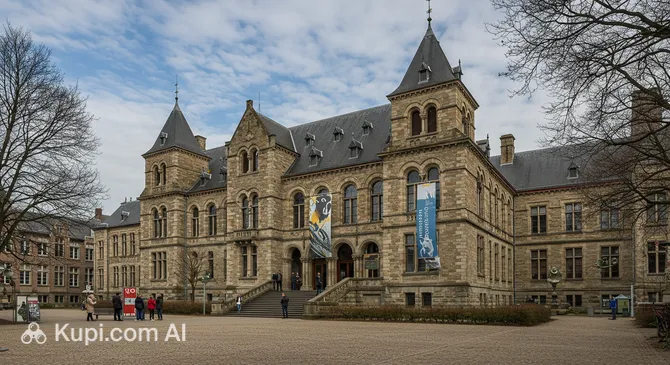
In the heart of the historic center of Maastricht lies a remarkable place where time seems to turn back. The Maastricht Natural History Museum occupies a former medieval monastery on the charming Bosquetplein square. This museum is a point of pride for the Netherlands, telling visitors the story of millions of years of evolution in the region.
Natural History Museum Maastricht. Illustration.
Source: Kupi.com AI
Traveler photos:
Established in its current form in 1996, the museum specializes in the geological and biological development of the southern part of the country. It houses an impressive collection of minerals, fossils, and artifacts that offer a glimpse into the distant past when these lands were an ancient seabed.
Despite its compact size, this space is filled with an atmosphere of discovery. It is ideal for a family visit, offering informative exhibitions that are clear and interesting to both professional researchers and curious young travelers.
Contacts
For more details before your visit or to contact the administration, you can use the following information:
The "stars" of the exhibition are undoubtedly the mosasaur skeletons. You can see an impressive 42-foot reptile that was once the terror of ancient seas. Be sure to find the special niche with underfloor lighting, where the famous skull of the first mosasaur found is displayed—a truly breathtaking sight.
For nature lovers, there is a large section dedicated to birds. Here, you can not only examine rare species but also hear various birdsongs. Interactive exhibits, such as a globe model demonstrating the movement of continents through the ages, help visualize the large-scale changes our planet has undergone.
Younger visitors won't be bored: there are playful elements designed for them, such as the chance to crawl through a fun "fox hole." And for those interested in science on a deeper level, it will be fascinating to look at classic specimens from scientific laboratories—dissected organs and creatures preserved in vintage glass jars.
Getting There
Finding this treasury of knowledge is quite easy—it is located in the heart of the city at the cozy De Bosquetplein 7. The museum is in close proximity to the university library and just a 5–10 minute leisurely walk from the famous Vrijthof square, making it a convenient addition to a stroll through the historic quarters.
If you arrive in Maastricht by train, the walk from the central railway station takes about 10–15 minutes. The route passes over the picturesque Sint Servaasbrug bridge and through old streets, allowing you to immediately immerse yourself in the city's atmosphere. You can also take local buses from the station to stops in the center, from which the museum entrance is just a couple of hundred meters away.
For those who prefer the comfort of a taxi, the trip from the station or outlying districts takes just a few minutes. Given the compact nature of the city center, many tourists prefer to get around on foot or on rented bicycles, which are extremely popular here.
Nearest city: Maastricht
History & Facts
Did you know that this region is responsible for naming an entire geological age? The Maastrichtian stage of the Cretaceous period was named after the city after the remains of giant marine reptiles—mosasaurs—were discovered in local quarries. The name "Mosasaurus" literally means "lizard from the Maas River".
The story of the first major discovery is full of drama. The skull of a prehistoric creature was found in 1764 in the Sint-Pietersberg quarries. At first, scientists mistakenly identified it as the head of a giant crocodile. Later, in the 1770s, a second skull was found by retired surgeon Johann Leonard Hoffmann, whose name is immortalized in the species name Mosasaurus hoffmanni.
A curious fact: the original famous Hoffmann skull is currently not here, but in Paris. During the French siege of 1794, it was taken as a war trophy. Maastricht houses an exact cast of it, along with other unique skeletal fragments found in more recent times.
Time Needed
When planning your visit to the Maastricht Natural History Museum, you should allow for about 1.5–2 hours. Although the museum is considered relatively small compared to those in major capitals, its collection is very dense and filled with fine details that you'll want to examine without rushing.
This time is sufficient not only to see the skeletons of ancient marine reptiles but also to explore the interactive displays, listen to birdsongs in the ornithology hall, and give children the chance to explore the play areas. If you are particularly interested in paleontology or geology, set aside a bit more time to read the descriptions of the unique fossils.
Working Hours
The museum welcomes visitors throughout the week, except for Mondays. Please note that opening hours differ between weekdays and weekends:
From Tuesday to Friday, the doors are open from 11:00 to 17:00. On Saturday and Sunday, the museum operates on a reduced schedule—from 13:00 to 17:00. The museum is closed on Monday.
Day
Working hours
Monday
Closed
Tuesday
11:00 – 17:00
Wednesday
11:00 – 17:00
Thursday
11:00 – 17:00
Friday
11:00 – 17:00
Saturday
1:00 – 17:00
Sunday
1:00 – 17:00
Nearby
The museum's location in the historic core makes it easy to combine natural history with other iconic landmarks. Just a few minutes' walk away, you can find a completely different perspective on the city's past and architecture.
A stroll through the surrounding area will lead you to ancient city gates and mysterious underground tunnels that served as protection for local residents for centuries. Below are the nearest attractions: