Support

Gilgit Airport

About the Airport

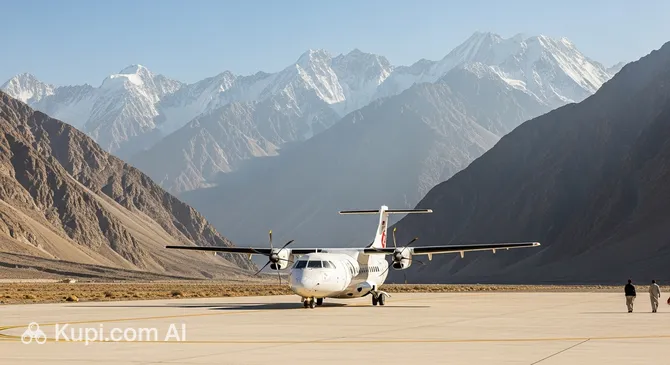
Gilgit Airport. Source: Kupi.com Binoculars

Gilgit Airport (GIL) is not just an air gateway, but the starting point for a breathtaking journey to the world's highest peaks. Located in a picturesque valley in the north of Pakistan, it serves as a key transport hub for mountaineers and travellers seeking to conquer the Karakoram mountains. Landing here is an adventure in itself: the aircraft performs an impressive manoeuvre amidst mountain peaks, revealing stunning views to passengers. The flight from Islamabad takes only about an hour, whereas the journey by car along mountain roads takes approximately 15 hours.

IATA Code GIL
ICAO Code OPGT
City Gilgit
Distance to centre ~2.3 km
Status Domestic
Passengers per year ~35,550 (2023-24)
Popular Airlines Pakistan International Airlines
Schedule Gilgit Airport online schedule

Features and Advantages

The main feature of the airport is its unique location at an altitude of nearly 1,500 metres above sea level. The short runway and surrounding mountains impose restrictions on the types of aircraft accepted—mainly ATR 42 turboprops. Due to the complex mountainous terrain and changeable weather, flights are often operated only during good visibility, which adds an element of unpredictability to travellers' plans.

Despite its modest size, the airport plays a crucial role in the development of tourism in the Gilgit-Baltistan region. A new modern terminal was opened here in 2014, significantly improving passenger comfort. For many tourists setting off on a trek to the foot of Nanga Parbat or exploring ancient Buddhist monuments, the airport of Gilgit becomes the first and unforgettable point of contact with the majestic nature of Pakistan.

Contact Information

  • Official Website: Gilgit Airport is managed by the Pakistan Civil Aviation Authority (PCAA). Current information should be sought on the official PCAA website (caapakistan.com.pk), as the airport does not have its own dedicated website.
  • Information Desk Phone: For the most accurate and up-to-date flight information, it is recommended to contact your airline directly. Contact numbers for airport services may be listed on the PCAA website, but they are subject to change.
  • Airport Address: Gilgit Airport (GIL), Gilgit City, Gilgit-Baltistan Region, Pakistan.
  • Email: There is no dedicated email address for general passenger inquiries. For communication, it is recommended to use the contact forms on the PCAA website or contact the airline directly.
  • Social Media: The airport does not maintain official pages on social media. Follow news on the pages of airlines operating flights to Gilgit.
  • Lost Luggage Information: For all issues related to lost or damaged luggage, you must contact the representative of the airline you travelled with. Airline counters are located in the arrivals hall.
  • Passenger Support Contacts: Primary support regarding booking, ticket changes, and flight information is provided by your airline. For general questions related to terminal infrastructure, you can appeal to airport staff on-site.

How to Get to the Airport

Getting to Gilgit Airport (GIL) from the city centre is quite simple, as it is located in close proximity to the main districts. Gilgit is a key transport hub of the region, and although the choice of transport options is not as vast as in the metropolises of Pakistan, you can reach the terminal quickly and without hassle. The main methods are taxis, private transfers, and rental cars.

The most convenient and popular way to get to the airport is by taxi or private transfer. A car can be found at almost any point in the city or ordered through your hotel. Ride-hailing services via apps may also be available in the region, which is a convenient option. The journey from the city centre usually takes no more than 10–20 minutes depending on traffic conditions. The cost of the trip is low, but it is recommended to agree on the price with the driver in advance or use an app with a fixed fare to avoid misunderstandings.

Direct public transport connections, such as special express buses to the airport, are absent in Gilgit. Locals often use shared taxis (usually minivans) that ply specific routes. Theoretically, one could take these to a point from where the airport is walking distance, but for tourists with luggage, this option is extremely inconvenient and not recommended, especially if you are short on time.

If you plan to actively travel around the surrounding areas, renting a car (often with a driver) can be an excellent solution. With a rented car, you can easily reach the airport at your required time. Near the Gilgit Airport terminal, there is a small parking area where you can leave a car for both short and long periods. Parking services are paid, but the cost is generally quite moderate.

Thus, for most travellers, the optimal choice will be a taxi—it is fast, inexpensive, and comfortable. If you value maximum convenience, especially when travelling with family or a large amount of luggage, it is worth booking a private transfer through your hotel in advance. Given the changeable weather in the mountains, which can affect flight schedules, always leave for the airport with a little extra time to spare.

Terminals and Map

Gilgit Airport (GIL) is a small regional airport with one passenger terminal that handles all domestic flights. Given its modest size and location in a mountainous area, the airport structure is as simple and functional as possible, making it convenient for passengers.

The terminal building is very compact and combines all necessary zones under one roof. There is no division into Terminals A, B or 1, 2—all operations are carried out in a single space. Navigation is simple and intuitive: upon entering, you immediately find yourself in the main hall where the check-in counters are located. Since the airport handles a limited number of flights, large queues are rare here.

The departure zone consists of a check-in hall, a security checkpoint, and a small waiting lounge before the boarding gate. The arrival zone is a separate small hall with a baggage claim belt. Everything is within walking distance, and moving between zones takes no more than a minute. Consequently, the question of transferring between terminals is not relevant here.

Passing through check-in and security usually takes little time due to the low passenger flow. Nevertheless, it is recommended to arrive at the airport approximately 1.5–2 hours before departure. This is because flight schedules depend heavily on weather conditions, and security procedures can be quite thorough.

The main advice for navigation at Gilgit Airport is not to worry. It is practically impossible to get lost here. All key points—from the entrance to the boarding gate—are within direct line of sight, and the friendly staff are always ready to help and direct you.

Airport History

Gilgit Airport (GIL) is not just an air gateway, but a true legend among aviation enthusiasts and travellers. Located in the heart of the high-altitude Gilgit-Baltistan region, it is famous for its challenging location and breathtaking views during takeoff and landing. Its history is closely linked to the development of one of the most inaccessible yet beautiful corners of the world.

The history of the airport begins even before 1947, when a simple dirt runway was built on this site for small aircraft. In those times, it was more of a strategic facility ensuring communication with the remote region. Later, the airport began to develop gradually but remained a modest airfield for a long time. Its role as a vital transport artery for the local population was immense, especially before the advent of full-scale ground transport via the Karakoram Highway.

A key stage in the development of Gilgit Airport was the commencement of regular passenger transport undertaken by PIA. Initially, flights were operated on Fokker F-27 aircraft, and later on more modern ATR 42 turboprops, which remain the main type of aircraft serving this route today. The runway was paved and slightly lengthened, yet its dimensions still impose serious restrictions. The airport operates exclusively under Visual Flight Rules (VFR), which means a strong dependence on weather conditions. Frequent flight cancellations due to cloud cover or strong winds have become an integral part of its history.

The main achievement of Gilgit Airport is opening the region to international tourism. It became the starting point for thousands of mountaineers and trekkers striving for the peaks of the Karakoram and the Himalayas. The airport is considered one of the most challenging in the world for pilots due to the short runway surrounded by high mountains and unpredictable weather. Landing here requires the highest level of skill: the aircraft flies along a narrow river valley, manoeuvring in close proximity to mountain slopes. This thrilling experience has itself become a separate attraction for many travellers.

Services and Amenities

Gilgit Airport (GIL) is a small regional airport serving primarily domestic flights. Due to its size and location in a mountainous area, the range of services here is focused on satisfying the basic needs of passengers awaiting their flight.

Dining and Shopping: The choice of establishments at the airport is limited. Typically, there is a small snack bar or café here where you can buy light snacks, sandwiches, tea, coffee, and soft drinks. Do not expect full-service restaurants or a wide variety of shops. Sometimes you can find a kiosk with local souvenirs and essential items.

Lounges and Facilities: A general waiting hall is equipped for passengers. There are no specialized VIP halls or business lounges at Gilgit Airport. Access to Wi-Fi may be limited or absent, so it is recommended to have mobile internet. The number of power outlets for charging devices is also small, so it is better to bring a portable charger (power bank) with you.

Financial and Medical Services: An ATM may be installed at the airport, but there are no full-service bank branches or currency exchange points. It is strongly recommended to exchange money in major cities in advance. For emergency assistance, there is a first aid station on the premises.

Services for Passengers with Special Needs: There are no special playrooms for children at the airport, but standard restrooms are available. Assistance with boarding and disembarking, including wheelchairs, is provided to passengers with reduced mobility. To arrange this, it is necessary to notify your airline in advance about the need for assistance.

Accommodation and Business Services: There are no hotels within the airport territory itself. The nearest accommodation options are located in Gilgit city, which can be reached by taxi. Conference rooms and business centres are absent at the airport.

Where to Eat

Gilgit Airport (GIL) is a small regional air terminal, so the choice of dining establishments here is quite modest and corresponds to its size. Do not expect large restaurants or chain coffee shops here as in international airports. The main opportunities for a snack are concentrated in the main terminal building, predominantly in the general area before security control.

As a rule, a small cafeteria or a few kiosks operate in the departure zone. Here passengers can buy tea, coffee, bottled water, and soft drinks. Food offerings usually include packaged snacks such as biscuits, crisps, and sandwiches, as well as simple local pastries, for example, samosas. This is a good option for a quick bite while waiting for a flight, especially considering that flights may be delayed due to weather conditions.

Regarding special offers, finding authentic local cuisine dishes within the airport itself is unlikely—for those, it is better to head to the city of Gilgit. The selection for passengers with special dietary needs (vegetarian, vegan, or gluten-free) is extremely limited, so if you follow a strict diet, it is recommended to bring food with you. Most products offered are Halal. Prices at the airport are moderate, and opening hours are usually tied to the flight schedule.

Thus, for a full lunch or dinner, it is better to eat at one of the cafés or restaurants in Gilgit itself before travelling to the airport. The facilities of the air terminal itself are more suitable for having tea and a light snack before departure.

Travel Tips

Travelling to Gilgit by air is an adventure in itself with breathtaking views. To make your airport experience as comfortable as possible, use these tips, keeping in mind the unique features of this high-altitude airport in Pakistan.

Arrival Time and Check-in. Flights from Gilgit Airport depend heavily on weather conditions, so the schedule may change. It is recommended to arrive at the airport at least 2 hours before the departure of a domestic flight. This will give you enough time in case of unforeseen changes. Check-in and security procedures here are simpler than in major international hubs but can be quite thorough. Online check-in, if available from your airline, will help save time.

Seat Selection on the Plane. This is one of the most important tips! The flight to Gilgit is one of the most scenic in the world. To enjoy stunning views of the Himalayas and the eight-thousander Nanga Parbat, try to secure a seat by the window on the left side when flying from Islamabad to Gilgit. On the return flight, the best views open up, correspondingly, from the right side.

Hand Luggage. Hand luggage rules are standard: liquids over 100 ml, sharp objects, and other dangerous substances are prohibited. Given the small size of the aircraft flying to Gilgit (usually ATR), be prepared that large hand luggage may need to be checked into the hold at the aircraft steps.

Transfers and Customs. Gilgit Airport handles only domestic flights, so there are no international transit or customs control procedures here. If you have a connection planned in another city, for example, in Islamabad, allow a very large time buffer (preferably at least 8-10 hours or even an overnight stay) due to the high probability of delay or cancellation of the flight from Gilgit due to weather conditions.

Economy and Comfort. Infrastructure at the airport is minimal. There is a small waiting hall, but the choice of cafés and shops is very limited. We recommend bringing water and light snacks with you. Book flight tickets in advance, especially during the high tourist season (summer), as the number of flights is limited and they sell out quickly.

What to Do in Case of Flight Delay. Delays and cancellations are a frequent occurrence for Gilgit Airport. Remain calm and stay in touch with your airline representative for current information. Always have a "Plan B": be mentally and financially prepared to stay in Gilgit for a day or two or consider an alternative, albeit very long, option—travelling by land along the famous Karakoram Highway.

Reached the end of the page?

That means the route is fully explored