Support

Alejandro Velasco Astete

About the Airport

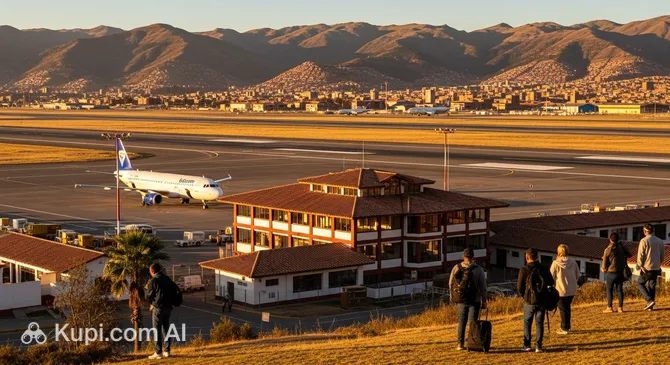
Alejandro Velasco Astete. Source: Kupi.com Binoculars

Alejandro Velasco Astete International Airport (IATA: CUZ) is the main aerial gateway to the heart of the former Inca Empire, the city of Cusco. Located high in the Andes, at an altitude of over 3,300 metres above sea level, it welcomes travellers from all over the world eager to see Machu Picchu and other wonders of the Sacred Valley. Named after the Peruvian pilot who was the first to fly across the Andes in 1925, today it is the second busiest airport in Peru. Its unique location within the city limits makes it very convenient for tourists, but also imposes certain restrictions on its operations.

IATA Code CUZ
ICAO Code SPZO
City Cusco
Distance to Centre approx. 3-4 km
Status International
Annual Passengers approx. 4 million (2023)
Popular Airlines LATAM Airlines, Sky Airline, JetSMART
Schedule Alejandro Velasco Astete Online Board

The airport's main advantage is its immediate proximity to the historic centre of Cusco, allowing travellers to quickly reach their hotels. However, its high-altitude location surrounded by mountains imposes strict limitations: the airport primarily accepts flights during daylight hours and under good weather conditions. It operates at the limit of its capacity, serving a huge number of tourists. Inside the terminal, there is everything necessary for a comfortable wait: cafes, souvenir shops, travel agency counters, and taxi services offering transfers both to the city and other points in the region, including Ollantaytambo, from where trains to Machu Picchu depart.

Contact Information

If you need to contact representatives of Alejandro Velasco Astete International Airport, you can use the following contact details:

  • Official Website: www.aap.com.pe/cusco
  • Information Desk Phone: +51 (084) 222611
  • Address: Av. Velasco Astete s/n, Wanchaq, Cusco, Perú
  • Email: For general enquiries and customer support, you can use the address atencionalcliente@aap.com.pe
  • Social Media: Up-to-date information and news can be found on the official page of the airport operator on Facebook.
  • Lost Luggage Information: In case of loss of checked baggage, you must immediately contact your airline's representative at the airport. For items left in the terminal, please contact the airport's Lost and Found service.
  • Passenger Support Service: For consultations and assistance, please contact the main airport phone number or email.

How to Get to the Airport

Alejandro Velasco Astete Airport (CUZ) is located within the city limits, just a few kilometres from the historic centre of Cusco, so getting there is quite straightforward. Travellers can choose the option that suits them best — from budget-friendly public transport to comfortable taxis or private transfers.

Taxis and Ride-Hailing Services are the most common and convenient method. A trip from the historic centre, for example, from the Plaza de Armas, will take 20-30 minutes depending on traffic. We recommend using official taxi services or booking a car via apps. The average cost of a trip is 15-30 Peruvian Soles. Important tip: always agree on the price with the driver before the trip begins, as taximeters are rarely found in local cars.

Public Transport in the form of small buses and vans, known as "combis", is the most economical option. The fare will cost only 1-2 Soles. Many routes passing through major streets like Avenida El Sol head towards the airport. This method is suitable for travellers with light luggage who are ready for local colour and potential crowding. If you have large suitcases, the trip may prove extremely inconvenient.

Private Transfer guarantees comfort and peace of mind. The service can be booked in advance at your hotel, a travel agency, or online. The driver will meet you at the appointed time and take you directly to the terminal. This option is more expensive than a taxi but saves you from having to find a car and haggle, which is especially valuable if you are in a hurry for your flight.

If you have travelled around Peru in a rented car, you can return it at one of the rental company offices directly at the airport. There is also a car park on the airport grounds where you can leave personal transport for a short or long term, although for most tourists flying out of Cusco, this option is less relevant.

Terminals and Map

Alejandro Velasco Astete Airport in Cusco (CUZ) is a compact and, at first glance, simple aviation hub, yet its structure has its own specific features. The airport consists of a single two-storey terminal that serves both domestic and international flights. Such an organisation significantly simplifies navigation for travellers.

The terminal layout is intuitive. The Ground Floor is the arrival and check-in area. Here you will find airline counters, the baggage claim area, and exits to the city. Also on the ground floor, you can find travel agency offices, currency exchange points, and taxi counters. The First Floor is entirely dedicated to the departure zone. After check-in, passengers proceed upstairs, pass through pre-flight security, and enter the waiting hall. Here lie the boarding gates, small duty-free shops, cafes, and souvenir stalls.

Since the airport has only one terminal, there is no need for transfers between buildings, making movement around the airport maximally simple. Departure and arrival zones are clearly separated by floors, so it is practically impossible to get lost. Despite its compact size, during peak hours and the high tourist season, the airport can be quite busy.

It is recommended to allow sufficient time for check-in and security screening. For domestic flights within Peru, it is worth arriving at the airport at least 2 hours before departure, and for international flights — 3 hours. Queues for check-in and security control can be long, especially for morning flights to Lima and other popular destinations. In general, navigation at Cusco airport will not cause difficulties even for an inexperienced tourist; the main thing is not to leave formalities to the last moment.

Airport History

The history of Alejandro Velasco Astete International Airport is inextricably linked with the transformation of Cusco into one of the main tourist centres of South America. The airport was officially opened in December 1964, replacing an older, smaller airfield. It received its name in honour of Alejandro Velasco Astete — a brave Peruvian pilot who, in 1925, was the first in history to fly across the Andes, connecting Lima and Cusco, but tragically died later that same year during an air show.

From the very beginning of its existence, the airport faced a unique geographical challenge: it is located in a narrow valley at an altitude of about 3,310 metres above sea level, making take-off and landing some of the most complex in the world and requiring special skill from pilots. Despite these limitations, with the growing popularity of Machu Picchu and other attractions of the Sacred Valley, the airport began to develop rapidly. In the 1970s and 1980s, it went through several stages of modernisation to accommodate larger aircraft and the growing flow of passengers.

Key reconstructions of the terminal and runway took place throughout the 1990s and 2000s to meet international safety and comfort standards. Today, despite its compactness and limitations (for example, the inability to perform night flights due to difficult terrain), it is the second busiest airport in Peru. Interesting fact: it was the physical limitations of the Velasco Astete airport and the impossibility of its further expansion that served as the main reason for the start of construction of a new, larger international airport in Chinchero, which in the future is expected to take on the main flow of tourists.

Services and Amenities

Alejandro Velasco Astete Airport in Cusco, being a key transport hub for travellers heading to Machu Picchu, offers a set of essential services for a comfortable wait. Despite its relatively small size, the terminal is well-organised and functional.

For those wishing to grab a bite or do some shopping, the airport has several cafes and small restaurants where you can drink coffee, try local pastries, or have a full lunch. Particular attention should be paid to souvenir shops: a wide range of products made from alpaca wool, ceramics, textiles, and other traditional Peruvian crafts is presented here. This is an excellent opportunity to buy last-minute gifts.

For a more comfortable wait, the airport operates a VIP Lounge, access to which can be obtained for a fee, via Priority Pass cards, or for business class passengers of certain airlines. Guests here are offered snacks, beverages, more comfortable seating, and a quiet atmosphere. Wireless internet (Wi-Fi) is available throughout the terminal, often with limited free access. Charging stations for electronic devices can be found in the waiting halls, although their number may be limited.

ATMs and currency exchange points are located in the airport building, allowing you to easily withdraw cash or exchange money upon arrival. Also, for passenger safety, a medical point is in operation, ready to provide first aid, which is especially important considering Cusco's high-altitude location.

Baby changing rooms are provided for travellers with children. Passengers with reduced mobility are offered staff assistance, and the terminal itself is equipped with ramps and special restrooms for convenient movement. There are no hotels directly on the airport grounds, but many accommodation options are located a few minutes' taxi ride away in the city itself. Specialised conference halls or business centres are not provided in the airport, however, basic conditions for work can be found in the VIP lounge.

Where to Eat

Alejandro Velasco Astete Airport in Cusco, despite its relatively small size, offers passengers several options for a snack or a full meal. Most establishments are concentrated in the main terminal building, both in the public area and in the departure zone after passing security control.

In the Public Zone (Landside), before check-in and control, you will find several cafes. This is the best place if you have time for a leisurely lunch. Here, as a rule, a wider selection of dishes is presented: from sandwiches and salads to some hot options. Prices here, as in any airport, are higher than in the city, but the selection allows finding something for any budget. This is an ideal place to drink a cup of famous Peruvian coffee or traditional mate de coca while seeing off friends or waiting for your flight.

In the Departure Zone (Airside), after passing control, the choice is more limited and oriented towards quick snacks. Small cafes and kiosks are located here, where you can buy coffee, soft drinks, pastries, sandwiches, and snacks. This is convenient for those who want to take something on board the plane or have a quick bite right before boarding.

Regarding cuisine, do not miss the opportunity to try local specialities even at the airport. Look for empanadas (pastries with various fillings, for example, chicken or cheese) or sandwiches with local ingredients. For passengers with special dietary needs, the choice may be limited. Vegetarian options, such as vegetable sandwiches or cheese pastries, are usually available. However, finding certified Halal, vegan, or gluten-free dishes may be challenging, so it is better to clarify the ingredients directly with the cafe staff. Opening hours are usually tied to the flight schedule; most of them are open from early morning until the last departure.

Travel Tips

To ensure your journey through the airport of Cusco goes smoothly, make use of these tips. Alejandro Velasco Astete Airport is a key hub for tourists heading to Machu Picchu, so knowing some nuances will help save time and reduce stress.

Arrival Time and Check-in: The airport in Cusco is not very large, but during the high tourist season, it can be crowded. We recommend arriving at least 2 hours before a domestic flight and 3 hours before an international one. If possible, complete online check-in to avoid queues at airline counters. Be patient at security checkpoints and move slowly — at an altitude of 3,400 metres, any haste can cause discomfort.

Seat Selection on the Plane: This is one of the most important tips for those flying out of Cusco! To enjoy a farewell view of the majestic Andes, be sure to choose a window seat. If your flight is heading to Lima, the best panoramas usually open up from the right side of the aircraft.

Hand Luggage: Standard security rules apply here as well: liquids in containers up to 100 ml, no sharp objects. A special point concerns coca leaves, which are popular in Peru for combating altitude sickness. Carrying them in hand luggage within the country is legal, but ensure that bringing such leaves is permitted in your destination country to avoid problems at customs upon arrival.

Customs Control and Transfers: When flying out of Peru, ensure that your souvenirs, especially those imitating antiques, are permitted for export. Sometimes a special certificate may be required. Passengers with connections in Cusco should note that this is primarily an airport for direct flights, and transit infrastructure is limited. If your connection requires collecting and re-checking luggage, allow extra time for this.

Saving Time and Money: Order taxis only at official counters inside the terminal. It is safer and often cheaper than negotiating with drivers at the exit. Prices for food and drinks at the airport are quite high, so it is better to have a snack in the city beforehand.

Flight Delays: Weather in the mountains is unpredictable, so delays and cancellations of flights, especially morning ones, are not uncommon. Always check the status of your flight online before leaving for the airport. In case of a long wait, bring a book, a portable charger, and snacks, as leisure opportunities in the terminal are limited. In the event of a long delay, do not hesitate to contact your airline representative to ask about the possibility of providing vouchers for food or drinks.

Reached the end of the page?

That means the route is fully explored