Support

Vigan Mindoro Airport

About the Airport

Vigan Airport, also known as Mindoro Airport, is not just a runway, but a cosy aerial gateway to one of the most charming colonial cities in the Philippines. Located literally just a few minutes' drive from the historic centre, it offers travellers a unique opportunity to start their exploration of the Ilocos region almost immediately after landing. Although it is a small airport, its role in providing direct access to the country's cultural heritage is hard to overestimate, as it allows visitors to avoid the long and tiring overland journey from larger aviation hubs.
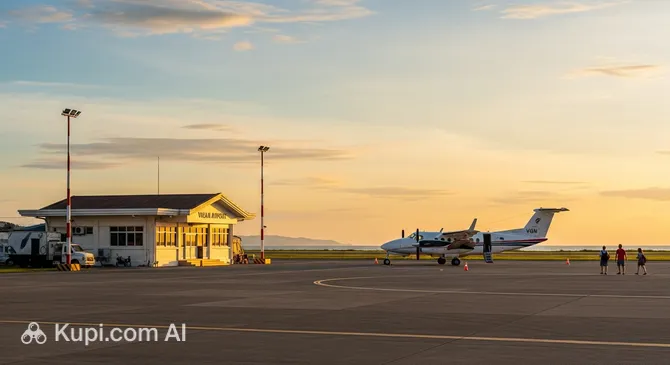
Vigan Mindoro Airport. Source: Kupi.com Binoculars
IATA Code VGN
ICAO Code RPUQ
City Vigan
Distance to centre approx. 3 km
Status Domestic (Community airport)
Passengers per year Passenger traffic data is limited as the airport mainly serves private and non-scheduled aviation.
Popular Airlines Sky Pasada, Platinum Skies, and charter carriers (it is recommended to check flight availability).

A key advantage of Vigan Airport is its incredible proximity to the famous Calle Crisologo and other UNESCO World Heritage sites. It is a small and very compact airport, which means a complete absence of the hustle and long queues characteristic of large aviation hubs. Check-in and baggage claim procedures here are maximally fast and simple. The airport mainly accepts small propeller planes and private jets, making it a convenient arrival point for those travelling by charter flights. Landing in Vigan itself becomes part of the adventure, opening up picturesque views of the South China Sea coast.

Contact Information

Vigan Airport (VGN) is a small regional airport serving mainly domestic flights. Most services, such as baggage tracing and passenger support, are provided directly by the airlines. Below are the main contact details and information.

  • Official Website: Vigan Airport does not have its own official website. The airport is managed by the Civil Aviation Authority of the Philippines (CAAP).
  • Inquiry Phone Number: There is no direct public phone number for inquiries. To clarify flight schedule information, it is recommended to contact your airline directly.
  • Address: Mindoro Airport Road, Vigan City, Ilocos Sur, Philippines.
  • Email: A separate email address for general inquiries is not provided.
  • Social Media: The airport does not have official pages on social media.
  • Lost Baggage Information: For all issues related to lost or damaged baggage, you should contact the support service of the airline you flew with.
  • Passenger Support Contacts: Assistance to passengers is provided by airline representatives directly at the airport terminal.

How to Get to the Airport

Getting to Vigan Airport (VGN) from the centre of the eponymous colonial city in the Philippines is quite simple thanks to its close location. The distance to the historic centre of Vigan, including the famous Calle Crisologo, is only a few kilometres, so the trip will not take much time. The main modes of transport here are local colourful transport and taxis.

Public Transport: Tricycles and Jeepneys. The main and most authentic mode of transport in Vigan is the tricycle (a motorcycle with a sidecar). This is the most popular and economical way to get to the airport.

  • Travel time: about 10-15 minutes from the city centre.
  • Cost: The trip is very affordable, usually costing between 50-150 Philippine Pesos (PHP). It is recommended to agree on the price with the driver before starting the journey.
  • Features: Tricycles can accommodate 2-3 passengers with small luggage. This is not just transport, but part of the local experience.

Jeepneys, the famous Philippine minibuses, ply the main roads, but for a short trip to the airport from the centre, they are less convenient than tricycles.

Taxi and Private Transfer. For greater comfort, especially if you have a lot of luggage, you can book a private transfer or taxi. Many hotels in Vigan will happily help organise such a service. This will cost more than a tricycle but ensures a trip in an air-conditioned vehicle. The travel time will remain approximately the same — 10-15 minutes.

Car Rental. Renting a car is a good option for those planning to explore the Ilocos region on their own. You can rent a car at one of the local rental agencies. However, renting a car solely to get to Vigan Airport is impractical due to the short distance. Parking at the airport is generally not a problem. Given the small size of the airport, there is a simple open parking lot, and the fee for it will likely be minimal or non-existent.

Important Note for Travellers. It is worth noting that Vigan Airport (VGN) is a small airfield that mainly serves private and charter flights. Regular commercial air service may be limited or seasonal. Most tourists travelling to Vigan by air arrive at larger airports, such as Laoag Airport (LAO), located approximately 70 km to the north, and from there get to Vigan by bus (the trip takes about 2 hours).

Terminals and Map

Vigan Airport (VGN) is a small regional airport serving the city of Vigan and its surroundings. Its structure is extremely simple and intuitive, making it very convenient for travellers who are not used to complex and crowded aviation hubs.

Structure and Navigation

The airport consists of one small terminal which serves both departing and arriving passengers. The building is single-storey, and all zones are within walking distance of each other; it is practically impossible to get lost here. Immediately upon entry, you will see the check-in counters, followed by a small waiting area and the boarding gate. The departure and arrival zones are actually in the same space, simply used at different times for different flights.

Procedures and Timing

Thanks to the compact size of the airport and low passenger traffic, all pre-flight formalities pass very quickly. Flight check-in and security screening usually take no more than 20–30 minutes. Nevertheless, it is recommended to arrive at the airport approximately 1-1.5 hours before departure to complete all procedures without rushing. Since there is only one terminal, there is no issue of transferring between terminals.

Recommendations

Navigation at Vigan Airport will not cause any difficulties. All main zones — from the entrance to the boarding gate — are clearly visible. Please note that the infrastructure here is minimal: do not expect a large selection of shops, cafes, or business lounges. This is a functional airport, the main task of which is to quickly and efficiently serve passengers on local flights.

Airport History

The history of Vigan Airport (VGN), also known as Ilocos Sur Airport, is much deeper than it might seem at first glance and is closely linked to the events of World War II. It was originally built by American engineering troops in 1945 as a military airstrip and was named Mindoro Airfield. It received this name not in honour of Mindoro Island, but after the district (barangay) in which it is located. The airfield was actively used by the United States Armed Forces in the Philippines - North Luzon (USAFIP-NL) during the campaign to liberate the islands.

After the end of the war, the facility was demilitarised and handed over to the civil authorities of the Philippines for peaceful use. Its main task became improving transport accessibility for the province of Ilocos Sur and its capital — the city of Vigan, which is a UNESCO World Heritage Site. For a long time, it was classified as a community airport under the management of the Civil Aviation Authority of the Philippines (CAAP), serving predominantly private aviation and non-scheduled commercial flights by small carriers.

The airport received a significant boost in development in the late 2010s. As part of the national programme to develop tourism infrastructure, a large-scale modernisation began in 2017-2018. Key stages included the expansion and lengthening of the runway from 900 to over 1,200 metres, which would allow it to accept modern turboprop aircraft such as the ATR 72. Construction of a new passenger terminal also commenced. These transformations are aimed at attracting major airlines and launching regular flights to turn the modest airfield into a full-fledged aerial gateway leading to the historical treasures of the Ilocos region.

Services and Facilities

Vigan Airport (VGN) is a small regional air hub serving mainly domestic flights and providing access to the historic city of Vigan and its surroundings in the Philippines. The airport infrastructure is quite simple and offers a basic set of services necessary for a comfortable wait before departure. It is important to understand that this is not a major international hub, so the choice of amenities here is limited.

Dining and Shopping. Opportunities for shopping and gastronomy at the airport are minimal. Typically, there is a small kiosk or cafeteria where you can buy light snacks, sandwiches, chips, and drinks. There are no full-service restaurants. There may also be small stands with local souvenirs. Passengers wishing to have a substantial meal are advised to do so before arriving at the airport.

Waiting Areas and Amenities. A general waiting hall with standard seating is equipped for passengers. Specialised VIP halls or business lounges are not provided at Vigan Airport. Access to Wi-Fi may be limited or absent, so it is better to rely on mobile data. The number of charging stations for electronic devices is also small, so a portable charger (power bank) will be very useful.

Financial and Other Services. There are no bank branches or currency exchange points at the airport. It is recommended to exchange money or withdraw cash from ATMs in the city of Vigan itself before travelling to the airport. Usually, a first aid station is present in the terminal building for emergencies. There are no special playrooms for children, but standard restrooms are available.

Additional Options. Passengers with reduced mobility are advised to notify their airline in advance of the need for assistance so that airport staff can facilitate boarding and disembarking. There are no hotels directly on the airport territory, however, many accommodation options can be found in Vigan, which is a few minutes' drive away. Conference rooms or business centres are absent at the airport.

Where to Eat

When planning a departure from Vigan Airport (VGN), it is important to consider that this is a small regional airport serving mainly domestic flights. Consequently, the infrastructure for passengers, including dining outlets, is quite modest here and not comparable to large international hubs.

The choice of catering establishments at Vigan Airport is extremely limited. Typically, only a small kiosk or counter operates within the terminal building. Here you can purchase basic items for a quick snack: bottled water, carbonated drinks, chips, biscuits, and possibly pre-packaged sandwiches or local pastries. There are no full-service restaurants, cafes, or bars with hot meals, alcoholic beverages, or diverse menus at the airport.

Specialised dietary options, such as vegetarian, vegan, gluten-free, or Halal dishes, are practically impossible to find here. The kiosk's operating hours are usually tied to the flight schedule. Due to the compact size of the airport, there is no separation into dining zones before and after security control (landside/airside) — all the few amenities are located in the general hall.

Given these features, the best strategy would be to eat beforehand. The city of Vigan is located very close to the airport and offers many excellent cafes and restaurants where you can enjoy both authentic Filipino cuisine and more familiar dishes. We recommend setting aside time for a proper lunch or dinner in the city before heading to your flight.

Travel Tips

To ensure your journey through the small airport of Vigan goes smoothly, take advantage of our tips. Since the airport serves mainly domestic flights and is small in size, it is recommended to arrive 1–1.5 hours before departure for a comfortable passage through all procedures. This time will be sufficient for check-in, baggage drop-off, and passing through security control without unnecessary haste.

To save time, you can check in for your flight online if your airline provides such an option. However, please note that for some charter flights, this option may be unavailable. During security screening, be prepared to remove laptops and other large gadgets from your hand luggage, as well as take off outerwear. Remember that the carriage of liquids in hand luggage is limited: the volume of each container must not exceed 100 ml.

When choosing a seat on the plane, be guided by your preferences: window seats will offer beautiful views of the Philippines islands, while aisle seats allow you to stand up freely without disturbing neighbours. Bear in mind that seat selection may be chargeable or unavailable on charter flights. It is strictly forbidden to place sharp objects (scissors, knives) and flammable substances in hand luggage. Always keep documents, money, and valuables with you.

Vigan Airport is very compact and has limited infrastructure. There are practically no shops or cafes here, especially after passing security control. It is strongly recommended to bring a light snack and water from the city, as the opportunity to buy them or refill an empty bottle after screening will likely not exist.

In case of a flight delay or cancellation, first contact your airline representative for information on the new departure time and possible compensation. Have a portable charger for your phone with you and download films or books in advance. Customs control is only undergone by passengers on international flights, so when departing from Vigan on a domestic route, this procedure is not required.

Reached the end of the page?

That means the route is fully explored