Support

Baneasa

About the Airport

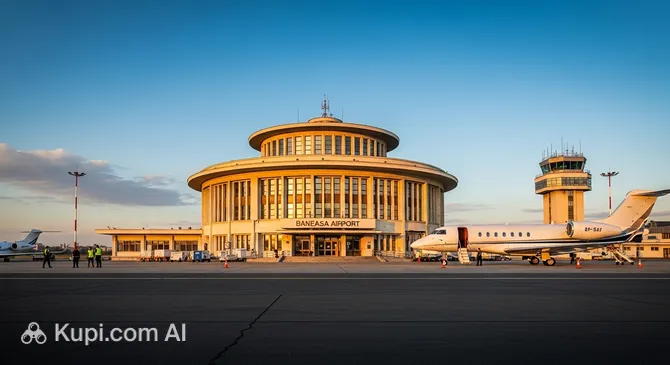
Baneasa. Source: Kupi.com Binoculars

Baneasa Airport is not merely a transport hub, but a true living legend of aviation, offering travellers a unique "boutique" flight experience. Unlike noisy and immense international hubs, an atmosphere of calm and elegance reigns here, and the terminal building itself is recognised as an architectural monument. Located practically within the city limits, this airport allows you to step off the plane and find yourself in the heart of the capital's events within minutes, bypassing exhausting traffic jams.

IATA Code BBU
ICAO Code LRBS
City Bucharest
Distance to centre 8 km
Status International (primarily business aviation and charters)
Passengers per year ~68,000 (figure rising with resumed scheduled flights)
Schedule Seasonal (please check the official website)

Airport Features and Benefits

The main advantage of Baneasa Airport is its exceptional location. It is situated just 8–9 kilometres from the city centre, in the northern part, which is considered the business and elite district of the capital. The journey to major office centres, Herastrau Park, or the Triumphal Arch takes mere minutes, making it the ideal choice for business travellers and those who value their time.

A second important feature is the speed of service. Thanks to the terminal's compactness and lower passenger flow, all pre-flight formalities here are completed as quickly as possible. Baneasa practically lacks the long queues for security or passport control typical of large airports. This allows passengers to arrive at the airport a bit later than usual, saving precious hours for rest or work.

One cannot overlook the historical atmosphere. The terminal building, designed in the shape of a propeller, is a striking example of mid-20th-century architecture. Inside, elements of classic decor, marble floors, and a sense of respectability have been preserved. Although the airport is equipped with modern technologies, it has retained the charm of aviation's "Golden Age," turning the wait for a flight into a pleasant part of the journey.

Contact Information

  • Official Website: www.bucharestairports.ro/baneasa
  • Information Desk Phone: +40 21 204 1000 (unified information centre for Bucharest airports)
  • Address: Șoseaua București-Ploiești nr. 40, Sector 1, Bucharest, Romania
  • Email: contact@bucharestairports.ro
  • Social Media: You can follow news about Bucharest airports on their official pages on Facebook and Instagram.
  • Lost Luggage Information: For issues related to lost or damaged checked baggage, please contact your airline's representative directly. If you have lost personal items within the airport premises, please use the general information desk contacts.
  • Passenger Support Service: For assistance and enquiries, you may use the main information desk phone number or write to the email address provided.

How to Get to the Airport

Baneasa - Aurel Vlaicu International Airport (BBU) is located in the northern part of Bucharest, just 8 km from the centre, making it easily accessible. The most economical way to reach it is by public transport. Several STB bus routes (e.g., 131, 335, 112, 605) stop in the immediate vicinity of the airport, connecting it to key points in the city, including Piața Romană. A bus trip is an excellent choice for budget travellers as the ticket cost is minimal.

There is no direct metro connection to Baneasa Airport. The nearest station, "Aurel Vlaicu" on the M2 line, is located at some distance, so an additional bus or taxi ride will be required from there. Similarly, there is no direct railway connection. From Bucharest's main railway station, Gara de Nord, it is most convenient to reach the airport by bus or taxi.

A more comfortable and faster option is a taxi or transfer. Official taxi services operate in the city, as well as popular ride-hailing apps like Uber and Bolt. A trip from the centre of Bucharest will take approximately 20-40 minutes depending on traffic conditions, and the cost will be roughly 30-50 RON. For maximum convenience, especially if you have a lot of luggage or are travelling at odd hours, you can book a private transfer in advance.

If you plan to travel around Romania by car, then car rental is a wonderful choice. Offices of many international and local rental companies are located in the airport area and in the city itself. For those arriving in their own or a rented vehicle, paid parking is provided within the Baneasa Airport territory, suitable for both short-term and long-term stays.

Important note for travellers: Baneasa Airport (BBU) is the capital's secondary airport and primarily serves business aviation, charter, and some budget flights. The city's main international air gateway is Henri Coandă International Airport (OTP), located nearby. Always check carefully which airport your flight departs from or arrives at to avoid confusion.

Terminals and Map

Baneasa - Aurel Vlaicu Airport (BBU) is distinguished by its compactness and historical significance. Unlike large international hubs, it consists of one passenger terminal that handles all flights—both departures and arrivals. The building, constructed in the mid-20th century, is an architectural monument and creates a special, almost intimate atmosphere.

Thanks to its simple and logical layout, navigating the airport causes no difficulties. All key zones—check-in counters, security checkpoints, the departure hall, and the arrival zone—are located in one building a short distance from each other. Signage and indicators help you orient yourself easily, and getting lost here is practically impossible. Since there is only one terminal, there is no need for transfers or shuttles between different buildings.

Departure and arrival zones are arranged sequentially. After entering the terminal, you immediately find yourself in the check-in area. After passing security control, passengers proceed to a small waiting hall. Check-in and security procedures at Baneasa Airport usually take significantly less time than at major airports due to the low passenger flow. Typically, all formalities take no more than 30-40 minutes, but it is always recommended to arrive in advance, following your airline's advice.

The main feature of the terminal is its historic status and relatively calm environment. The airport mainly serves business aviation and charter flights, so there is no hustle and bustle typical of large air gateways. This makes the stay at Baneasa more comfortable and predictable. The main advice for travellers: simply follow the signs—the entire path from the entrance to the gate is intuitive and will not take much time.

Airport History

Baneasa Airport, bearing the name of Romanian aviation designer and pilot Aurel Vlaicu, is one of the oldest operating airports in the world and has a rich history. Its journey began in 1909, when the flight school of the famous French aviation pioneer Louis Blériot was founded on this site. Baneasa officially received airport status in 1920, becoming the cradle of Romanian civil aviation and the country's first international airport.

In the interwar period, the airport developed actively. It was from here in 1922 that the first international flight on the Bucharest-Paris route departed, operated by the legendary Franco-Romanian airline CFRNA (later transformed into LARES, and then TAROM). The terminal building, which is an architectural monument today, was built between 1947 and 1952. For decades, Baneasa was the main air hub of Romania, hosting all international and domestic flights.

The situation changed with the opening of the new Otopeni International Airport (now Henri Coandă) in 1970. Baneasa gradually switched to domestic transport, and in the early 2000s became a popular base for budget airlines, leading to a sharp increase in passenger flow. This required modernisation: a large-scale reconstruction was carried out in 2007, significantly improving infrastructure and passenger comfort.

Since March 2012, Baneasa Airport has been repurposed and today serves mainly business aviation, charter, and government flights. This decision allowed for the decongestion of the capital's main airport and turned Baneasa into an elite city airport, located just a few kilometres from the centre of Bucharest. Its history is a living reflection of the evolution of global and Romanian aviation, from the first fragile aircraft to modern business jets.

Services and Amenities

Baneasa - Aurel Vlaicu Airport (BBU), being a city airport of Bucharest and focusing primarily on business aviation and private flights, offers passengers a compact but functional set of services, ensuring a comfortable stay before departure.

Within the terminal, you will find several cafes and snack bars where you can have coffee, grab a sandwich, or order light snacks. The selection of shops is limited, but here you can purchase press, souvenirs, and essential items. Since the airport serves predominantly private and business flights, the emphasis is on fast and high-quality service rather than extensive shopping.

For passengers who value elevated comfort, VIP lounges and a specialized General Aviation Terminal are available. Here you can wait for your flight in a calm atmosphere, hold a business meeting, or utilise additional services. Free Wi-Fi is available throughout the airport, and charging stations for electronic devices are installed in waiting areas.

Financial services are represented by ATMs and currency exchange points, allowing you to solve urgent monetary issues right upon arrival or before departure. To ensure passenger safety, a medical point operates at the airport, ready to provide first aid if necessary.

For travellers with children, mother and child rooms are provided, equipped with everything necessary for baby care. Special assistance is provided to passengers with reduced mobility. To receive this service, it is recommended to notify your airline of your needs in advance so that airport staff can organise accompaniment and comfortable movement through the terminal.

Although there are no hotels directly within the airport building, thanks to its location within city limits, there are many accommodation options nearby to suit any taste and budget. For business travellers, conference rooms and business centres are available, allowing meetings and events to be held without leaving the airport territory.

Where to Eat

Baneasa Airport (BBU), being compact and oriented mainly towards business aviation, offers passengers basic but convenient dining options. Do not expect a wide variety of restaurants here as in large international hubs; however, grabbing a snack or having a coffee before departure will not be difficult.

The main dining points are located in the main terminal, both in the public area before security control (landside) and in the departure zone (airside). Typically, these are cafés and snack bars offering a standard assortment: coffee, tea, soft drinks, beverages, as well as light snacks. This is an excellent option for those who want a quick bite or to relax while waiting for boarding.

The menus of these establishments are mainly focused on quick and convenient dishes. You will easily find sandwiches, fresh pastries, salads, and desserts. This is an ideal choice for a light breakfast or a quick snack, but for a full hot meal, the selection may be limited. Sometimes in local cafés, you can encounter elements of Romanian cuisine, for example, traditional pastries, which will be a pleasant bonus for curious gourmets.

Passengers with special dietary needs should be prepared for a limited selection. Vegetarians will be able to find simple salads or meat-free pastries; however, specialized vegan, gluten-free, or halal dishes are likely unavailable here. If you have strict dietary restrictions, it is more reliable to bring food with you. Prices at the airport are expectedly higher than in the city, and the opening hours of establishments usually coincide with the flight schedule.

Travel Tips

Travelling through Baneasa (Aurel Vlaicu) Airport in Bucharest can be very comfortable if you know a few nuances. This airport is smaller and quieter than the main international airport, Otopeni, and serves mainly private and charter flights. Here are a few tips that will make your trip even smoother.

Arrival Time and Check-in. Even for a small airport, it is recommended to arrive 2 hours before departure, especially if you need to check in luggage. This will give you enough time for all formalities without rushing. To save time, use online check-in if your airline provides such an option. Security procedures here are standard, but queues are generally shorter than at large airports.

Hand Luggage. Rules for carrying liquids are standard: containers up to 100 ml, packed in a single transparent bag with a capacity of up to 1 litre. Ensure there are no prohibited items in your hand luggage—sharp objects, flammable substances. Always check your airline's rules, as requirements for the weight and dimensions of hand luggage may differ.

Seat Selection and Transfers. When choosing a seat on the plane, be guided by your preferences: by the window for beautiful views, by the aisle for freedom of movement. Baneasa Airport is not a major transfer hub. If you have a connection, especially with a flight from Otopeni Airport, allow significant time for the transfer between airports, as it may take more than an hour considering city traffic.

Customs Control. For travellers within the EU, customs formalities are kept to a minimum. If you are arriving from a non-EU country, be prepared for the standard customs control procedure. Use the "Green Channel" if you have nothing to declare, and the "Red Channel" if you are carrying goods subject to declaration.

Savings and Unforeseen Situations. To save money, bring an empty water bottle with you and fill it after passing security. Prices for food and drinks at airports are traditionally higher. In case of a flight delay, contact your airline representative to learn about your rights (EU rules apply in Romania). Since the airport is small, the number of cafés and shops is limited, so in the event of a long delay, be prepared for a modest choice of entertainment.

Reached the end of the page?

That means the route is fully explored