Support

Iasi Airport

About the Airport

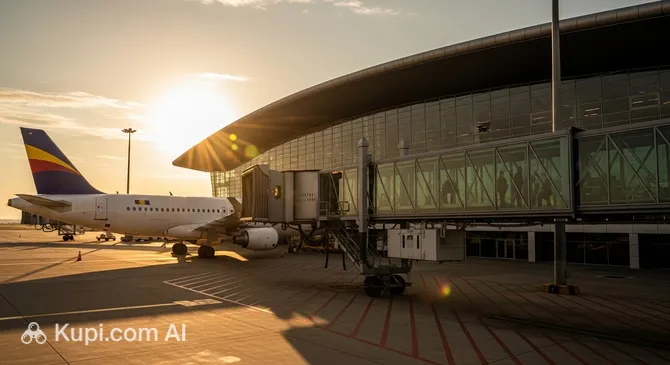
Iasi Airport. Source: Kupi.com Binoculars

Iasi Airport (IAS) is not merely a transit point, but a true aerial gateway to the cultural capital of Romania and the historic region of Moldavia. Situated on a picturesque hill just a few minutes' drive from the city centre, it welcomes travellers with stunning views even before landing. Thanks to extensive reconstruction and the opening of the new T4 terminal, the airport has strengthened its position, becoming the third busiest aviation hub in the country after Bucharest and Cluj-Napoca. This is a place where modern comfort intertwines with a cosy atmosphere, making the start of any journey through Eastern Europe easy and pleasant.

IATA Code IAS
ICAO Code LRIA
City Iasi
Distance to centre ~8 km
Status International
Annual Passengers ~2.3 million (2023 data)
Schedule Available online

Features and Advantages of the Airport:

The airport's main source of pride is its new Terminal T4, which has become the second-largest terminal in Romania. This modern three-level building has significantly increased capacity, offering passengers spacious waiting areas, numerous check-in counters, and advanced security systems. The airport serves as a major hub for low-cost carriers, opening up excellent opportunities for budget-friendly travel across Europe.

Another undeniable advantage is its location. The airport is very close to the city, and you can reach the centre in literally 15–20 minutes by taxi or the regularly running bus. The surrounding area is also notable: the airport borders the Ciric recreation area, so if you have a long layover, you can spend time in nature by the lake without venturing far from the terminal.

Contact Information

For your convenience, we have compiled essential contact information for the international airport of Iasi (IAS), which may be useful during trip planning or while travelling.

  • Official Website: www.aeroportis.ro
  • Information Desk Phone: +40 232 271 590
  • Address: Strada Moara de Vânt nr. 34, Iași 700750, Romania
  • Email: contact@aeroportis.ro
  • Social Media: The airport has an official Facebook page where current news and important information for passengers are published.
  • Lost & Found Information: In case of lost or damaged luggage, you should first contact the counter of the airline you flew with. Additional information can be obtained at the "Lost & Found" office in the arrivals area or via the airport information desk phone.
  • Passenger Support Service: For general inquiries and consultations, you can contact the main airport phone number.

Getting to the Airport

Iasi International Airport (IAS) is located just a few kilometres from the city centre, so getting there is quick and hassle-free. Travellers have access to various transport options — from budget buses to comfortable taxis and rental cars.

Public Transport

The most economical way to get to the airport is to use the city bus No. 50. The route connects key points of the city, including the central Piața Unirii square and the railway station, with the airport terminals. Buses run from early morning until late evening at regular intervals. The journey from the centre of Iasi takes approximately 20-30 minutes, and the ticket cost is about 3-3.5 RON (less than 1 Euro). This is an ideal choice for those travelling light and looking to save money.

Taxi and Transfer

For maximum comfort and speed, you can order a taxi or use ride-sharing services such as Uber or Bolt, which are widely available in the city. The trip from the centre to the airport will take about 15-20 minutes. The cost of the trip is usually 35–50 RON (approximately 7–10 Euro), making this a convenient and affordable option, especially if you are travelling with family or large luggage. We recommend ordering a car through official apps to avoid inflated prices.

Car Rental and Parking

If you plan to actively travel around Romania and explore its picturesque corners, renting a car will be a convenient solution. Most major international and local rental companies have offices at Iasi Airport. For those arriving in their own or rented vehicles, parking lots are provided on the airport territory. Both short-term and long-term parking zones are available within walking distance of the terminals.

Terminals and Map

The airport of Iasi (IAS) is a modern and rapidly developing aviation hub that has expanded significantly in recent years. A key feature of the airport is its new terminal infrastructure, designed to efficiently handle passenger traffic. As of 2024, the airport consists of four terminals, but two of the newest ones are actively used for passenger transport.

Terminal Structure:

  • Terminal T4 — This is the newest and largest terminal, opened in 2024. It handles all international flights (outside the Schengen area). The terminal is designed according to modern standards, with spacious waiting lounges, a large number of check-in counters, and the latest baggage handling systems.
  • Terminal T3 — Previously the main international terminal, it now specialises in domestic flights within Romania and flights to Schengen countries. It is located in immediate proximity to T4.
  • Terminals T1 and T2 — These are the old airport buildings. T1 has historical significance, and T2 previously served domestic flights. With the opening of the new terminals, their role in handling regular passenger flights has been minimised.

Navigation and Transfers Between Terminals

The airport layout is quite simple. Terminals T3 and T4 are located next to each other and are connected, allowing for easy movement between them on foot. You will not need shuttles or buses to transfer. Navigation inside is intuitive thanks to clear signs in Romanian and English. Departure zones (check-in desks, security control) and arrival zones (baggage claim, customs) are clearly separated. In the new Terminal T4, departure and arrival halls are located on different levels to optimise passenger flows.

Time for Procedures and Recommendations

Although Iasi Airport is not a giant hub, we recommend arriving in advance, especially if you are flying from the new Terminal T4 during peak season.

  • For international flights (T4): arrive 2.5–3 hours before departure. This time is sufficient for calmly completing check-in, baggage drop, passport control, and security screening.
  • For domestic and Schengen flights (T3): arriving 1.5–2 hours before departure is sufficient.
To avoid confusion, be sure to check the departure terminal number indicated on your flight ticket, as recent changes in airport operations may not yet be familiar to everyone.

Airport History

The history of Iasi Airport (IAS) dates back to the first half of the 20th century, making it one of the oldest airports in Romania. The official founding date is considered to be June 24, 1926, when a regular air route linking Bucharest, Galati, Iasi, and Chisinau was opened. In the first decades of its existence, the airport served mainly domestic flights and had a dirt runway.

A significant stage of development began in the post-war period. In 1969, the first concrete runway with a length of 1800 metres was built, and the first passenger terminal was erected. This allowed for the reception of more modern aircraft, such as the An-24 and Tu-134, and substantially expanded the geography of flights. However, the real breakthrough occurred in the 21st century.

With the start of the 2000s, the airport entered a phase of active modernisation. In 2001, Terminal 2 was opened, and in 2012, a large-scale expansion project began. In August 2014, a new runway 2400 metres long was put into operation, capable of accommodating large airliners, and in October of the same year, the new Terminal 3 was inaugurated. These changes transformed the airport into an important international hub in the northeast of the country.

Thanks to modernisation, passenger traffic began to grow rapidly, and already in 2017, the airport served its millionth passenger. Continued growth required further expansion: in 2024, the modern Terminal 4 was opened, increasing capacity to 3.5 million passengers per year and becoming the second largest in Romania. Today, Iasi Airport is a modern aviation complex playing a key role in the region's transport system and continuing its glorious history.

Services and Amenities

Iasi Airport (IAS) offers passengers all necessary amenities for a comfortable wait for their flight. Regardless of the purpose of your trip to Romania, you will find quality service here. The terminals feature various cafes and restaurants where you can have a snack or a full meal, as well as shops, including Duty Free. Here you can purchase souvenirs, perfumes, confectionery, and other goods.

For those who value enhanced comfort, a business lounge is available at the airport, offering a secluded atmosphere, snacks, and beverages. Free Wi-Fi is available throughout the airport, and special stations are provided for charging gadgets. This allows passengers to stay connected and handle work matters while waiting for departure.

At Iasi Airport, travellers have access to ATMs and currency exchange points, which is particularly convenient for international guests. In case of need, there is a medical point in the terminal ready to provide first aid. For passengers with children, mother and child rooms are equipped where you can take care of little ones in a quiet environment.

The airport is fully equipped for the needs of passengers with reduced mobility. Special assistance is provided during boarding and disembarking, and terminal infrastructure includes ramps and adapted restrooms. Although there are no hotels directly within the airport building, many hotels for every taste and budget are located just a few minutes' drive away. For business travellers, conditions in the business lounge allow for productive time, though specialised conference centres are absent on the premises.

Dining Options

At Iasi Airport, passengers will find several establishments where they can have a snack or a full lunch. The main dining spots are concentrated in the newest and largest Terminal 4, which handles the majority of flights. There are cafes and restaurants both in the public area (before security control) and in the departure zone (after control).

For those who want a quick coffee and something light, coffee shops are perfect. In the public area of Terminal 4, there is Tucano Coffee, and in the departure zone of Terminal 3 — Gloria Jean's Coffees. Here you will be offered various coffee drinks, fresh pastries, sandwiches, and desserts. This is an excellent choice if you are short on time. Estimated prices: coffee — from 15 RON, sandwich — from 25 RON. Most establishments operate according to the flight schedule, from early morning until the last departure.

If time permits, you can dine at the Travel Chef restaurant, located in the departure zone of Terminal 4 (after passing control). The menu here is more diverse and includes hot dishes, soups, and salads. This is a good opportunity to try dishes of Romanian cuisine if they are featured on the menu. The cost of a main course starts from approximately 40 RON. In the public area of Terminal 4, the fast-food establishment La Peneș also operates, specialising in chicken dishes.

Passengers with special dietary needs should note that the selection may be limited. Vegetarian options, such as vegetable salads or sandwiches, are generally available in cafes. However, finding certified vegan or gluten-free dishes may be difficult. For a quick snack at any time of day, vending machines with drinks, chips, and chocolate are installed in the terminals.

Travel Tips

Planning is the key to a stress-free start to any journey. By following these tips, you can make your stay at Iasi Airport as comfortable as possible and avoid unforeseen situations.

Arrival time at the airport. To avoid rushing, arrive at the airport in advance. For international flights, it is recommended to arrive 2.5-3 hours before departure, while for domestic flights or flights to Schengen countries, 1.5-2 hours will be sufficient. This time is enough to check in luggage without haste, pass all controls, and find your boarding gate.

Check-in and Security Control. The easiest way to save time is to complete online check-in on the airline's website. At security control, keep your passport and boarding pass ready. All electronics (laptops, tablets) must be removed from bags, and liquids in carry-on luggage must be in containers of no more than 100 ml and packed in a single transparent bag.

Choosing a seat on the plane. A window seat will offer you beautiful views during takeoff and landing, while an aisle seat provides more legroom and the ability to stand up freely without disturbing neighbours. If flying with children or if you simply value comfort, consider paying extra for seats with increased legroom.

Carry-on Luggage. Be sure to check your airline's carry-on allowance, as weight and size requirements may vary. Remember general rules: sharp objects and flammable liquids are prohibited in the cabin. All gels and aerosols must be in volumes of no more than 100 ml.

Connecting Passengers. If you have a connecting flight in Iasi, clarify when checking in your luggage whether you need to collect and re-check it. For self-transfers, allow sufficient time to complete all formalities: baggage claim, re-check-in, and security control.

Customs Control. When flying from Romania to a country outside the EU, you will need to pass customs control. If you have no goods to declare, proceed through the "Green Channel". If you are carrying goods exceeding established limits (for example, large sums of cash, tobacco, or other taxable items), you must choose the "Red Channel".

Saving Time and Money. A pre-booked transfer often costs less than a taxi taken on the spot. To avoid spending on drinks, bring an empty reusable bottle and fill it with water at a drinking fountain after the security zone. Small snacks brought from home will also help you save.

In Case of Flight Delay. Remain calm and monitor the departure boards for information. Contact your airline's representative counter for the latest updates. Remember that when flying from the EU, you are protected by passenger rights, which may include the provision of food, beverages, and in some cases, monetary compensation.

Reached the end of the page?

That means the route is fully explored