Support

Obelisk Center of Asia

About

The "Center of Asia" Obelisk is a landmark monument located in the city of Kyzyl, the capital of the Republic of Tuva, which is part of Russia. It is situated on a scenic embankment at the confluence of two rivers — the Big Yenisei (Bii-Khem) and the Little Yenisei (Kaa-Khem), which form the mighty Yenisei. This monument is one of the main symbols of the city and all of Tuva, attracting both locals and tourists alike.
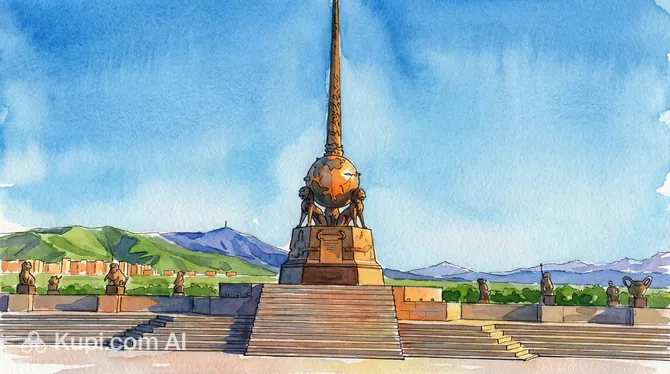
Obelisk Center of Asia. Illustration.
Source: Kupi.com AI

Traveller photos:

The monument symbolizes the geographical center of the Asian continent, although it is worth noting that this is a symbolic rather than a strictly scientific determination of the exact geographic point. Nevertheless, the idea of being in the "heart of Asia" gives this place a special aura and significance. The first obelisk was installed here in 1964, and the modern, more majestic version appeared in 2014.

The modern "Center of Asia" sculptural composition features a high spire topped with a globe supported by three stylized lions. The globe is decorated with dragon images in an oriental style, and the pedestal features bas-reliefs of animals symbolizing the richness of the region's fauna. The central element of the composition is a scroll with the inscription "Center of Asia" in three languages: Russian, Tuvan, and English. This place is not just a landmark, but a point of attraction where you can feel the vastness and unique culture of this region.

Contacts

The "Center of Asia" Obelisk is a landmark monument in the city of Kyzyl, which is open to the public at any time. As it is a public site and a well-known attraction, no special contact information is usually required for a visit. You can easily find the obelisk using city maps or by asking locals for directions, as it is one of the key symbols of the region.

How to contactContact
AddressUlitsa Krasnykh Partizan, 9, Kyzyl, Respublika Tyva, Russia, 667000

What to Do

Visiting the "Center of Asia" Obelisk in Kyzyl is an opportunity to experience a unique symbol marking the geographical center of the Asian continent. Guests can enjoy the majestic architecture of the monument, crafted in an original Scythian style. Its artistic design is inspired by ancient Iron Age archaeological finds, making it not just a monument but a true work of art. This location is perfect for photo sessions, as it offers picturesque views of the mighty Yenisei and the city skyline.

A well-maintained embankment stretches around the obelisk, which is an attraction in its own right. Here, visitors can take a leisurely stroll along the river, admiring the surrounding landscapes. Various city festivals, cultural events, and folk celebrations are often held on the embankment, adding local color and allowing you to immerse yourself in the local atmosphere.

In addition to the obelisk itself, other interesting sculptural compositions can be seen on the promenade, such as the expressive "Royal Hunt" group. For those who want to dive deeper into the history and culture of Tuva, information plaques and bas-reliefs are installed on the monument's pedestal and along the promenade. They tell the stories of significant events and traditions of the region, providing a better understanding of this amazing place and its significance.

Getting There

Getting to the "Center of Asia" Obelisk in Kyzyl is quite simple, as it is one of the city's main symbols and is located in its central part. The monument is situated on the scenic Yenisei embankment, making it easily accessible for a walk. If you are staying in the center of Kyzyl, you can reach the obelisk in a short time while enjoying views of the city and the river.

For those who prefer public transport, many city routes pass near the Yenisei embankment. You can check with locals or use a map to find the stop closest to the obelisk. Taxis are also always an option — a fast and comfortable way to reach the attraction from anywhere in the city. Just tell the driver "Center of Asia Obelisk" or "Yenisei embankment," and you will be taken to your destination without any trouble.

Since the "Center of Asia" Obelisk is located in close proximity to other significant tourist sites in Kyzyl, it is convenient to combine your visit with other sightseeing. When planning your route through the city, you can easily include this iconic monument in your itinerary.

Nearest city: Kyzyl

History & Facts

The "Center of Asia" Obelisk in the city of Kyzyl is not just an attraction, but a symbol with a history dating back to the early 20th century. The idea of determining the geographical center of Asia emerged at the turn of the 19th and 20th centuries. In 1910, the engineer V. M. Rodevich mentioned in his notes a traveler who, according to legend, erected a symbolic post at the Saldam estate on the banks of the Yenisei, thus marking the presumed center of the continent. This event marked the beginning of the monument's history, which today attracts many tourists to Russia.

During the Soviet period, various commemorative signs dedicated to this idea appeared in Kyzyl, but the first full-scale "Center of Asia" Obelisk was erected in 1964. It was designed by the artist Vasily Demin. The monument consisted of a two-meter marble base topped with a globe and a three-sided spire, symbolizing upward aspiration and the region's central position. For many years, this monument was an important point on the city map and confirmation of its unique geographical status.

The "Center of Asia" monument acquired its current, more majestic appearance in 2014. This event was timed to an important anniversary — the centenary of the unification of Tuva and Russia. As part of a large-scale reconstruction of the Yenisei embankment, a new obelisk was installed, designed by the famous Buryat artist and sculptor Dashi Namdakov. The new monument became not only a symbol of the geographical center but also a striking embodiment of the region's rich culture and history, harmoniously fitting into the renovated urban space of Kyzyl.

Time Needed

When planning a visit to the "Center of Asia" Obelisk in Kyzyl, keep in mind that a standard tour of this iconic site and a walk along the adjacent Yenisei embankment usually take 30 to 60 minutes. This is quite enough time to get to know the monument, enjoy the views, and take some commemorative photos.

However, if you want to dive deeper into the atmosphere of this unique place, your stay here might take more time. For example, if you plan a detailed photo session, wish to join a guided tour to learn about the history and symbolism of the obelisk, or if your visit coincides with a cultural event taking place in the square. In such cases, feel free to allow 1-2 hours or even more to enjoy all aspects of this remarkable corner of Russia at a leisurely pace.

Working Hours

The "Center of Asia" Obelisk in Kyzyl, as well as the adjacent embankment, are available for visiting 24/7 every day of the week. This means you can enjoy the view of this iconic monument at any time convenient for you, whether it's early morning, midday, or late evening.

Visiting the "Center of Asia" Obelisk is free of charge. Thanks to its 24-hour access and the absence of entrance fees, no advance booking or registration is required. The attraction is open to everyone year-round.

8:00 – 22:00

Nearby

Visiting such an iconic site as the "Center of Asia" Obelisk is just the starting point for exploring the amazing city of Kyzyl. To truly experience the spirit of this place and get the most out of your visit, it is worth paying attention to the attractions located nearby.

Exploring the surroundings will allow you not only to see more interesting sites but also to better understand the culture and history of the region. A short walk or drive can reveal new facets of Kyzyl that you might not have known existed.

NameDistance
Tsechenling Buddhist Center0.5 km
Arat Square0.7 km
Tyva Republic National Park0.9 km
Tuva National Museum1.2 km
Mio Pizza2.4 km
Aristokrat2.6 km

Reached the bottom of the page?

Looks like you know this route inside out