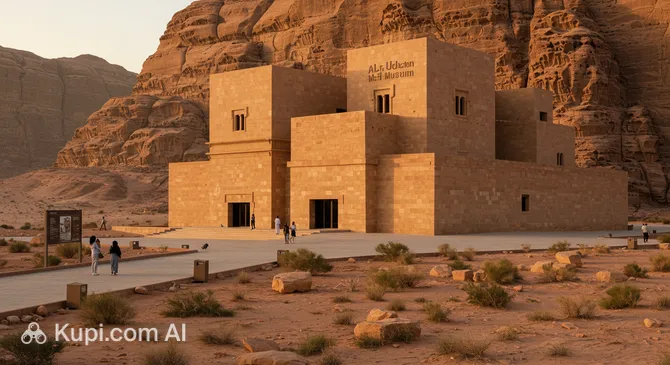
AlUla Museum is a modern cultural center located in the heart of the ancient AlUla region. It is a vital part of an ambitious project to transform this area into the world's largest "open-air museum," spanning over 200,000 years of human history.
AlUla Museum. Illustration.
Source: Kupi.com AI
Traveler photos:
This institution in Saudi Arabia serves as a primary gateway to the past, showcasing artifacts from prehistoric times to the Nabataean era and the rise of Islamic culture. The museum helps travelers grasp the scale of the region's heritage, where legendary kingdoms once flourished and ancient trade routes passed through.
Thanks to its integration into the landscape and focus on preserving memory, it is a must-visit for those who want to see the authentic treasures of the Arabian desert and understand why UNESCO included nearby Hegra on its World Heritage List.
Contacts
For more details before your visit, you can use the official contact information. Please note that obtaining up-to-date information from primary sources will help you better plan your visit.
Within the museum's galleries, visitors will encounter rare artifacts: from Paleolithic stone tools to exquisite everyday objects from the era of the Kingdoms of Dadan and Lihyan. You can see how writing, architecture, and crafts have changed over thousands of years as you move through halls dedicated to different historical eras.
Special attention should be paid to the exhibition dedicated to the Incense Road. Here, you can learn how ancient traders crossed the sands carrying precious resins and spices, and the role oases played in their journey. Interactive elements and detailed maps help visualize the complex trade routes that connected India, Arabia, and the Mediterranean.
After exploring the indoor exhibits, take note of the architectural context of the entire complex. The museum is closely linked to other cultural landmarks in the city, such as Design Space AlUla and the mirror-clad Maraya concert hall. A walk between these sites allows you to appreciate how modern art and architecture harmonize with the majestic natural landscape.
Getting There
Getting to this unique location in the northwest of the country is quite straightforward. The region's main transportation hub is Prince Abdul Majeed bin Abdulaziz International Airport (ULH), which handles both domestic flights from the kingdom's major cities and international arrivals. From the airport to the museum, it is most convenient to take a taxi or a pre-booked tourist transfer.
For those who prefer independent travel by rental car, the region is connected to other cities by a network of modern roads. For example, the drive from Medina takes about 3-4 hours (approximately 300 km) along scenic desert highways. GPS coordinates: 26.6086648°N, 37.9232758°E.
Within the city itself and its surroundings, public transport is limited, so most tourists rely on taxis or organized tours. The museum is located in the central part of the Al Sukhayrat district, making it accessible for those staying in nearby hotels.
Nearest city: AlUla
History & Facts
The AlUla region has served as a key crossroads of civilizations for the last 2,500 years. Its strategic position on the famous Incense Road made the local oasis a coveted resting place for trade caravans traveling from India and Southern Arabia to the shores of the Mediterranean.
Archaeological finds indicate that human activity in these parts began as far back as the Paleolithic era (over 200,000 years ago). The powerful Kingdoms of Dadan and Lihyan flourished here, controlling trade and creating unique irrigation systems that allowed for survival in harsh desert conditions. Later, the region became part of the Nabataean Kingdom, which left behind the majestic Hegra.
The modern history of these lands is also full of changes. In the 1980s, residents finally left the Old Town, and in 2017, the Royal Commission for AlUla (RCU) was established. It is under its auspices that new museum spaces are being created today, designed to carefully preserve and showcase the colossal historical heritage of the Arab East to the world.
Time Needed
For most travelers, 2 to 3 hours is sufficient to explore the museum's main collection. This is enough time to leisurely view the key artifacts and study the information panels explaining the succession of eras in this region.
However, if you are a true history buff and plan to visit nearby sites like the Old Town or archaeological zones, it's worth dedicating a full day to exploring this area. Keep in mind that immersing yourself in the atmosphere of a "living museum" requires a sense of contemplation and no rushing.
Working Hours
Currently, the museum may be undergoing temporary updates to its exhibits or reconstruction. According to available data, the site is sometimes marked as "temporarily closed," so it is crucial to verify current information before your visit.
It is recommended to check the official website of the Royal Commission for AlUla or contact the local visitor center in advance to find out the exact opening hours and any possible schedule changes during public holidays.
Nearby
Exploring the museum's surroundings will allow you to dive deeper into the atmosphere of the ancient oasis. AlUla offers many interesting locations just a few minutes' drive away, each revealing a new facet of the region's history.