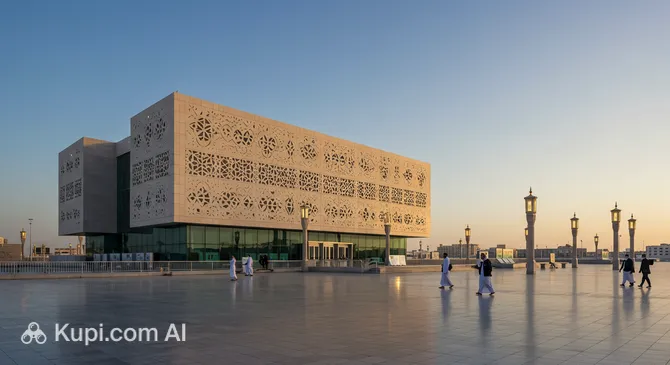
Located in the heart of the holy city of Medina, the Assalam Museum is a unique space where history meets modern technology. This cultural landmark of Saudi Arabia is situated in close proximity to the western side of the Prophet's Mosque (Masjid an-Nabawi), making it a must-visit for every tourist and pilgrim.
Assalam Museum. Illustration.
Source: Kupi.com AI
Traveler photos:
Covering an impressive area of 17,400 square meters, the museum is entirely dedicated to the rich heritage of Islamic civilization. It houses an impressive collection of rare manuscripts and artifacts that illustrate key moments in the development of religion and culture. The primary focus is on the values of peace, mercy, and tolerance, which is reflected in the museum's name (Assalam translates as "Peace").
The project, implemented under the auspices of the Muslim World League, offers visitors not just an exhibition, but a deep educational immersion. Thanks to interactive installations, the history of the ancient city and the life of the Prophet come to life before the guests' eyes, turning an ordinary tour into a fascinating journey through the centuries. Its high rating and positive reviews confirm the museum's status as one of the region's most significant educational platforms.
Contacts
To clarify visiting details, you can refer to the following contact information:
In the halls of the Assalam Museum, visitors can expect an immersive dive into the past. Here, you can see detailed dioramas and models recreating the appearance of ancient Yathrib and the early stages of the Prophet's Mosque construction. Interactive screens and modern installations allow you to literally "walk" through the streets of old Medina and learn about the daily life of its residents, architectural monuments, and ancient water supply systems.
Special attention should be given to the thematic zones dedicated to the Hijrah and the history of the first mosques, such as Quba and Al-Qiblatayn. For those interested in culture, the museum offers educational programs and workshops that reveal the essence of Islamic traditions and values. This place is ideal for quiet contemplation and studying the chronology of the Islamic world's development from the pre-Islamic era to the present day.
After finishing the tour, guests can walk to the Bab al-Salam gate. Having visited the museum filled with historical facts, the sight of the Prophet's Mosque is perceived completely differently—you begin to see the deep layers of history behind the modern grandeur that you just learned about in the exhibition halls.
Getting There
Finding the Assalam Museum is very easy due to its exceptional location. It is located directly on the western side of Masjid an-Nabawi, next to the Bab al-Salam gate. If you are already on the mosque grounds, you only need to walk about 300 meters northwest along the first road leading from the complex—the museum building with a prominent sign will be on your left.
For those coming from other parts of the city, it is most convenient to use a taxi or public buses heading to the central stops near the Prophet's Mosque. It is worth noting that the Al Haram area is very busy, so private transport may face difficulties finding parking. The journey from Medina International Airport (PRINCE MOHAMMAD BIN ABDULAZIZ) by taxi will take approximately 20–30 minutes.
Nearest city: Medina
History & Facts
The Assalam Museum, also known as the "Museum of Peace," was created with a noble mission—to reveal the deep meanings of Islamic civilization and show the role of Medina as the cradle of faith. The museum's exhibition is carefully structured and divided into 10 thematic halls, each based on verified historical sources.
Particular attention is paid here to the city's pre-Islamic period, when it was still called Yathrib. Visitors can learn about the life of ancient tribes, the development of agriculture, and trade routes. One of the key sections is dedicated to the Hijrah—the migration of Prophet Muhammad, which became a turning point in history. The museum recreates in detail the stages of building Masjid an-Nabawi and the formation of the first Islamic constitution.
An important part of the museum's concept is the emphasis on values of peace and tolerance. Through interactive installations, the project's authors aim to convey the true essence of Islamic traditions to a global audience, telling stories not only of religious rites but also of the social and architectural development of the region over the centuries. The museum is managed by the Muslim World League and represents a significant contribution to preserving the cultural heritage of the region.
Time Needed
To leisurely explore all ten halls, study the models of ancient Medina, and watch the interactive presentations, the average visitor will need from 2 to 3 hours. The exhibition is quite dense, so setting aside less time is not recommended if you want to delve into the historical details.
Given its proximity to the city's main shrine, a visit to the museum is best combined with a visit to the Prophet's Mosque. It is recommended to plan your trip to the museum in the morning or immediately after the opening of the evening shift to avoid large crowds of pilgrims and study the artifacts in a calm environment.
Working Hours
The museum operates on a convenient schedule with a break in the middle of the day, allowing you to plan your visit for either the morning or evening. The complex is open daily from Monday to Sunday.
The schedule is divided into two shifts:
Morning shift: 08:00 – 12:00
Evening shift: 17:00 – 23:00
This schedule is maintained throughout the week, providing access to the exhibitions even for those busy during the day.
8:00 – 12:00, 5:00 – 23:00
Nearby
The area around the museum and the central mosque focuses on spiritual life; however, a little further from the historical center, you can find many places for family recreation and entertainment.
A stroll through the surrounding areas will allow you to see the modern face of the city, where traditional hospitality is combined with well-developed infrastructure for tourists with children.