Support

Cavenagh Bridge

About

Cavenagh Bridge is more than just a crossing; it is the oldest surviving pedestrian suspension bridge in Singapore. Built in 1869, it was the first steel engineering structure of its type in the city and still retains its original Victorian appearance. The structure spans 79 meters, and its elegant forms blend seamlessly into the historical landscape on the banks of the Singapore River.
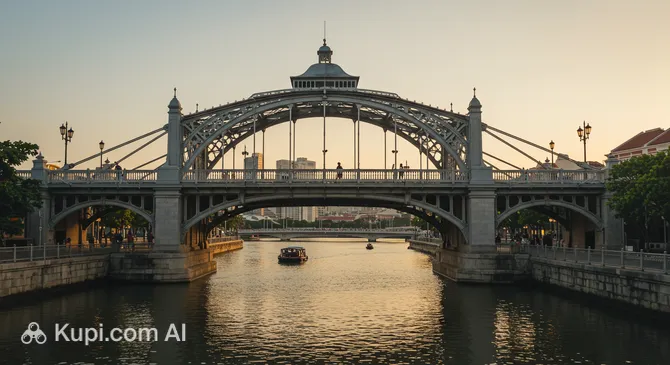
Cavenagh Bridge. Illustration.
Source: Kupi.com AI

Traveler photos:

This national monument earned its name in honor of Major General William Orfeur Cavenagh. Originally, the bridge was intended for horse-drawn traffic, but due to its design features, heavy carriages and cattle weighing more than 152 kilograms were banned from crossing by the late 19th century. Today, it is an exclusively pedestrian zone connecting the business district with the city's cultural center.

Of particular value are the details: the steel arched braces manufactured in Glasgow and the antique bronze gas lamps that still adorn the structure. At the ends of the bridge, you can see the Cavenagh family coats of arms, highlighting the aristocracy and historical significance of this site.

Contacts

For those planning a visit to this historical location, it is useful to have official information at hand. Although the bridge does not have a separate support service or ticket office, it is protected by Singapore's national heritage bodies.

How to contactContact
Address1 Fullerton Square, Singapore 049178
Websitewww.roots.gov.sg

What to Do

A walk across Cavenagh Bridge is a must for lovers of atmospheric photography and Victorian aesthetics. It offers magnificent panoramic views of the Singapore River and the lively Boat Quay. It is especially interesting here to watch the movement of river boats, which skillfully maneuver under the low spans depending on the tide levels.

Be sure to pay attention to the preserved antique plaques at the entrance. They still display prohibitions that seem amusing to the modern tourist: for example, elephants and camels are not allowed to cross here. These details turn an ordinary walk into a fascinating immersion into the past of a 19th-century port city.

A visit to the bridge is easily combined with exploring other iconic sites in the Colonial District. Very close by is the Sir Stamford Raffles Landing Site, the Old Parliament House, and the famous Cricket Club. After examining the architectural details and family coats of arms on the bridge, you can head to the quay to finish your walk with dinner at one of the many waterfront restaurants.

Getting There

The historic site is located at 1 Fullerton Square, in the heart of the business and tourist center. The easiest way to get here is by public transport, as parking in the area is very limited. The nearest metro station (MRT) is Raffles Place (North South and East West lines), which is no more than a 5–7 minute leisurely walk away. You can also walk from Clarke Quay station in about 10 minutes.

If you prefer buses, routes 51, 97, 100, and 130 stop in the immediate vicinity of Fullerton Square or Boat Quay. A taxi or Grab ride from the Marina Bay Sands area will take about 10 minutes and cost approximately 10–20 SGD, depending on the time of day and traffic conditions.

For tourists arriving from Changi Airport, the best option is to take the MRT towards Tanah Merah station and then transfer to the Green Line to Raffles Place — the entire journey takes about 45 minutes. A taxi from the airport will be faster (about 30–40 minutes) and more comfortable if you are traveling with luggage.

Nearest city: Singapore

History & Facts

Construction of this crossing began in 1867 and was completed by 1869, just in time for a significant date — the 50th anniversary of the founding of Singapore. Interestingly, this structure was the last bridge in the city built using convict labor. It was originally planned to be named Edinburgh Bridge to mark the visit of the Duke of Edinburgh, but it was ultimately named after William Orfeur Cavenagh, the last Governor appointed by the East India Company.

The engineering solution for the bridge was truly international: the structure was designed and manufactured in Glasgow (Scotland). After successful testing in its homeland, it was dismantled into parts, shipped across the ocean, and reassembled on the banks of the Singapore River. However, design miscalculations soon became apparent: due to the nature of the tides, boats often had to wait for low water levels to pass under the spans.

In 1880, the weight-bearing capacity of the structure began to cause concern, and authorities introduced a strict ban on heavy vehicle traffic. Since the beginning of the 20th century, all vehicular traffic has ceased, and the site officially became exclusively pedestrian. In 1987, the city allocated 1.2 million dollars for a large-scale five-month restoration to strengthen the steel elements and preserve this unique national monument for future generations.

Time Needed

For a quick look and a few memorable shots against the backdrop of the river, 30–60 minutes will be enough. This time is quite sufficient to take a leisurely stroll across the old deck, examine the decorative elements, and read the historical plaques.

If you plan to include this spot in a larger walking route through the Colonial District, you should set aside 1–2 hours. This will allow you not only to enjoy the atmosphere by the Singapore River but also to visit neighboring squares or relax in one of the cozy cafes on the Boat Quay waterfront.

Working Hours

The site is open to visitors daily and around the clock. There are no gates or checkpoints, so you can come here early in the morning to catch the sunrise over the river without the crowds of tourists, or late in the evening when the bridge is beautifully illuminated by city lights.

According to official data, the schedule is as follows:

  • Monday: 24 hours
  • Tuesday: 24 hours
  • Wednesday: 24 hours
  • Thursday: 24 hours
  • Friday: 24 hours
  • Saturday: 24 hours
  • Sunday: 24 hours

Open 24 hours

Nearby

Its location in the historic center makes visiting this site an excellent starting point for a broader exploration of the city. A walk along the quays will allow you to see the contrast between colonial architecture and modern skyscrapers.

NameDistance
Clarke Quay Central Karaoke0.6 km
Lau Pa Sat0.7 km
Melt Café0.7 km
ArtScience Museum0.8 km
Marina Bay Sands0.8 km
Singapore Flyer1.2 km
National Museum of Singapore1.2 km

Reached the end of the page?

That means the route is fully explored