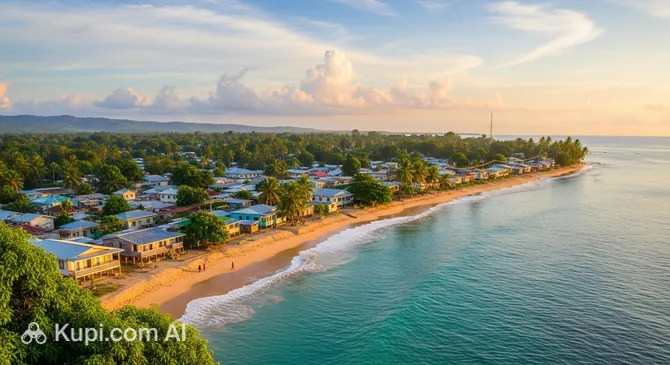
Exploring the cultural and natural landscape of Kirakira requires a shift in perspective; you will not find manicured botanical gardens or air-conditioned museums with ticket counters here. Instead, the town itself serves as a living exhibition, where the "parks" are functional community spaces bordered by untamed jungle, and the "museums" are the historic buildings and vibrant traditions kept alive by the local people. The charm of this provincial capital lies in its open-air heritage and the seamless integration of nature into daily life.
The Town Oval (Station Field)
In the absence of formal city parks, the large, grassy Town Oval in the center of the station acts as the community's primary green space and social heart. Surrounded by rain trees and government buildings, this field is much more than a patch of grass; it is the stage for the province's intense sporting culture. In the late afternoons, it transforms into a bustling arena for cricket and football matches, which are played with passionate competitiveness. For a tourist, sitting on the sidelines here offers the best "people-watching" experience in town, providing a window into the local community spirit that rivals any organized cultural show.
The Coastal Fringe and Black Sand Beaches
Nature serves as the city's greatest recreational area. The coastline stretching east and west from the main wharf functions as a natural linear park. These beaches are characterized by their glistening black volcanic sand and driftwood logs, which serve as natural benches for sunset viewers. While not maintained like a resort beach, this wild coastal fringe is where locals come to cool off, fish, and relax. The contrast between the dark sand, the deep blue of the Pacific, and the bright green of the overhanging palms creates a dramatic, photogenic landscape that is free for anyone to explore.
Makira's Rainforest Edge
Just steps away from the town center, the urban environment dissolves into the dense Makira Rainforest. While not a demarcated park with paved trails, the forest edge offers immediate access to one of the most biologically diverse ecosystems in the Solomon Islands. Visitors can take short walks along the dirt tracks leading inland to find themselves surrounded by towering banyan trees and ferns. This area is a haven for birdwatchers hoping to spot endemic species like the Makira Flycatcher, effectively serving as a vast, open-air aviary.
The Historic Government Station
Kirakira does not possess a dedicated building labeled "museum," but the Government Station area operates as an open-air historical site. Established during the British colonial era, this district retains the layout and architecture of the mid-20th century. Visitors can walk among the raised wooden administrative buildings with their wide verandas and louovered windows, designed to maximize airflow before the age of electricity. These structures stand as silent witnesses to the transition from a protectorate to an independent nation, offering architectural enthusiasts a tangible connection to the past.
Local Churches and Choral Traditions
In the Solomon Islands, culture is often preserved within the church, and Kirakira is no exception. The town's main Anglican Church serves as a cultural repository for the community. While not a museum of artifacts, it is a "museum of sound" and living tradition. The province is renowned for its intricate choral harmonies, and attending a Sunday service allows visitors to experience this intangible cultural heritage firsthand. The fusion of traditional Melanesian melodies with Christian hymns creates a unique art form that is deeply moving and central to the identity of the Makira people.
Authentic Experience: The "Story" Session
Since history here is oral rather than written, the best way to learn about the past is to seek out a "story" session. Ask your guesthouse host if they can arrange a visit to a nearby village elder. Sitting on a woven mat, listening to legends about the Kakamora (mythical forest dwarfs) or tales of ancient navigation, provides a cultural education far richer than reading a plaque on a wall. It is a rare opportunity to engage with history that is still breathing and evolving.