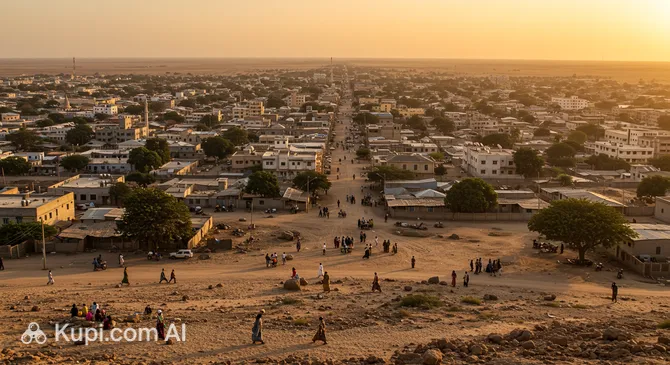
Burao is the pulsating heart of the northern Togdheer region, a city rightfully considered one of the most important trading hubs in Somalia. As the second-largest city in this part of the country, it draws travelers with its authentic energy, where age-old nomadic traditions meet the rhythm of a modern commercial center. There is no capital-city pretension here, but there is plenty of real life: from bustling, dusty markets to leisurely evening conversations in local tea houses.
Burao. Illustration.
Source: Kupi.com AI
The city is situated on a high plateau, which shapes both its geography and way of life. With a population estimated by various sources to reach 750,000, Burao is a dynamically growing metropolis. Exploring the city's rich history allows for a better understanding of its role as the administrative and cultural foundation of a region that has maintained its status as a key market for all of East Africa for decades.
The main feature of Burao is its unique "market city" atmosphere. Here, you can see the largest caravans in the region, and the local hospitality—despite the harsh semi-desert climate—is as warm as the sun. A visit to Burao is an opportunity to see the region without tourist filters, immersing yourself in the daily lives of traders, livestock herders, and artisans whose labor has sustained this land for centuries.
Weather Overview
Burao is located in an arid semi-desert climate zone, which determines the weather conditions throughout the year. The sun shines almost constantly here, and temperatures remain high regardless of the season. A typical day in the city is a combination of dry heat and occasional dusty winds coming from the plains.
On average, temperatures range from +20°C to +26°C, but during the hot months (May – September), the daily maximum can exceed +31°C. The coldest nights occur in December and January, when the thermometer can drop to +14°C, requiring a light jacket or sweater. It is worth studying detailed information about the Burao climate in advance to choose the right wardrobe for your trip.
Precipitation in the region is rare. The main rainy periods occur in April – May and October – November. The rest of the year, the city lives in a dry season mode. Due to the lack of dense greenery, Burao can often be dusty, especially in windy weather, so travelers are advised to carry accessories for face and eye protection.
Average monthly temperature
Average monthly precipitation
Interesting Facts
Major Hub: Burao is the second most important commercial center in the region, specializing in the export of livestock to Saudi Arabia and other Gulf countries.
Explosive Growth: In just a few decades, the city has made an incredible leap: while just over 12,000 people lived here in 1962, the population is now counted in the hundreds of thousands.
Regional Status: Historically, Burao served as the capital of the vast Togdheer region, which in the past included the territories of the modern Sool and Sanaag provinces.
Nomadic Heritage: About 58% of the Burao district's population still leads a rural or nomadic lifestyle, making the city a unique meeting point for urban and traditional steppe cultures.
Trading Crossroads: Due to its location, the city serves as a link between the port of Berbera and the inland regions of Ethiopia and Somalia.
How to Get There
Burao is an important transport hub for the northern part of the region, although getting here can be a challenge due to the nature of the local infrastructure. The city's main gateway is Burao Airport (IATA: BUO). It primarily handles domestic flights from Hargeisa and Mogadishu. Flight times from neighboring major cities usually do not exceed one hour, making air travel the fastest and most comfortable way to reach the city. You can find more details on how to get to Burao on specialized transport pages.
Ground transportation is the primary choice for locals and adventurous tourists. The journey from Hargeisa (about 200 km) by car or intercity bus takes between 4 to 6 hours. The route passes through scenic but arid plains; road conditions vary from partially paved to dirt tracks, so 4WD vehicles are recommended for the trip. There are also established connections with the port city of Berbera.
There is currently no railway service in Burao or across Somalia. All passenger traffic is distributed between aviation and the road network, served by minibuses and truck taxis.
Main Attractions
Burao is a city where the main attraction is life itself and its daily rhythms. You won't find grand monuments or ancient ruins of global significance here, but the spirit of the Togdheer region reveals itself in its authentic locations. The center of attraction for any visitor is the Burao Central Market. This is not just a place of trade, but a true socio-economic hub where major deals are settled and representatives of different clans and communities meet.
Of particular interest is the Livestock Market—one of the largest in East Africa. This spectacle is impressive in its scale: thousands of head of livestock intended for export gather here. Observing the traditional bargaining process and the interactions of the nomads allows you to touch the roots of Somali culture and economy, which have changed little over the last centuries.
While walking through the central districts, it is worth noting the administrative buildings of the Togdheer region. Their architecture is simple and functional, yet they reflect Burao's status as an important political center. It is also interesting to simply get lost in the labyrinth of residential neighborhoods to see typical Somali homes and feel how a modern city lives in semi-desert conditions.
Local Cuisine
The culinary traditions of Burao are inextricably linked to the nomadic pastoralist lifestyle, so fresh meat forms the basis of the local cuisine. Thanks to its status as the largest livestock market, you can always find top-quality camel, goat, and beef in the city. Dishes are prepared simply but are very filling and aromatic.
One of the most popular dishes that is a must-try is maraq—tender meat stewed with rice and spices. Also widely available is baallo (fermented milk), which is excellent for quenching thirst in the hot climate. In markets and small eateries, flatbreads with beans or sorghum are often served, forming the staple diet for local residents.
The food culture in Burao is centered around street markets and small family restaurants. It is customary to eat slowly, often sharing a meal with friends. Favorite beverages include strong tea with milk and spices (cardamom, cloves), as well as aromatic coffee. Alcohol is not consumed in the city due to religious and cultural traditions, but freshly squeezed tropical fruit juices are available everywhere.
Travel Tips
A trip to Burao promises to be an unforgettable adventure for those ready to immerse themselves in the authentic culture of the region. To make your journey comfortable and safe, use these practical tips.
Clothing and Essentials: Choose modest clothing made of natural fabrics to protect you from the scorching sun and dust. Keep local conservative norms in mind: men and women are advised not to wear shorts or open tank tops. Be sure to bring comfortable closed-toe shoes and sunglasses.
Transportation: It is best to use taxis or rickshaws to move around the city. If you plan to travel outside the city, renting a car with a local driver is recommended, as they are familiar with road conditions and routes.
Finances: The main currencies are the US dollar and the Somali shilling. International payment cards are rarely accepted, and ATMs are very scarce, so always carry cash with you in small dollar bills.
Health and Safety: Be sure to obtain medical insurance before your trip. Drink only bottled water and avoid ice in drinks. In the evening, try not to leave central, well-lit areas without a local guide.
Communication: The primary language is Somali. English is common among educated youth and hotel staff, but knowing a few phrases in the local language ("Assalamu Alaikum" for a greeting) will win people over. For connectivity, it is best to purchase a local SIM card.
Local Etiquette: Show respect for religious traditions. Always ask for permission before taking photos of local residents or their property. Greetings are an important part of communication; they should be polite and unhurried.
What to Avoid: Do not discuss sensitive political topics and do not photograph military or government facilities—this can raise serious suspicion with the authorities.
Extra Tip: Visit the livestock market early in the morning to see the city at its most active and authentic state before the midday heat sets in.
Burao will reveal itself to you as a city with a strong character and a kind heart if you approach your exploration with openness and respect for local traditions. Have a pleasant journey!
Entertainment & Nightlife
Entertainment in Burao is predominantly quiet and traditional in nature. Since the city follows strict cultural norms, classical Western-style nightlife is almost entirely absent—you won't find noisy nightclubs or bars here. Instead, local tea houses become the center of evening activity, where residents gather for long conversations accompanied by fragrant Somali tea with spices.
For those seeking cultural leisure during the day, the best option is visiting the vibrant market squares. The city's daytime activity is centered around trade and socializing. Burao lacks major theaters or cinemas, so the main "performance" here is the street life itself—vibrant, noisy, and colorful. Evening strolls are best enjoyed in the central, well-lit areas where cafes and small shops remain open.
If you feel the need for a more diverse entertainment infrastructure, locals often recommend heading to Hargeisa, located a few hours' drive away. There, the selection of modern cafes, cultural centers, and public spaces is significantly wider. In Burao itself, the value lies in the ability to enjoy the moment, good company, and the quiet of Somali evenings.
Parks & Museums
In Burao, classical ideas of city parks and museums may not match reality, as the city develops in an arid climate with limited resources. There are no large art galleries or world-renowned historical museums; however, the old quarters and central market squares serve as a "living museum," where the history of the Togdheer region is written every day through the lives of its residents.
Green spaces in the city are minimal due to the semi-desert terrain. Instead of typical European parks, residents and guests find respite in the shaded courtyards of private properties or in small gardens at some administrative buildings. The surroundings of Burao consist of vast steppe expanses, which are beautiful in their own way, especially after rare rains when the ground is briefly covered in greenery.
For those seeking cultural enrichment, it is recommended to pay attention to the architecture of old mosques and public spaces, which carry the local identity. Burao is a place for those who value ethnographic observations more than viewing museum exhibits behind glass. The absence of formal cultural institutions is compensated for by the sincerity and openness of the local population.
Getting Around
The transport system in Burao reflects the dynamic and somewhat chaotic nature of the city itself. There are no subways, trams, or trolleybuses; the main form of public transit consists of nimble minibuses and shared taxis. They ply the main streets, connecting residential neighborhoods with market areas. Despite the lack of a fixed schedule, transport runs quite frequently, and fares remain minimal.
A popular alternative to buses are three-wheeled rickshaws, often called "tuk-tuks" here. These are ideal for quick trips over short distances, especially in the narrow streets of the city center where regular cars can find it difficult to maneuver. You should always agree on the fare for a rickshaw ride in advance, as they usually lack meters.
For more comfortable travel, you can use private taxi services or rent a car with a driver—the latter is considered the most preferable option for tourists unfamiliar with local traffic rules. Roads in central Burao can be very congested during peak hours due to crowds of people and livestock, so plan your trips with a bit of extra time. Walking is also popular in the central part, as the main shopping points are located quite compactly.
Accommodation
The hotel industry in Burao is primarily geared toward business travelers, humanitarian mission staff, and transit traders. It is difficult to find luxury five-star international hotels here, but the city offers a decent selection of mid-range and budget accommodations where cleanliness and safety are priorities.
Most popular lodging options are concentrated in the central part of the city, in close proximity to the main markets and administrative offices. This is convenient for those who want to be in the thick of things and have quick access to transport. For those planning a longer stay, apartments are available in Burao, often rented by expats and representatives of international organizations.
When planning your trip, keep in mind that online booking through global aggregators may be unstable in this region or may not cover all available options. Often, the best way to secure accommodation is through direct contact with the hotel or booking through local partners. Despite the limited choice, prices for accommodation remain quite affordable, and the staff at local guesthouses are usually very friendly and ready to help with daily arrangements.
Nearby Cities
Burao occupies a strategic position in the north of the region, making it a convenient base for short trips to the surrounding areas. Despite the harsh landscape, neighboring cities offer interesting contrasts—from bustling capitals to quiet agricultural settlements.
One of the key destinations is Hargeisa, the administrative center of the region, located 161 km away. A trip there will allow you to compare the pace of life in the two largest cities and enjoy more developed infrastructure. For those interested in port bustle and seaside scenery, Berbera is a good choice—an important logistics hub on the coast, with the road passing through desert plateaus.
Shorter trips are possible to towns like Oodweyne, which is only 53 km from Burao. This small settlement allows you to see provincial Somali life in all its simplicity. Also within reach are Buhoodle and the Ethiopian town of Aware, though trips there require more careful transport planning.
Exploring the outskirts of Burao is a journey across endless plains where you can encounter nomadic caravans and see the true scale of this region. Each direction reveals a new facet of life in this part of East Africa.
Shopping & Souvenirs
Shopping in Burao is primarily an immersion into the atmosphere of traditional East African trade. The city has no modern shopping malls with glass storefronts, but markets flourish here, serving as the heart of the local economy. The main place for shopping is the Central Market, where you can find absolutely everything under the open sky or in small shops: from food and spices to imported electronics and household items.
If you want to bring something unique back from your trip, look for Somali fabrics—they are famous for their vibrant colors and interesting patterns. Burao is also known for its leather goods and traditional handicrafts. In the markets, you can find high-quality spices, which make excellent gifts for gourmets. Bargaining is not just welcomed here; it is a mandatory part of the purchasing process, allowing you not only to lower the price but also to strike up an acquaintance with the seller.
Shops and stalls usually operate from early morning until sunset, with a break for the midday heat and prayers. Payment is primarily made in cash: both local Somali shillings and US dollars are used. Bank cards are rarely accepted, so tourists should always carry an adequate supply of cash in small denominations. Tax Free returns are not provided in the region, but low prices for authentic goods make shopping here very worthwhile.