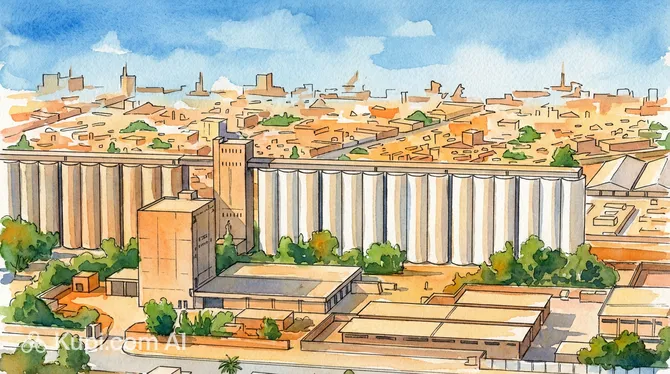
Raqqa is a city in northern Syria, situated on the picturesque banks of the legendary Euphrates River. As the administrative center of the province of the same name, it represents a unique blend of ancient heritage and a modern history of restoration. While the city is not yet a traditional tourist destination, its atmosphere is filled with the energy of life and the resilience of its local residents.
Geographically, Raqqa is located 160 kilometers east of Aleppo, occupying a strategic position on a plain. With a population of about 300,000, it is the sixth-largest city in the country. Life here is closely tied to agriculture and the resources of the great river, which has defined the destiny of this region for centuries.
Raqqa. Illustration.
Source: Kupi.com AI
The city's main value lies in its deep past. The history of Raqqa is inextricably linked to the Abbasid era, when the city flourished as an important cultural and political center under Caliph Harun al-Rashid. Today, echoes of this former greatness can be seen in the preserved fragments of ancient buildings nestled among residential neighborhoods.
A visit to Raqqa is a choice for those who want to see the authentic, non-touristy Syria in the process of its transformation. We invite you to get to know this hub city, where daily life on the banks of the Euphrates reveals the sincere and steadfast character of the local people.
Weather Overview
The climate in Raqqa is classified as continental desert, which means pronounced seasonal temperature fluctuations. Summers here are long and very hot: in July and August, the thermometer often reaches +40°C and above, while humidity remains minimal. Precipitation in the summer months is a rarity, so the air can often be dusty.
Winters in the city are mild but can sometimes be quite cool. The average January temperature is around +9°C, but nighttime lows can drop to 0°C. Most precipitation falls between November and March, but the total amount is small. It is worth studying the city climate in more detail before your trip to choose your wardrobe correctly.
The optimal times to visit Raqqa are spring (March–April) and autumn (October–November), when the weather is comfortably warm without the exhausting heat. During these times, it is pleasant to walk along the Euphrates, as the river provides additional freshness, and the absence of strong winds makes being outdoors as pleasant as possible.
Average monthly temperature
Average monthly precipitation
Interesting Facts
For several years in the 8th century, Raqqa served as the capital of the powerful Abbasid Caliphate during the reign of the famous Caliph Harun al-Rashid.
The city is a vital strategic hub, connecting the northern, eastern, and western regions of the country due to its location on the main transport artery — the Euphrates River.
Since the mid-1970s, the region's economic well-being has largely depended on electricity generation and irrigation linked to a series of dams on the Euphrates.
Despite the arid climate of its surroundings, the province of Raqqa covers a vast area — nearly 20,000 square kilometers, most of which has historically been used for agriculture.
Unique examples of medieval brickwork, a characteristic feature of the local architectural school during its peak, can still be found in the city today.
How to Get There
Transportation to Raqqa currently relies primarily on road travel. The city is connected to other major centers in the country by a network of roads running along the Euphrates valley. The most popular route is from Aleppo: the distance of about 160 km is covered by car in 2–3 hours, depending on road conditions and transit points. For more detailed trip planning and route features, visit the page how to get to Raqqa.
There is currently no operational airport in the city. Travelers who prefer flying must use the nearest air hubs in Aleppo or Deir ez-Zor and then transfer to ground transport. Such a transfer can take between 4 and 6 hours. It is recommended to use private carriers or organized groups for comfort and safety during the journey.
Railway service in the region is currently virtually non-functional for passenger travel, although historically, lines connected Raqqa with other provinces. The main form of public transport remains intercity buses and shared taxis (services), which depart once they are full. Within the city, it is most convenient to move around by taxi or rented vehicle, given the road conditions in some areas.
Station
Passenger traffic
Distance
Aleppo railway station
5
170 km
Gaziantep railway station
5
191 km
Gökçe Train Station
1
204 km
Nusaybin railway station
3
234 km
Diyarbakır railway station
5
242 km
Main Attractions
Currently, Raqqa is undergoing restoration, so there aren't many traditional museum complexes; however, the city and its surroundings are of great interest to history buffs. One of the key attractions is the remains of historical Abbasid-era buildings. These fragments of ancient architecture offer a glimpse into the scale of the city during the time it served as the residence of the great caliphs.
A stroll along the Euphrates River embankment is a must. This is the central public space where life hums at any time of day. Here, you can observe the traditional lifestyle of the locals, see how the river is used for the city's needs, and enjoy views of the water, which has witnessed many historical events.
The commercial heart of the city lies in its central squares and markets stretching along the river. These are not just places for shopping, but true cultural crossroads where you can feel the rhythm of modern Raqqa. While many monuments are still awaiting restoration, it is in these everyday places that the spirit of the city, its resilience, and its hospitality are best felt.
Local Cuisine
The culinary traditions of Raqqa are a vibrant reflection of northern Syrian gastronomy, with a distinct emphasis on products from the Euphrates valley. The star of the local table is river fish, which is grilled over charcoal with local spices. It is also worth trying dishes made from barley and wheat grown in the surrounding fields, served as hearty side dishes for meat.
The staple diet consists of classic Middle Eastern dishes: succulent kebabs, smooth hummus, and crispy falafel. Be sure to try fresh flatbreads straight from the tandoor, which locals buy every morning at the markets. The gastronomic scene is mainly represented by cozy street cafes and market stalls, where the food is always fresh and prepared according to home recipes.
As for drinks, Raqqa has a true cult of tea and Arabic coffee (with cardamom), which accompany every conversation. On hot days, ayran — a traditional yogurt-based drink — is perfectly refreshing. The dining culture here is very democratic: people eat heartily, enjoy delicious food, and often dine outdoors while taking in the view of the river.
Travel Tips
A trip to Raqqa requires careful preparation, and these tips will help make your stay more comfortable and safe.
Clothing and Essentials: Choose modest clothing that covers your shoulders and knees to show respect for local traditions. In summer, a hat and sunglasses are essential — temperatures in Raqqa can exceed +40°C. Be sure to bring comfortable closed-toe shoes, as the streets can be dusty and uneven.
Transport: The best way to get around is by taxi or renting a car with a local driver. Public transport does not have a fixed schedule and can be overcrowded.
Finance: Only cash (Syrian pounds) is used in the city. International cards are not accepted, and there are no ATMs for foreign cards. Exchange your currency in advance in larger cities or at official exchange points.
Health and Safety: Use only bottled water for drinking and washing fruit. Pharmacies can be found in the center, but it is better to bring any specific medications with you. Avoid walking through damaged buildings — it is unsafe due to the risk of collapse.
Communication: The primary language is Arabic. English is not widely spoken, so learn basic phrases ("Shukran" — thank you, "As-salamu alaykum" — hello). It is best to purchase a SIM card at official offices of Syriatel or MTN.
Local Etiquette: Syrians are very hospitable. If you are invited for tea, a polite refusal might be met with sadness, but no one will insist. It is customary to remove your shoes when entering a home.
What to Avoid: Do not photograph sensitive sites, transit points, or administrative buildings without permission. Also, avoid political discussions and the mention of sensitive historical events.
Extra Tip: Plan all your errands for the first half of the day, as activity in the city drops off quickly after sunset, and street lighting may be limited.
May your introduction to Raqqa be filled with interesting discoveries and kind encounters with the local people!
Entertainment & Nightlife
Entertainment in Raqqa is predominantly quiet and family-oriented. You won't find noisy night clubs or large entertainment centers here, as the city is focused on restoring its natural rhythm of life. The main gathering places for locals in the evening are the cozy cafes on the banks of the Euphrates. These are ideal spots to enjoy a cup of strong Arabic coffee, try a hookah, and enjoy the cool breeze coming off the river after a hot day.
Nightlife is centered around the central squares and illuminated parts of the embankment, where street food stalls stay open late. The atmosphere is friendly, with a crowd consisting mostly of local families and young people. Daytime activities are limited to walking through the markets or occasional public events. For those seeking large-scale entertainment like cinemas or festivals, residents often travel to nearby Aleppo.
Safety in the evening is well-maintained in central and residential areas, but tourists are advised to stick to well-lit places and avoid walking in the outskirts where buildings may still be damaged. The most reliable way to get around at night is by calling a taxi through acquaintances or the staff at your accommodation, as public transport finishes service by that time.
Parks & Museums
Currently, Raqqa does not have large museum exhibitions or well-maintained city parks in the traditional sense, as the city's resources are directed toward housing reconstruction. Nevertheless, the Euphrates shoreline serves as the main natural park. It is a natural recreational zone where scattered trees and the proximity of the water create a pleasant microclimate for walking, though it currently lacks benches and organized infrastructure.
The city's cultural heritage is mainly represented by an "open-air museum" — the historical ruins of the Abbasid period. Walking through certain quarters, you can come across fragments of ancient walls and gates that allow you to touch history without buying a ticket. These sites are important witnesses to the past and are gradually becoming centers of attention for researchers.
For the residents of Raqqa, private courtyards and gardens remain important green spaces, as the total number of public green zones within the city limits is small. There are plans to restore city squares in the future, but for now, visitors should prepare to appreciate the stark yet majestic plains and the wide expanse of the river, which serve as the city's park areas.
Getting Around
The public transport system in Raqqa is mainly represented by private minibuses, which locals call "services." They run along key routes connecting residential areas with central squares and markets. There is no set schedule: vehicles depart as they fill up, and the fare is fixed and very low, paid in cash to the driver.
For more comfortable and faster trips, visitors prefer to use taxis. A car can be hailed directly on the street, or you can arrange with a driver for a private hire for the entire day. This is especially convenient if you need to visit several remote areas, as walking can be tiring due to dust and the condition of the sidewalks. Bicycles and light motorcycles are also very popular among residents as a maneuverable way to get around.
When planning your movement around Raqqa, keep in mind that traffic jams may occur at major intersections during morning and evening hours. App-based payment systems do not work here, so always keep small denominations of cash on hand. If you plan to travel extensively between cities, the best solution is to rent a car with a local driver who is well-acquainted with the current road conditions and bypass routes.
Accommodation
Today, the hotel infrastructure in Raqqa is in its formative stages. There are no international chain hotels in the city, and the primary accommodation options for visitors consist of basic guesthouses and private apartments. Most lodging options are concentrated in the central districts near the Euphrates embankment, where infrastructure is being restored most rapidly.
For short-term visits, tourists and international organization employees most often choose to rent furnished apartments. This provides a necessary level of comfort, including autonomous power supply and access to water, which is not always guaranteed in more budget-friendly options. Prices for such housing remain moderate, but conditions can vary significantly.
If you are planning a trip, it is highly recommended to book accommodation in advance through local contacts or a host, as standard online booking systems may not display all available options. When choosing a place to stay, prioritize properties in lively residential neighborhoods with working street lighting and security.
Nearby Cities
Raqqa can serve as a starting point for exploring the northern part of the country, where interesting historical and natural sites are hidden among the vast plains. Neighboring cities offer a chance to get acquainted with the region's industrial and agricultural potential, as well as to see massive engineering structures on the Euphrates.
Just 45 kilometers away is the city of Tabqa, famous for its grand dam and the huge reservoir, Lake Assad. It is a popular spot for those wanting to see the "Syrian Sea" and relax by the water. To the north, near the border, lies Tell Abyad, an important trading post. A trip there allows you to see the border landscapes and feel the atmosphere of steppe Syria.
Although tourist routes in this region are just beginning to re-emerge, trips to neighboring settlements like Maskana reveal a panorama of true life in the Euphrates valley. Exploring the surroundings of Raqqa is a great chance to see the diversity of the Syrian north beyond the main tourist paths.
Shopping & Souvenirs
Shopping in Raqqa primarily means visiting the traditional oriental bazaars concentrated in the city center and along the Euphrates embankment. There are no massive shopping malls with global brands here, but there is an abundance of goods for daily life. Of particular interest to visitors are the local fabric markets, where you can find high-quality cotton and traditional Syrian patterns.
The food stalls delight with an abundance of fresh vegetables, fruits, and, of course, fish from the river. If you are looking for something special, look for spices and local crafts. Despite a limited selection of souvenirs, you can find interesting ceramics and handmade items produced by artisans in the surrounding villages. These are honest, authentic items created for use rather than specifically for tourists.
Shops and stalls usually operate from morning until late evening, with a lunch break during the hottest part of the day. Payments are made exclusively in cash in the local currency; the use of bank cards in the city is currently impossible. Bargaining at the markets is welcomed and is part of the local communication culture, helping you not only save money but also strike up a friendly conversation with the seller.