Support

Bridge on the River Kwai

About

The Bridge over the River Kwai is one of the most famous historical landmarks not only in Kanchanaburi but in all of Thailand. This railway bridge, which became world-renowned thanks to a book and a film of the same name, is a symbol of dramatic past events and attracts travelers from all over the world, especially from the UK and Australia.
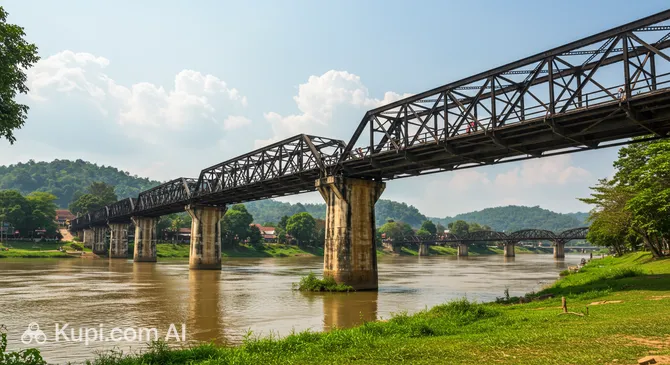
Bridge on the River Kwai. Illustration.
Source: Kupi.com AI

Traveler photos:

An interesting fact is that the river the bridge crosses was not originally called the Kwai. Its current name—Khwae Yai (Great Kwai)—was given under the influence of popular culture, while the actual Khwae Noi (Little Kwai) river flows further along the railway route. This story adds a special intrigue to the site and makes it even more appealing to curious tourists.

Today, the bridge is part of an active railway, and trains still slowly pass over it. Visitors can not only walk along the special pedestrian paths beside the tracks but also take a short train ride to fully experience the atmosphere of the place. The bridge offers picturesque views of the river, tropical vegetation with mango and jackfruit trees, and the hilly landscapes surrounding the city.

Contacts

The Bridge over the River Kwai is primarily a historical monument and a public site, so it does not have a dedicated contact service. To find current information, such as the schedule for tourist trains crossing the bridge or related events, it is recommended to contact the tourist centers in Kanchanaburi or local tour operators.

How to contactContact
AddressMaenamkwai Road, Tambon Tha Ma Kham, Amphoe Mueang Kanchanaburi, Chang Wat Kanchanaburi 71000, Thailand
Websitewww.paddleandmore.travel

What to Do

The main reason tourists visit the Bridge over the River Kwai is the opportunity to touch history and enjoy the views. The primary activity here is a ride on a special tourist train that travels slowly across the bridge. This allows you to not only feel the atmosphere of this iconic site but also take stunning panoramic photos of the famous river and its banks. Additionally, you can walk freely across the bridge, examining its structure and imagining the events of the past.

The train ride takes only about five minutes and costs approximately 100 baht, but the impression it leaves lasts for a long time. After walking across the bridge, it is worth exploring the outskirts of Kanchanaburi, which are famous for their scenic views of mountains, fields, and tropical gardens. When planning your visit, keep in mind that the hottest months in Thailand are March, April, and May, so for a more comfortable trip, it is better to choose another time of year.

Getting There

The famous Bridge over the River Kwai is located in the city of Kanchanaburi, which is situated approximately 130 kilometers west of Bangkok. Thanks to convenient transport links, getting here from the capital of Thailand is quite easy, making this attraction popular among tourists.

The fastest and most comfortable way to get from Bangkok is by rental car or taxi. The drive along modern highways takes about one and a half to two hours. For a more budget-friendly journey, you can use public transport. Regular buses and minivans depart from various bus terminals in Bangkok and take passengers directly to Kanchanaburi. Another interesting option is the train journey, which is an adventure in itself and allows you to enjoy the countryside views.

Upon arrival in Kanchanaburi, finding the bridge is very easy, as it is the city's main tourist attraction. It is located near the center and can be reached on foot from many hotels or by local taxi or tuk-tuk in a few minutes. The bridge is clearly visible and marked on all tourist maps, so you will have no trouble finding your way to this historical structure.

Nearest city: Kanchanaburi

History & Facts

The Bridge over the River Kwai in Kanchanaburi is more than just a picturesque structure; it is a powerful historical symbol whose story is inextricably linked to the events of World War II. Its construction began in 1942 as part of the Thai-Burma Railway project, which Japanese forces built to supply their armies in Burma. This route, which earned the grim nickname the "Death Railway," became a site of tragedy for tens of thousands of people.

Construction was carried out under incredibly difficult conditions in the middle of jungles and mountains. The primary labor force consisted of Asian laborers as well as Allied prisoners of war, mainly British, Australian, and Dutch. Exhausting labor, disease, and harsh treatment led to a massive loss of life. This is why the bridge and the entire railway have become a memorial and a place of pilgrimage for tourists, especially from the countries whose citizens perished during its construction.

The original bridge did not stand long in its initial form. In 1944-1945, it was repeatedly bombed by Allied aircraft and eventually destroyed. After the end of the war, part of the railway in Thailand was restored, including the bridge itself. The bridge that trains cross and tourists walk on today is a post-war reconstruction; however, its central arched spans are the original structures, recovered and reinstalled in their original place. It continues to function as part of an active railway line, serving as a living reminder of the region's complex and tragic history.

Time Needed

To visit the Bridge over the River Kwai itself, it is usually enough to set aside 1-2 hours. This is plenty of time to take a leisurely stroll across the structure and capture impressive photos against the backdrop of the river and picturesque surroundings. Many tourists also find time to ride the tourist train that still runs along this historic path.

The train ride across the bridge takes only about five minutes but offers unique sensations and angles for photography. However, if your goal is not just to see the bridge but to delve deeper into the history of the Kanchanaburi region, you should plan for a full day. This will allow you to visit other significant sites related to the history of the "Death Railway" without rushing, including museums and memorial cemeteries, making your journey through Thailand even more meaningful.

Working Hours

The famous Bridge over the River Kwai in Kanchanaburi is open to visitors 24 hours a day, as it is part of the active railway infrastructure. You can walk across it freely at any time. However, it is important to remember that the tourist train running along this historic route only operates during the day. No advance booking is required to walk across the bridge.

To fully enjoy the picturesque views and take high-quality photos, it is recommended to visit the bridge during daylight hours. Early morning is the ideal time for a visit when it is not yet too hot, which is especially relevant during the hot season in Thailand, lasting from March to May. Visiting at this time will allow you to comfortably explore the bridge and its surroundings.

Open 24 hours

Nearby

Visiting the famous Bridge over the River Kwai is undoubtedly a key highlight for any visitor to Kanchanaburi. However, to truly experience the atmosphere of this historical site, it is worth looking beyond a single attraction and exploring its surroundings. Many other interesting sites are located near the bridge, helping you gain a deeper understanding of the region's history and culture.

Exploring the surrounding area will enrich your experience, allowing you to see not only the world-famous monument but also other important sites, from museums to temples and scenic natural spots. Below is a list of attractions located in the immediate vicinity of the bridge.

NameDistance
Keereetara Riverside0.3 km
TMK Park Kanchanaburi1 km
Death Railway Museum and Research Centre2.5 km
Tara Villa Riverkwai Resort2.8 km
Wat Thewa Sangkharam2.9 km
Kanchanaburi Skywalk3.4 km
Thai Paper Mill Kanchanaburi4 km

Have you reached the end of the page?

So the route has been studied inside and out