Support

Tunis-Carthage International Airport

About the Airport

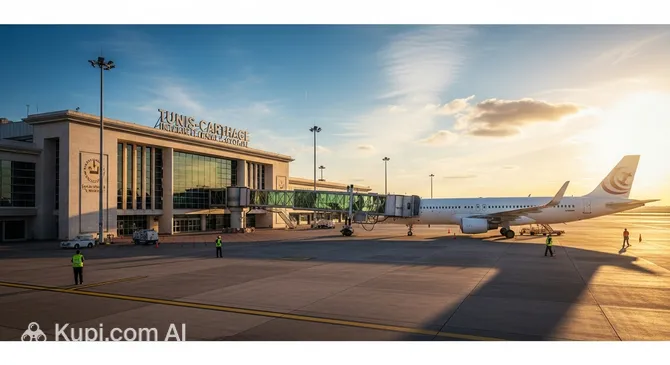
Tunis-Carthage International Airport. Source: Kupi.com Binoculars

Tunis-Carthage International Airport is not merely the country's main air gateway, but the place where your immersion into the atmosphere of North Africa begins. Located just a few minutes' drive from the legendary ruins of ancient Carthage and the lively capital centre, it seems to bridge eras, welcoming travellers with modern comfort and a subtle Arabian charm. Here, amidst the hum of arriving flights, you can already feel the warm Mediterranean breeze and the anticipation of a vibrant Tunisian holiday.

IATA Code TUN
ICAO Code DTTA
City Tunis
Distance to Centre 8 km
Status International
Passengers per Year Over 6.6 million (2023)
Schedule Available on the official airport website

Airport Features and Advantages

Tunis-Carthage Airport is distinguished by its compactness and intuitive layout, making navigation simple even for those flying here for the first time. Its main advantage is its exceptionally convenient location: a trip to the city centre or the elite coastal districts of Gammarth and La Marsa usually takes no more than 15–20 minutes. This allows tourists to quickly reach their hotel and not waste precious holiday time on long transfers.

The terminal offers travellers the necessary range of services for a comfortable wait and for addressing immediate needs upon arrival:

  • Currency Exchange and Connectivity: Currency exchange points and counters for local mobile operators (Orange, Ooredoo, Tunisie Telecom) operate around the clock in the arrivals area, where you can immediately purchase a SIM card with a favourable internet package.
  • Shopping and Dining: The Duty Free zone delights with a selection of local products — from fresh dates and olive oil to traditional ceramics, while in cosy cafes, you can enjoy your first glass of the famous mint tea with pine nuts.
  • Transport Accessibility: Outside the terminal exit, you can always find yellow city taxis that operate strictly by the meter, as well as regular buses running to the capital centre.

Despite the high passenger flow, the airport maintains an atmosphere of Arab hospitality. For those who value enhanced comfort, VIP lounges (such as Espace Privilège) are available, allowing you to spend time before your flight in a secluded and calm environment.

Contact Information

  • Official Website: For the most up-to-date information on flights, services, and regulations, visit the official website of the Office of Civil Aviation and Airports (OACA): www.oaca.nat.tn
  • Help Desk Phone: For general enquiries, you can contact the numbers: (+216) 71 754 000 or (+216) 71 755 000.
  • Airport Address: BP 137 / 147, 1080 Tunis Carthage, Tunis.
  • Email: To contact the administration, you can use the address: info@oaca.nat.tn.
  • Social Media: Official news and updates are often published on OACA social media pages, such as Facebook.
  • Lost Luggage Information: In case of lost or damaged luggage, you should first contact your airline's representative at the airport. They have all the necessary contacts and procedures to resolve the issue.
  • Passenger Support Contacts: For assistance with passengers with reduced mobility and other special enquiries, it is recommended to contact your airline in advance, as well as use the general airport help desk numbers.

How to Get to the Airport

Getting to Tunis-Carthage International Airport (TUN) from the centre of Tunis is quite simple, as it is located just 8 kilometres northeast of the city. Depending on your budget, time, and preferences, you can choose one of several convenient methods. The trip usually takes between 15 to 30 minutes, but during peak hours, more time may be required due to traffic.

By Public Transport

The most budget-friendly option is city buses. SNT route No. 35 departs from the Tunis Marine bus station, and TUT route No. 635 departs from Avenue Habib Bourguiba, near the central square. Buses run approximately every 30-40 minutes throughout the day. The ticket cost is minimal, making this the most economical method. However, be prepared that buses can be crowded and may lack air conditioning, which is particularly noticeable in hot weather.

By Taxi or Transfer

Taking a taxi is the most balanced method in terms of speed and comfort. Official yellow taxis can be easily found throughout the city or hailed via an app. Important recommendation: always ask the driver to switch on the meter ("compteur") or agree on the fare before the trip begins to avoid misunderstandings. A higher tariff applies at night. For maximum convenience, especially if you are travelling with family or large luggage, you can pre-book a private transfer. In this case, the price will be fixed, and the driver will meet you at the designated location.

Car Rental and Parking

If you plan to travel extensively around Tunisia, renting a car can be an excellent solution. Counters of major international and local rental companies are located in the airport arrivals hall. Booking a car online in advance can save you money. For those arriving at the airport in their own or a rented vehicle, parking zones are provided. There are both short-term car parks for quick drop-offs/pick-ups and guarded long-term parking lots.

Terminals and Map

Tunis-Carthage International Airport (TUN) has two passenger terminals. Terminal 1 is the main terminal and serves the majority of scheduled international flights by major airlines. Terminal 2 is primarily designated for charter flights, especially during the height of the tourist season, as well as for some budget carriers.

The airport structure is quite simple and intuitive. Both terminals have clearly marked Departures and Arrivals zones. Navigation signs are in three languages: Arabic, French, and English, which facilitates orientation for international tourists. Despite the compact size, it is always useful to monitor the departure boards to stay informed about your check-in counter and boarding gate number.

It is important to know that the terminals are located in separate buildings at some distance from each other. There is no direct pedestrian walkway between them. To move between Terminal 1 and Terminal 2, it is necessary to use the free shuttle bus, which runs at specific intervals, or take a taxi. When planning a transfer or a meeting in the other terminal, allow at least 15-20 minutes for the journey.

Departure zones in both terminals include check-in counters, passport control, and security checkpoints. During peak periods, especially in summer, queues may form, so it is recommended to arrive at the airport well in advance — at least 2.5-3 hours before an international flight. Arrival zones are standard: passport control, baggage claim belts, and customs inspection.

The main difference between the terminals lies in the level of comfort and range of services. Terminal 1 offers passengers more amenities: most Duty Free shops, cafes, restaurants, currency exchange points, and car rental offices are located here. Terminal 2 is more functional and has a basic set of services, as it is designed for the rapid turnover of tourist charter flights to Tunisia.

For a comfortable journey, always verify in advance with your airline which terminal your flight operates from. This information is usually indicated on the ticket or the carrier's website. If you are flying via charter to one of the resorts, there is a high probability that your terminal will be the second one.

Airport History

The history of Tunisia's main airport begins in 1938. Originally known as Tunis-El Aouina Airport, it was built for military purposes and played an important role during World War II. It opened its doors to civil aviation in 1944, marking the beginning of its long service as the country's primary transport hub.

The airport's true flourishing began after the country gained independence. With the development of tourism, a need for modern infrastructure arose. A key moment in history was 1972, when a new terminal was ceremoniously opened. It was then that the airport received its modern name — Tunis-Carthage International Airport, in honour of the great ancient city whose ruins are located very close by. This symbolic renaming highlighted the connection of the modern country with its rich historical heritage.

Over time, passenger traffic grew steadily, necessitating further expansion. In 2006, a large-scale reconstruction and modernization project was completed, significantly increasing the airport's capacity. Waiting lounges, runways, and navigation equipment were updated, allowing it to meet the highest international standards. Today, it is the busiest airport in the country, serving millions of travellers annually.

Over the decades of its existence, the airport has become not just a transport facility, but a witness to key moments in the modern history of Tunisia. It has connected the country with the rest of the world, contributed to its economic development, and opened its unique culture to guests from all continents. Its proximity to the capital Tunis and legendary Carthage makes it the starting point for unforgettable journeys through this amazing North African country.

Services and Amenities

While waiting for their flight at Tunis-Carthage International Airport, passengers can avail themselves of various services to make their journey more comfortable. Several cafes and snack bars operate here, where you can grab a quick bite or have a coffee, as well as restaurants offering dishes of both local and international cuisine. In the departure zone, there are Duty Free shops with a good selection of perfumery, cosmetics, and traditional Tunisian souvenirs.

For travellers who value enhanced comfort, VIP lounges function at the airport. Access is open to business class passengers of certain airlines, as well as to anyone wishing to enter for an additional fee. In the lounges, guests can enjoy quiet, complimentary snacks, beverages, and fresh press. Free Wi-Fi is available throughout the terminal, and special zones with sockets are equipped for charging gadgets.

Financial matters can be settled directly at the airport. At passengers' disposal are bank branches, 24-hour currency exchange points, and ATMs. This is particularly convenient for tourists arriving in the country, as it allows them to immediately acquire local currency — Tunisian Dinars. In case of feeling unwell, a medical centre operates at the airport, ready to provide first aid.

The airport cares for passengers with special needs. For travellers with small children, mother and child rooms are provided where you can take care of your baby in a calm environment. Passengers with reduced mobility are provided with special assistance, including escort and provision of wheelchairs. To receive this service, it is recommended to contact your airline in advance.

Although there are no hotels directly on the airport premises, several hotels of various classes are located in the immediate vicinity. Many of them offer their guests a free shuttle to and from the terminal, making them an excellent choice for transit passengers or those with an early flight. Also, business centres and conference hall services may be available for business travellers in these hotels.

Where to Eat

At Tunis-Carthage International Airport, passengers will find several options for a snack or a full meal both before and after passing passport control. Although the choice of establishments is not as extensive as in giant hubs, you can comfortably spend time waiting for your flight while refreshing yourself before the journey.

In the public zone (landside), before check-in and security control, several cafes are located. This is a convenient place to have coffee with a croissant while saying goodbye to those seeing you off, or to grab a quick bite upon arrival. Establishments offering light snacks, pastries, and beverages predominate here.

The main part of the restaurants and cafes is located in the "airside" zone, after passing all formalities. In the departure hall, you will find a food court with several food points offering both international cuisine and local specialities. Here you can find pizza, sandwiches, salads, and hot dishes. For those wanting to experience the local flavour until the last minute, it is recommended to visit a cafe serving traditional Tunisian mint tea and oriental sweets. This is a great way to conclude your journey through Tunisia.

Regarding special dietary needs, all food in the establishments is Halal by default. Vegetarians will find it easiest to find suitable options among salads, vegetable sandwiches, or pastries. The selection of vegan and gluten-free dishes may be limited, so it is better to check the ingredients with the staff on-site. The price range at the airport is generally higher than the city average. The opening hours of most establishments are tied to the flight schedule, but some may close at night, leaving only points with beverages and packaged snacks open.

Travel Tips

To ensure your journey through Tunis-Carthage International Airport goes as comfortably as possible, make use of our tips. Planning in advance will help avoid unnecessary stress and make the start or end of your trip to Tunisia pleasant.

Arrival Time and Check-in: It is strongly recommended to arrive at the airport at least 3 hours before international flights and 2 hours before domestic ones. This is especially relevant during the peak tourist season when queues for check-in and security control can be long. If possible, complete online check-in for your flight — this will save you time at the airline counters. The screening process may involve several stages, so keep your passport and boarding pass handy.

Hand Luggage and Seat Selection: Rules for carrying hand luggage are standard: liquids with a volume of no more than 100 ml each must be packed in a transparent bag. Take all valuables, documents, medication, and electronics (including power banks) with you into the cabin. When choosing a seat on the plane, consider your preferences: a window seat offers beautiful views during takeoff and landing, while an aisle seat offers the freedom to stand up without disturbing neighbours.

Passengers with Transfers: If you have a connecting flight at Tunis airport, verify with the airline in advance whether you need to collect and re-check your luggage. In the transit zone, there are cafes and shops where you can spend time waiting for the next flight. Exiting into the city during a long layover is only possible with an appropriate visa (if required for your citizenship).

Customs Control and Savings: Upon arrival, be prepared to present your passport and, possibly, a return ticket or hotel booking confirmation at passport control. Customs inspection usually proceeds quickly. To save money, exchange only a small amount at the airport for initial expenses, as the exchange rate in the city is generally more favourable. You can also pre-book a hotel transfer online, which often turns out to be cheaper than taking a taxi on the spot.

In Case of Flight Delay: If your flight is delayed, first contact your airline representative for information on the new departure time. Depending on the duration of the delay, you may be provided with beverages, meals, or even hotel accommodation. Be sure to keep all receipts for necessary expenses so that you can request compensation later.

Reached the end of the page?

That means the route is fully explored