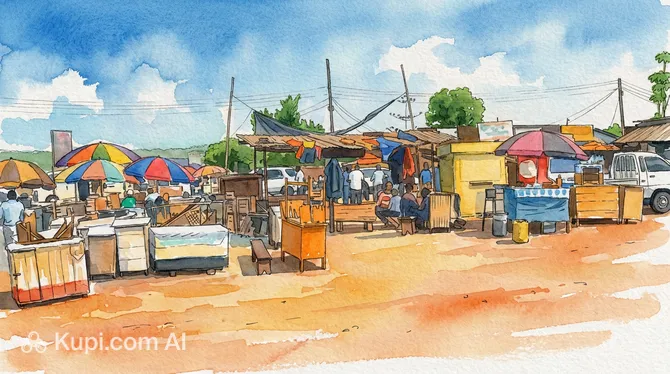
Located just thirteen kilometers northeast of the capital of Uganda, the town of Kasangati is a dynamically developing suburban center. Serving as the headquarters of Kyadondo County in the Wakiso District, this locality acts as a major residential and commercial hub for thousands of people who commute daily to Kampala. Kasangati. Illustration.
Source: Kupi.com AI
The city is rightfully called a true "melting pot" of cultures: thanks to rapid urbanization, it is home to representatives from various regions of the country and abroad. This diversity is reflected in daily life, the multilingual environment, and the unique character of the local streets. The history of development of the town is closely linked to its transformation from a small settlement into one of the largest residential areas in the Central Region.
Although Kasangati is primarily a functional suburb, it attracts visitors with its authentic atmosphere and the pace of life characteristic of modern Africa. There are no typical tourist facades here; instead, there is an opportunity to see the real Uganda in its movement and growth. We invite you to get to know this energetic town, which serves as an excellent starting point for exploring the central part of the country.
Weather Overview
Thanks to its location at an altitude of almost 1,200 meters above sea level, Kasangati enjoys a moderate equatorial climate. Temperatures remain relatively stable throughout the year, usually hovering between 21–23°C, making stays in the town comfortable even on the sunniest days.
A typical weather pattern includes warm days with highs of up to 27°C and a pleasant coolness at night, when the thermometer can drop to 17–18°C. Rainfall is distributed unevenly: the region experiences two distinct rainy seasons—spring (peaking in April) and autumn (November), when downpours can be quite intense.
When planning a visit, it is worth noting that humidity is often high, and the weather in the city can change quickly. Sunny periods are ideal for walking, but sudden tropical rain is a common occurrence, so a light raincoat should always be at hand.
Average monthly temperature
Average monthly precipitation
Interesting Facts
Rapid Population Explosion: The town's population is showing some of the highest growth rates in the region—in just six years, the number of residents increased from 142,000 to over 207,000 people.
Transport Significance: Kasangati historically grew along the Kampala-Gayaza road, which has remained a critically important transport artery for supplying the capital with food for decades.
High Population Density: There are more than 2,700 people for every square kilometer of the town, creating a unique urban environment with dense construction and active street life.
Administrative Hub: Despite its status as a suburb, Kasangati plays a key political role as the official center of Kyadondo County.
How to Get There
The accessibility of Kasangati is defined by its proximity to the capital of Uganda. The town is located just 13 kilometers from Kampala, making it easily reachable for travelers. Detailed information on routes and logistics can be found in the how to get to the city section.
The primary means of transport are cars and taxis traveling along the busy Kampala-Gayaza highway. In normal conditions, the trip takes about 20-30 minutes, but during peak hours, heavy traffic can increase this time to an hour. Microbuses, known as "matatus," are also extremely popular, regularly plying the route between the cities and offering the most budget-friendly travel option.
Railway connections in this area are poorly developed, and most passenger transport is carried out by road. The road surface on the main highway is in acceptable condition, but when planning a trip, one should consider the specifics of local driving and high congestion during morning and evening hours.
Main Attractions
Since Kasangati is primarily a residential and commercial satellite of the capital, classic tourist attractions are practically non-existent. However, this doesn't mean the town has nothing to surprise the attentive traveler. The main interest here is life itself—noisy, chaotic, and incredibly vibrant, characteristic of fast-growing African hubs.
The center of attraction and the main "sight" are the local markets and trading quarters spread along the main roads. Here you can immerse yourself in the atmosphere of authentic Ugandan commerce, observe the brisk trade, and see the daily life of the middle class and migrant communities. These are the places where the city's pulse is felt most strongly.
For those interested in the region's modern history and politics, Kasangati is notable as the administrative center of Kyadondo County. A walk through its main streets allows you to get an idea of the architecture and infrastructure of a modern Ugandan suburb undergoing constant transformation.
Local Cuisine
The gastronomic face of Kasangati is an honest and vibrant portrait of traditional Ugandan cuisine. The main dish, without which a local table is unimaginable, is matooke—steamed or boiled green bananas served as a side dish to meat or vegetable stews. It is also worth trying ugali (thick maize porridge) and rice with beans in a thick groundnut sauce.
Street food holds a special place in the food culture. While walking through the town, be sure to try the famous chapati, samosas with various fillings, and juicy meat skewers grilled over charcoal right by the roadside. For a quick snack, the "Rolex"—an omelet wrapped in a flatbread—is perfect and has become a true culinary symbol of the country.
Local meals are typically washed down with freshly squeezed tropical fruit juices, traditional black tea with milk and spices, or local beer. The town's restaurant scene consists mainly of simple, local eateries where portions are always generous and the atmosphere is relaxed.
Travel Tips
Visiting Kasangati will give you a unique experience of immersion into Ugandan daily life. To make your trip comfortable and safe, we have prepared several practical recommendations.
Clothing and Essentials: Choose light clothing made from natural fabrics, as the region has a humid and warm climate. During the rainy seasons (March–May and September–November), be sure to carry a raincoat. For walking around town, you will need comfortable closed shoes, as many roads are unpaved.
Transport: Use "matatus" or official taxi services for trips to Kampala. If you decide to use a boda-boda (motorcycle taxi), always ask the driver to go carefully and agree on the price in advance.
Finances: The main currency is the Ugandan Shilling. Cards are rarely accepted and only at very large outlets, so always carry a supply of cash. It's better to exchange money beforehand in Kampala or Entebbe.
Health and Safety: Avoid walking alone after dark in unfamiliar areas. Drink only bottled water and always carry a basic first aid kit. In case of serious illness, it is better to contact clinics in the capital.
Communication: Many languages are spoken in the town, but English is widely used. Knowing a few phrases in Luganda (for example, "Jebale ko"—a greeting to someone working) will help you win over the locals.
Local Etiquette: Ugandans are very polite. Always start a conversation with a greeting. Ask permission before taking photos of people or their private property.
What to Avoid: Do not display large sums of money or expensive equipment in crowded places. Avoid political discussions and remain neutral in conversations on sensitive topics.
Additional Tip: Consider the traffic—jams on the road to Kampala can be unpredictable, so allow an extra hour for travel to important meetings or flights.
Following these simple rules will help you enjoy the town's hospitality and make your introduction to Kasangati truly pleasant.
Entertainment & Nightlife
The entertainment scene in Kasangati is local in character and primarily oriented toward residents. Evening activity is concentrated in the numerous small bars and cafes scattered throughout the town. Here you can often find workers and employees relaxing after a day's work in Kampala.
On weekends, the atmosphere becomes more lively: in some venues, live music is played or small dance floors are open. Sports bars broadcasting football matches are among the most popular meeting places. If you are looking for large-scale nightclubs, modern cinemas, or theatrical performances, you should head to neighboring Kampala, where the nightlife hums until morning.
For safety reasons, it is better to choose well-lit central streets for nighttime walks and use official taxi services. Although the town has its own places for relaxation, most tourists prefer to use Kasangati as a quiet base, heading to the capital for more vibrant experiences.
Parks & Museums
In terms of cultural institutions, Kasangati currently remains a developing area. There are no specialized museums or galleries directly within the town limits. Residents and visitors usually head to Kampala for cultural enrichment, where the National Heritage and the country's main historical exhibits are located.
Park infrastructure is also limited due to the dense residential development that has accompanied rapid population growth in recent decades. The main green zones are represented by natural vegetation on the outskirts and private gardens. There are almost no public parks for walking within the town itself, making every green island particularly valuable.
For those seeking relaxation in nature, the best solution is a trip toward Lake Victoria or a visit to the forest reserves in the vicinity of Wakiso. There you can enjoy the silence and the rich flora of the region, which is missing in the fast-growing and densely built-up Kasangati.
Getting Around
The transport system in Kasangati is typical of most large Ugandan suburbs and is characterized by a lack of formal government transport. The primary role in transportation is played by "matatu" microbuses. They do not have a strict schedule and depart as they fill up, connecting Kasangati with Kampala and neighboring settlements.
For short-distance trips within the town, locals most often use "boda-boda" motorcycle taxis. This is the fastest but also the riskiest form of transport, requiring a certain degree of bravery from the passenger and the mandatory use of a helmet. The price for a boda-boda ride must always be agreed upon in advance.
Payment in public transport is made only in cash. You don't need to buy tickets—the money is handed to the conductor directly inside the microbus. Tourists who prefer comfort are recommended to use official taxi services via mobile apps, which provide fixed pricing and safer travel conditions.
Accommodation
The hospitality sector in Kasangati is still in its formative stages and is primarily oriented toward business trips and long-term stays. You won't find large chain hotels here, but there is a sufficient number of small guest houses and budget hotels offering basic amenities for an overnight stay.
Recently, the segment of rental apartments has been actively developing in the town, which is convenient for those planning to stay in the region for a week or more. Most of these accommodation options are located in residential neighborhoods, providing a quieter environment compared to the noisy center of Kampala.
Travelers who value high service levels and luxury are advised to book accommodation in the capital, which is easily reachable by taxi. However, if you want to save money and feel the rhythm of life in a typical Ugandan suburb, the guest houses in Kasangati are a perfectly acceptable and affordable option.
Nearby Cities
Thanks to its location, Kasangati serves as a convenient base for exploring the surrounding towns and natural beauties of Central Uganda. Just a few kilometers away are interesting localities, each with its own character and atmosphere.
Very nearby is the town of Kimwanyi, and slightly further is the rapidly growing Nansana, which is also part of the metropolitan area. Additionally, it's worth paying attention to Kireka, known for its trading zones. If you have time, be sure to visit Entebbe to see the grandeur of Lake Victoria and walk through the famous Botanical Gardens.
Exploring the surroundings of Kasangati allows you to see the contrast between bustling commercial suburbs and peaceful rural landscapes. This is a great opportunity to get a complete picture of the diversity of life in the heart of Africa.
Shopping & Souvenirs
Shopping in Kasangati primarily involves visiting bustling street markets and small commercial complexes lining the Kampala-Gayaza highway. There are no huge malls with escalators here, but there are plenty of shops offering everything you need: from the freshest tropical fruits and vegetables to vibrant African textiles and clothing.
For tourists, the items of greatest interest might be the works of local artisans. You can sometimes find woven baskets, wooden figurines, and traditional bead jewelry in the markets. Prices here are significantly lower than in the capital, but it's important to remember that bargaining is an essential part of the purchasing process at a local market.
Most shops operate from early morning until sunset, and payment is almost exclusively accepted in local currency. If your goal is branded goods and modern electronics, it's better to head to the large shopping centers in Kampala, located just half an hour's drive away.