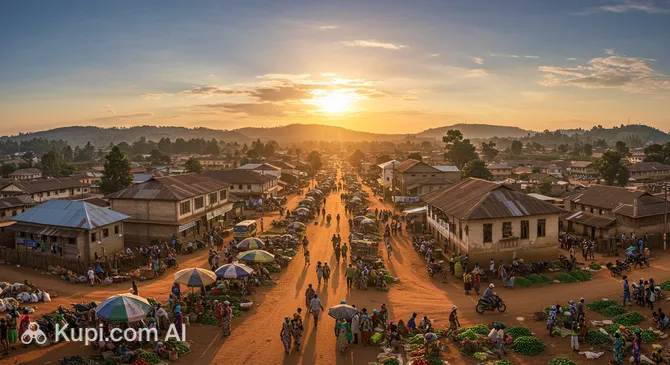
Nansana is a dynamic and fast-growing city located in the Central Region of Uganda. As part of the Wakiso District, this municipality serves as an important link between the capital and the northwestern regions of the country. The city possesses a unique "commuter town" energy that never sleeps, offering guests a chance to immerse themselves in the authentic atmosphere of modern African urbanization.
Geographically, Nansana is situated just 12 kilometers from the center of Kampala at an altitude of about 1,191 meters above sea level. Thanks to this location, it maintains a moderate and pleasant climate, while its population of over 530,000 makes it one of the most populous cities in the country. If you are interested in the development of this place, it is worth looking into the section dedicated to the history of Nansana, which officially received municipal status in 2015.
Nansana. Illustration.
Source: Kupi.com AI
For tourists, the city is primarily attractive for its authenticity. There are no glossy facades here, but there is the lively Nansana Market and the headquarters of adventure tour companies like Kaga Cycling Safaris. It is an ideal place to see the daily life of Ugandans without filters before heading deeper into the country toward the national parks.
Visiting Nansana is an opportunity to feel the rhythm of the real Uganda, meet hospitable locals, and enjoy the city's strategic position as a starting point for great journeys.
Weather Overview
Nansana is located in an equatorial climate zone, which becomes milder and more comfortable due to the city's altitude. Warm weather persists throughout the year, with average temperatures ranging from +21°C to +23°C. The hottest days usually occur in February, when the air warms up to +27°C, while the coolest evenings happen in July and August.
The region is characterized by two rainy seasons. Most precipitation falls in March–May and October–November. April is considered the wettest month, when tropical rains can be short but very intense. If you want to know more about how to prepare for your trip, check the data on the city's weather by month.
Overall, the city's climate is favorable for visiting year-round. Even during rainy periods, the sun often peeks through the clouds, and a fresh breeze (averaging 1–1.5 m/s) makes walking around the municipality pleasant, preventing the exhausting heat typical of lowlands.
Average monthly temperature
Average monthly precipitation
Interesting Facts
Rapid Growth: Nansana demonstrates one of the highest population growth rates in the region—about 6.68% annually—which turned it from a small settlement into a massive municipality in just a couple of decades.
Transport Hub: The city is located on a critically important highway connecting the capital with the oil-rich Hoima region, making it strategically significant for the country's economy.
Administrative Center: Despite its proximity to the capital, Nansana is an independent administrative entity divided into four major divisions: Nansana, Nabweru, Gombe, and Busukuma.
High-Altitude Position: The city is located at an altitude of nearly 1,200 meters above sea level, giving residents cooler evenings compared to the low-lying areas of Uganda.
Official Status: Nansana received its modern status as a full-fledged municipality relatively recently—on September 9, 2015.
How to Get There
Nansana has excellent transport accessibility due to its location on the main highway connecting Kampala and Hoima. The main flow of travelers arrives here from the capital; the journey takes between 30 and 45 minutes, although during peak hours, it is worth allowing twice as much time due to heavy traffic. If you need clarification on routes, you can explore the trip details on the dedicated page.
For those arriving in the country by air, the nearest hub is Entebbe International Airport. From there, Nansana can be reached by taxi or via the Entebbe–Kampala Expressway, bypassing the capital's center to save time. Within the city itself and between its districts, it is most convenient to move around by rented car or use the services of local carriers.
Railway communication in this area is poorly developed and oriented mainly toward freight transport. However, proximity to Kampala's main station allows tourists to consider this option as part of a larger trip through the region, although for daily trips to Nansana, rail transport is practically not used.
Main Attractions
Although Nansana is not a traditional tourist center with an abundance of monuments, it offers a unique experience for those seeking authenticity. The main point of interest here is the Nansana Market. This is the pulsating heart of the city, where among endless rows of fresh fruit, fabrics, and household items, you can feel the true spirit of Central Uganda. The market is interesting not just for shopping, but also for the opportunity to observe the vibrant culture of street trade.
For outdoor enthusiasts, the city serves as a base for Kaga Cycling Safaris. This organization specializes in bicycle tours that start in the city's surroundings and lead travelers along unexplored paths not only in Uganda but also in neighboring countries. This is an excellent way to see rural landscapes and meet local communities outside the usual car routes.
Another feature of the city is its status as a transit hub. Many travelers stop here to prepare for a trip toward Hoima and further to the shores of Lake Albert. A walk through the central streets of the municipality allows you to see how modern shopping centers sit alongside traditional shops, reflecting the rapid development of the region.
Local Cuisine
The gastronomic culture of Nansana is a celebration of simple and hearty dishes from Central Uganda. The basis of the local diet is matooke (mashed green bananas), served with a thick peanut or bean sauce. It is also essential to try luwombo—meat or fish slow-cooked in banana leaves, which gives the dish a unique aroma and tenderness.
Street food in the city deserves special attention. On every corner, you can find vendors of the famous Ugandan Rolex—an omelet with vegetables wrapped in a fresh chapati flatbread. It is a filling, cheap, and very tasty snack loved by locals and tourists alike. For those who want to see the full variety of produce, the best place is the Nansana Market, where they sell the freshest pineapples, mangoes, and cassava.
Popular drinks in the city include freshly squeezed tropical fruit juices and local beer. It is also worth trying traditional banana juice or the low-alcohol drink mwenge-bigere. Most locals prefer to dine in small "cafeterias," where food is prepared daily and served in large portions, highlighting the hospitable nature of Ugandan cuisine.
Travel Tips
Preparing for a trip to Nansana requires an understanding of local specifics. These tips will help you feel confident and enjoy your journey through this dynamic city.
Transport and Traffic: Plan your movements with extra time. The Kampala–Hoima highway is extremely busy in the morning (06:00–09:00) and evening (16:00–19:00). It is better to wait out peak hours in a cafe than to sit in a traffic jam.
Safety: Nansana is generally safe during daylight hours, but you should avoid walking in unlit outskirts at night. Use taxi-hailing apps instead of catching a car on the street in the dark.
Finances: The main currency is the Ugandan Shilling. Always carry cash in small denominations for paying for matatus and market purchases. Cards are only accepted in large hotels and supermarkets.
Connectivity: Buy a local SIM card (MTN or Airtel) immediately upon arrival. This will give you access to cheap internet and the ability to call taxis via apps. You will need your passport for registration.
Clothing: Choose light clothing made from natural fabrics, but don't forget comfortable closed shoes for walking around the city. Uganda is a conservative country, so overly revealing clothing in residential areas may attract unwanted attention.
Etiquette: Greetings are very important. Don't hesitate to say "Hello" or "Jambo." Locals appreciate politeness and a smile. Always ask permission before taking a photo of a person or their shop.
Health: Drink only bottled water. Always carry hand sanitizer and sunscreen, as the sun at the equator is very active even in cloudy weather.
What to Avoid: Do not engage in political discussions and try not to display expensive gadgets or large sums of money in crowded places.
By following these simple rules, you can focus on the main thing—getting to know the culture and rhythm of life in this amazing African city.
Entertainment & Nightlife
The entertainment scene in Nansana is closely intertwined with its status as a bustling suburb. Most nighttime activity is concentrated along the Kampala–Hoima highway, where numerous local bars and small cafes are located. Here you can hear popular Ugandan music and try local beer in the company of friendly locals. The atmosphere in these establishments is usually relaxed, and there is no dress code.
For those looking for larger-scale nightclubs, casinos, or cinemas, residents usually head to nearby Kampala, which can be reached by taxi in 20–30 minutes. Within Nansana itself, evening gatherings at "nyama choma" spots—places where meat is roasted over an open fire—are popular and form an important part of the local social culture.
Daytime entertainment in the city is mainly represented by active recreation. Cycling trips with Kaga Cycling Safaris allow you to combine sport with sightseeing. Safety in the central areas of the city is maintained in the evening due to the constant movement of people; however, for nighttime travel, it is recommended to use trusted taxi services or ride-sharing apps.
Parks & Museums
As a densely built-up municipality, Nansana does not have large state parks within its borders. However, this is compensated for by its proximity to the natural riches of the Wakiso District. Private gardens and hotel grounds, as well as open spaces in the Gombe and Busukuma divisions, where urban development gives way to rural landscapes, act as "green lungs" for residents and visitors.
The city does not have its own museums at the moment, but its status as a transit point makes it easy to reach the country's main treasures. Just a 15–20 minute drive away is the Uganda National Museum in Kampala, which houses unique ethnographic and archaeological collections telling the story of the region's tribes.
For those seeking aesthetic pleasure, we recommend paying attention to local art workshops. While they are not museums in the strict sense, you can see the works of modern Ugandan artists and woodcarvers here, whose products reflect the contemporary spirit of Nansana and its drive for development.
Getting Around
Public transport in Nansana is a lively and somewhat chaotic system, typical of East Africa. The main role here is played by matatus—white minibuses that run on fixed routes. Travel in them is inexpensive, but be prepared for crowded conditions, especially during peak hours. You don't need to buy tickets in advance; payment is made in cash to the conductor during or at the end of the trip.
For faster and more maneuverable movement, locals and tourists use boda-bodas (motorcycle taxis). This is the quickest way to get through the traffic jams for which the Kampala–Hoima highway is famous. We recommend using mobile apps such as SafeBoda, Uber, or Bolt to guarantee a fixed price and ensure the driver has a helmet.
Within the municipality, the transport network is unevenly developed: in central areas, the roads are paved, while in outlying neighborhoods, dirt surfaces predominate. If you prefer comfort, the best choice is to rent a car with a driver or call a regular taxi via an app. Remember that traffic in Uganda is on the left side, and traffic in Nansana can be very intense during morning and evening hours.
Accommodation
Even though Nansana is more often perceived as a residential area, there are decent accommodation options for tourists and business travelers. One of the best-known establishments is the Wilsen Hotel Nansana, which offers comfortable rooms, modern service, and free Wi-Fi, making it a popular choice among expats and those working in the Wakiso District.
In addition to classic hotels, the rental apartment segment is actively developing in the city. This is an excellent option for those planning to stay in the region for a long period. Most of these properties are concentrated in the central part of the municipality, closer to the main shopping areas and transport interchanges. Prices here are usually lower than in central Kampala, which allows for significant budget savings.
When planning a trip, it is recommended to book accommodation in advance, especially if you are aiming for a specific middle-class hotel. While there are no peak tourist seasons in the city itself, good rooms in quality guesthouses are often occupied by representatives of international organizations and business travelers.
Nearby Cities
Thanks to its location, Nansana serves as an excellent starting point for exploring the central part of the country. Just a few kilometers away is the capital, the majestic Kampala, where the main cultural and historical monuments are concentrated, including the Kasubi Tombs and the Uganda National Museum.
For a quieter introduction to the region, you can head to the district's administrative center—the town of Wakiso, or visit Kasangati, known for its picturesque hilly terrain. Also of interest is a trip to Matugga, which demonstrates the region's agricultural potential and the traditional lifestyle of local communities.
Exploring these nearby towns will allow you to see different facets of Ugandan life—from the bustling metropolis to quiet suburban settlements, each possessing its own unique charm.
Shopping & Souvenirs
Shopping in Nansana is primarily about getting to know the Nansana Market. Here, trade goes on from early morning until late evening. For a tourist, this place is interesting for the opportunity to buy authentic African "kitenge" fabrics with vibrant prints, as well as woven products made from dried palm grass, which make excellent souvenirs.
Along the main road, there are small shopping centers and specialized shops. You can find everything here: from modern electronics to traditional clothing. If you are looking for branded items and a familiar Western shopping format, it is worth traveling to the large malls in Kampala, but for local flavor and favorable prices on food and handmade goods, it is worth staying in Nansana.
Typical store opening hours are from 8:00 AM to 8:00 PM, with many shops remaining open until the last customer. Payment is most often made in cash in local shillings (UGX), but larger outlets and hotels are beginning to accept bank cards. Don't forget to bargain at the market—in Nansana, this is an important part of communication culture that will help you not only save money but also strike up a pleasant conversation with the seller.