Source: Kupi.com AI
| Characteristic | Value |
|---|---|
| IATA code | NRL |
| ICAO code | EGEN |
| City | North Ronaldsay |
| Country | United Kingdom |
| Time zone | Europe/London |
| Schedule | Online timetable |
| Characteristic | Value |
|---|---|
| IATA code | NRL |
| ICAO code | EGEN |
| City | North Ronaldsay |
| Country | United Kingdom |
| Time zone | Europe/London |
| Schedule | Online timetable |
Given that North Ronaldsay Airport is a small airfield serving local lines, many administrative functions are performed by the Orkney Islands Council or the carrier airline (Loganair). Below are the current contact details:
Considering the miniature size of North Ronaldsay island, the journey to the local airport will not take much time and differs radically from the usual transfers in large metropolises. There are no traffic jams, traffic lights, or complex interchanges here. The distance from most residential houses and guest rooms to the terminal is only 1–3 kilometres, making logistics extremely simple and calm.
Transfers and Taxis
There is no classic taxi service or municipal public transport on the island. The main way for tourists to get to the airport is a transfer organised by their accommodation. Most often, guests are met and seen off by transport from the North Ronaldsay Bird Observatory, which is the main centre of attraction on the island. The cost of the trip is usually nominal or included in the accommodation. It is recommended to arrange the ride in advance when booking your stay.
Walking and Cycling
For those travelling light, a walk to the airport can be a pleasant end to the trip. From most points on the island, you can walk to the runway in 15–30 minutes, enjoying the fresh sea air. A bicycle is also a popular means of transport. You can leave it right at the airport building — trusting one another is the custom here.
Car and Parking
Car rental in the traditional sense (with offices of international brands) is absent on the island. Locals use personal transport, and tourists rarely bring cars by ferry due to logistical complexities. If you do happen to be here by car, parking at the airport is free. It is a small open area next to the terminal where there are always available spaces.
Important Transport Hubs Nearby
North Ronaldsay Airport is part of a vital air network connecting the Scottish islands. The main hub through which most routes here pass is Kirkwall Airport. Regular flights to the island operate from there.
For aviation record enthusiasts, the neighbouring Papa Westray Airport is of interest. The flight between the neighbouring island of Westray and Papa Westray is considered the shortest scheduled flight in the world, and routes are often combined with a visit to North Ronaldsay.
If you are planning a complex journey through the north of the UK, you may need connections via larger hubs. For example, Wick Airport on the northern mainland of Scotland or Inverness Airport, which serves many international destinations. For those heading to the Shetland Islands, a key point will be Sumburgh Airport.
Terminal Structure
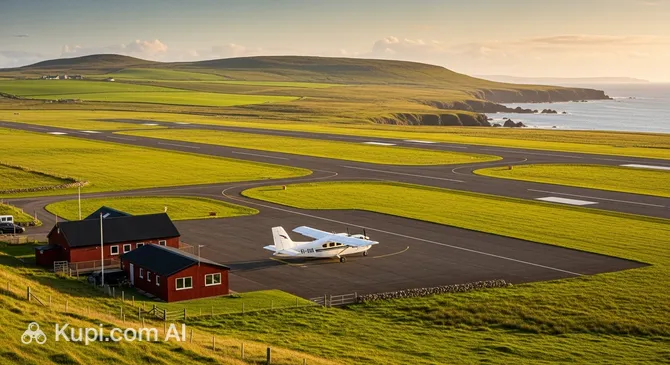
North Ronaldsay Airport is the complete opposite of giant international hubs. There is only one compact terminal operating here, which resembles a cosy country cottage more than an air terminal. This single-storey building combines all necessary services: the check-in area, waiting lounge, staff room, and control room. There is no division into international and domestic sectors, nor is there a complex system of corridors, as the airport serves exclusively inter-island flights.
Layout and Navigation
Navigation in the airport is extremely simple and intuitive. Entering through the main entrance, you immediately find yourself in the main room where the check-in desk is located. The movement scheme is linear: street entrance — check-in — waiting lounge — boarding exit. It is impossible to get lost here, as everything is within direct line of sight. Toilets and minimal amenities are located right there, within walking distance.
Departure and Arrival Zones
Unlike large airports, there is no clear separation of passenger flows using glass partitions or different floors.
Check-in and Security Procedures
Thanks to the small size of the airport and the specifics of local flights, all formalities take a minimum amount of time.
Features and Recommendations
The main feature of the North Ronaldsay terminal is its staff. Often the same people perform the functions of dispatchers, fire crew, loaders, and check-in agents. This creates a unique atmosphere of trust and community. Passengers are advised to keep warm clothing at hand, as the walk from the terminal to the aircraft takes place in the open air, where strong winds from the North Sea often blow.
The history of North Ronaldsay Airport is a chronicle of how aviation defeated the isolation of the northernmost island of the Orkney archipelago. Unlike large mainland hubs, this airfield was created not for commercial profit, but as a vital artery connecting a small community with the outside world.
Inception and Launch of Regular Service
Although landings of small aircraft on the island happened earlier (often on ordinary farm fields), the official history of modern air service began in the second half of the 20th century. A key milestone was 1967, when the airline Loganair launched regular inter-island flights in the Orkney Islands. This event radically changed the lives of the islanders: if previously the delivery of mail, groceries, or a doctor's visit depended on the capricious sea and ferry schedules, the opening of the air bridge made the connection to Kirkwall a matter of minutes.
Stages of Development and Management
An important stage in the airport's history was the transfer of management to the Orkney Islands Council. This allowed for the systematisation of runway and terminal building maintenance. Unlike many other airfields that were closed or privatised, North Ronaldsay remained a municipal facility focused on social needs.
Over the past decades, the airport has undergone several stages of modernisation:
Interesting Facts and Role in Island Life
North Ronaldsay Airport is unique in how closely it is integrated into the life of the local community.
Today, North Ronaldsay Airport continues to write its history, remaining one of the most authentic and soulful aviation hubs in the UK, where technology serves to preserve a traditional way of life.
Services at North Ronaldsay Airport correspond to its status as a tiny island airfield: minimalism and a home-like atmosphere reign here. Passengers should not expect service at the level of international hubs, but the basic needs of travellers are met here thanks to the responsiveness of the staff and thoughtful logistics.
Restaurants, Cafes, and Shops
The terminal lacks catering outlets, Duty-Free shops, or newsstands. You will not be able to buy water or a snack on-site before departure. Travellers are strongly advised to take care of food and drinks in advance. The nearest place where you can have a full lunch or buy souvenirs (including items made from the wool of local sheep) is the shop and cafe at the North Ronaldsay Bird Observatory, located nearby.
Lounges and VIP Services
The entire passenger terminal is a single cosy waiting lounge. There is no division into business classes or closed lounge zones. The room has sufficient seating, and it is warm and dry, which is a main priority in the windy northern climate. Every guest receives "VIP service" here thanks to the individual approach of the few airport staff.
Wi-Fi and Communication
Public Wi-Fi may be available within the terminal (often provided by the Orkney Islands Council), but connection speed does not guarantee the ability to watch videos or download large files. Mobile coverage is present on the island, but the signal may be unstable depending on the operator and weather conditions. There are few power outlets for charging gadgets, so it is better to have a charged power bank with you.
Banks and Currency Exchange
There are no ATMs or currency exchange points at the airport. Moreover, access to cash is limited throughout the entire island of North Ronaldsay. It is critically important for tourists to withdraw the necessary amount of cash (Pounds Sterling) in advance, for example, at Kirkwall Airport before flying to the island. Some places (such as the Observatory) accept cards, but cash remains a reliable payment method.
Medical Services and Safety
There is no specialised medical post with a doctor in the building. However, airport staff, who also perform fire service functions, are trained in first aid. In emergency cases, urgent medical evacuation by helicopter or plane to the "mainland" (Kirkwall) is organised.
Services for Passengers with Children
There are no designated mother and child rooms or playgrounds in the terminal. Nevertheless, waiting for a flight here is rarely long. Children are usually interested in watching the preparation of small planes for departure through the terminal windows or directly from the edge of the airfield under adult supervision.
Services for Passengers with Reduced Mobility
The terminal building is single-storey, which facilitates movement. Since boarding the aircraft takes place from the ground, Loganair staff always personally assist passengers with reduced mobility to board. It is recommended to notify the airline of the need for assistance when booking a ticket, considering the small dimensions of the aircraft used.
Hotels and Accommodation
There is no hotel directly in the airport building.
Conference Rooms
Business centres are absent at the airport. For meetings or small events, the only suitable place on the island is the aforementioned Bird Observatory, which has the necessary space and infrastructure.
If you are used to starting your journey with a cup of coffee in the terminal or lunch in a restaurant overlooking the runway, North Ronaldsay Airport will surprise you. Catering here is organised quite differently than in large international hubs and requires a little planning from the traveller.
Dining in the Terminal
Inside the single airport building, there are absolutely no cafes, restaurants, bars, or even vending machines. The terminal is designed exclusively for check-in and short waits for flights. Given that most passengers spend no more than 20–30 minutes here before departure, the lack of gastronomic infrastructure inside the building is perceived as normal. There is no division into "clean" and "dirty" zones with food courts: after completing formalities, you go straight to the aircraft.
Where to Eat: North Ronaldsay Bird Observatory
Since the airport does not have its own catering, the role of the "airport restaurant" is taken on by the cafe at the Bird Observatory, located in close proximity to the airfield. This is the main meeting place on the island where you can have a full meal before departure or immediately after arrival.
Local Cuisine and Specialities
A visit to the island is a unique chance to taste the famous North Ronaldsay Mutton. Local sheep are known for living on the shore behind a stone dyke and feeding almost exclusively on seaweed. Thanks to this diet, their meat has a unique taste, dark colour, and is considered a delicacy (protected by PDO status). The cafe also offers home baking, Scottish soups, and fresh seafood if the catch is good.
Dietary Requirements
The menu at the cafe is small and changes daily, but the chefs are usually ready to accommodate guests.
Prices and Opening Hours
The price range can be described as average (moderate for the UK). A full lunch will cost approximately 10–15 Pounds Sterling.
Recommendations for Passengers
Given the lack of shops at the airport, bring a bottle of water and a light snack (sandwich, fruit, chocolate) with you if you do not have time to stop by the Observatory. Flights on Loganair planes between islands take only 15–20 minutes, so on-board service is not provided. If you are flying in transit via Kirkwall, it is better to stock up on provisions there before flying to North Ronaldsay.
Travelling through a tiny island airport is a unique experience that differs greatly from flying on large liners. To ensure your visit to North Ronaldsay goes smoothly and leaves only pleasant memories, use the following practical tips compiled taking into account the specifics of local aviation.
Arrival Time and Check-in
Forget the need to arrive 2-3 hours early. For flights from North Ronaldsay, it is sufficient to arrive at the terminal 20–30 minutes before departure. However, do not be late: the check-in counter closes strictly on schedule so that the pilot has time to perform the necessary calculations. The main feature of check-in is mandatory weighing. Not only baggage but also passengers themselves are placed on the scales (or asked for their weight). This is critically important for balancing the light aircraft, so treat the procedure with understanding and humour.
Baggage and Hand Luggage
Britten-Norman Islander aircraft have very limited space.
Seat Selection
Specific seats are not indicated on tickets. Seating is directed by the pilot based on weight distribution on board.
Connections and Transfers
The airport serves only local flights, and your main transfer hub will be Kirkwall Airport. When planning connections with flights to the "mainland" (to Edinburgh, Glasgow, or London), allow a time margin of at least 2–3 hours. Weather in the Orkney Islands is changeable: a flight from the island may be delayed due to fog, even if large planes in Kirkwall are flying on schedule.
Customs and Documents
Since all flights are domestic (within the UK), customs and passport control are absent. Nevertheless, airline staff may ask you to present photo identification (passport or driving licence) at check-in, so keep documents handy.
Actions in Case of Flight Delay
Delays due to strong winds or low cloud cover are not uncommon in this region.
Money-Saving Tips
To save money, book tickets in advance via the Loganair website, as fares on the day of departure may be higher. Also, consider a combined flight: a ticket including a visit to the neighbouring island of Papa Westray may cost the same as a direct one but will give you the unique experience of the shortest flight in the world.
Have you reached the end of the page?
So the route has been studied inside and out