In the heart of the town of Penrith rise the majestic ruins known as Penrith Castle. This impressive 14th–15th-century structure, built of characteristic bright red sandstone, once served as a powerful northern defensive line in Great Britain.
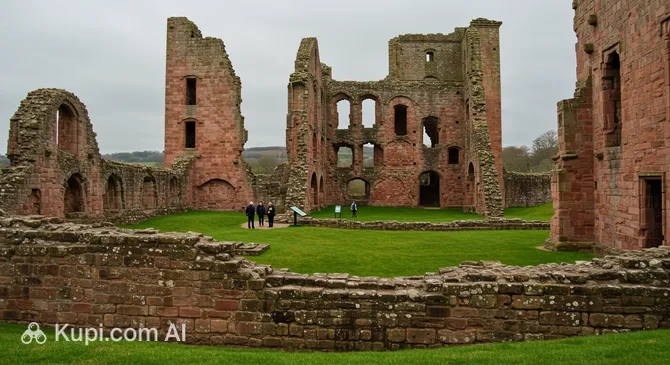
Penrith Castle. Иллюстрация. Источник: Kupi.com AI
The castle is a classic medieval fortress with four wings surrounding a central courtyard. Fragments of two key towers have survived to this day: the Red Tower and the White Tower, featuring vaulted lower chambers. Surrounded by a dry moat, the castle is now a Grade I listed building and is under the care of English Heritage.
Today, it is not just a historical monument but part of a cozy public park. The contrast between the rugged red stone walls and the emerald green lawns makes the castle a popular spot for walks, where history literally intertwines with the everyday life of the modern town.
Contacts
For more details before your visit or to organize a group trip, you can use the official contact information for English Heritage, which manages the site.
Visitors are invited to take a fascinating journey into the past, freely exploring the preserved parts of the fortress. You can examine the massive corbels on the eastern facade, which once supported the floor of Richard III's banquet hall, and peer into the deep dungeons that served as prisons in ancient times. Information panels with reconstructions will help you imagine how the castle looked in its prime.
The surrounding park is an ideal place for peaceful leisure. Here you can have a picnic on the grass while admiring panoramic views of the Eden Valley or practice photography: the textured red stone of the walls looks especially striking in the rays of the setting sun. For families with children, exploring the ruins turns into a real adventure among the labyrinths of ancient foundations.
If you still have energy, it is worth taking a walk to the Penrith Beacon on Beacon Hill. Although the current tower dates back to the 18th century, the site itself has been used for signal fires since the 13th century. It offers one of the best bird's-eye views of the town and the castle.
Getting There
The castle is located at Ullswater Rd, Penrith CA11 7EG, right in the heart of the town, making it extremely accessible. If you are arriving by train, the walk from Penrith North Lakes railway station will take no more than 15–20 minutes. The route is integrated into the town environment, allowing you to explore local streets along the way.
For those traveling by car, the most convenient way is via the A66, following signs for the town center. You can leave your car at the municipal parking lot in the public park or on nearby Ullswater Road. If you prefer the bus, most routes into town stop within walking distance of the castle.
For those staying in the nearby areas of the Lake District, a taxi or a bicycle is a convenient option — the trip will take very little time, and the views along the way will set a historical mood.
Ближайший город: Penrith
History & Facts
The history of this site began at the end of the 14th century when Ralph Neville, 1st Earl of Westmorland, initiated the construction of the fortress to protect the northwestern borders of England from frequent Scottish raids. There is a theory that the castle was built on the foundations of an ancient Roman fort, highlighting the strategic importance of this point over the millennia.
The castle reached its peak in the second half of the 15th century when it came into the possession of Richard, Duke of Gloucester (the future King Richard III). Between 1471 and 1485, he transformed the austere military fortress into a luxurious royal residence. It was under his rule that the grand banquet hall with high windows and extended kitchen blocks appeared, the remains of which can still be seen today.
However, the Tudor era brought decline: the castle gradually fell into disrepair, and locals began using its famous red sandstone as building material for their homes. During the Civil War in 1648, the ruins briefly returned to service as a headquarters for Parliamentarian forces, but they were soon finally dismantled to prevent any future military use.
Time Needed
A standard tour of the ruins and a leisurely stroll through the adjacent park usually takes about 1–2 hours. This is plenty of time to carefully study the information panels, look into the surviving towers, and take atmospheric photos against the backdrop of the ancient walls.
If you decide to combine your visit with a climb to the Penrith Beacon to enjoy a panoramic view of the Eden Valley, plan to spend about 2–3 hours here. Such a route will allow you to fully experience the scale and beauty of this historical area.
Working Hours
Penrith Castle is usually open to the public daily from 09:00 to 17:00. Since it is located within a public park, access is possible throughout daylight hours.
Nevertheless, it is recommended to check the official English Heritage website before your trip, as opening hours may change depending on the season or maintenance work being carried out at the site.
09:00–17:00
Nearby
Penrith is a town with a rich past, and a tour of the castle is an excellent start for a major historical itinerary. Exploring the surroundings will allow you to dive deeper into the atmosphere of Cumbria and see monuments from various eras, from the Neolithic to Victorian times.