Support

Aniak Airport

About the Airport

Aniak Airport (ANI) is not merely a runway in the vast expanses of Alaska, but a true lifeline for the city of the same name and the entire Yukon-Kuskokwim region. Located far from major metropolises, it serves as the main gateway to the world for local residents and a starting point for travelers wishing to explore the unique nature of the United States. For many, it is the only year-round means of reaching other settlements, which underscores its strategic importance.
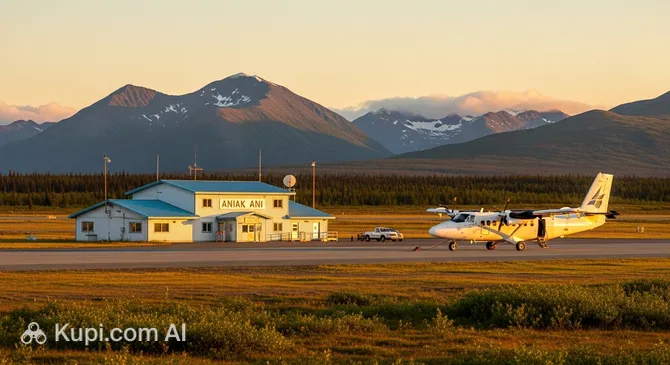
Aniak Airport. Source: Kupi.com Binoculars
IATA Code ANI
ICAO Code PANI
City Aniak
Distance to center approx. 2 km
Status Domestic
Annual Passengers over 12,000
Popular Airlines Ravn Alaska, Ryan Air Service

The main feature of Aniak Airport is its vital role for the isolated community. It is not a large transport hub with leisure zones and shopping arcades, but primarily a functional facility ensuring a connection with civilization. Its main merit is the reliable fulfillment of its mission: the reception and dispatch of passenger, cargo, and mail flights. Furthermore, the airport services air ambulance and air taxi flights, which is critically important in the harsh climate conditions of Alaska.

The airport infrastructure is modest and corresponds to its size. A small terminal with a waiting area is available for passengers. Travelers should note that the complex weather conditions of Alaska may affect flight schedules, so it is always advisable to check the status of your flight with the airline in advance.

Contact Information

  • Official Website: Aniak Airport (ANI) is a regional airport and does not have its own separate website. Information regarding its status and the management company's contacts is available on the Alaska Department of Transportation portal.
  • Information Desk Phone: The main contact number for the airport is +1 (907) 675-4332. Please note that communication will likely take place in English.
  • Airport Address: Airport Rd, Aniak, AK 99557, USA.
  • Email: An official email address for general passenger inquiries is not provided. It is recommended to use the telephone for communication.
  • Social Media: The airport does not maintain official pages on social networks. The most current information regarding flights is best verified on airline websites.
  • Lost Luggage Information: For all issues related to lost or damaged luggage, it is necessary to contact the support service of the airline you flew with directly. Airport staff do not handle luggage tracing.
  • Passenger Support Contacts: Questions regarding tickets, schedules, flight check-in, and special services on board should be addressed to representatives of your airline.

How to Get to the Airport

Aniak Airport (ANI) is a key transport hub for the small and remote settlement of Aniak, located in the state of Alaska, United States. Due to the specifics of its location and small size, the transport infrastructure here differs radically from major cities. When planning a trip, it is important to consider local peculiarities.

On Foot or via Local Transport

The airport is located in the immediate vicinity of Aniak's residential areas. The simplest and most common way to reach the terminal is on foot. The walk will take just 5-15 minutes from any point in the settlement. Locals often use personal transport suited to the season for movement: quad bikes (ATVs) in summer and snowmobiles in winter. If you have a lot of luggage, it may be possible to arrange assistance with one of the locals.

Taxis and Transfers

There are no official taxi services operating on-call in Aniak as there are in big cities. However, it is possible to arrange a private ride. The best way to organize a transfer is to contact your place of accommodation (for example, a hotel or lodge) in advance and check if they provide airport pickup services. The cost of such a service would be negotiable.

Car Rental and Parking

Major car rental companies are not represented in Aniak. Renting a car for a short trip to the airport is not a common practice here. For those arriving at the airport in their own vehicle, there is a small informal parking area next to the terminal. As a rule, it is free, but one should not expect guarded lots or covered parking facilities.

Public Transport

Due to the small size of the settlement, Aniak effectively has no public transport system, such as buses, trains, or a metro. The entire flow of transport is ensured by private vehicles and small aviation connecting Aniak with other settlements in Alaska.

Terminals and Map

Aniak Airport (ANI) is a small regional airport, so its structure is extremely simple and understandable for passengers. There is only one terminal functioning here, which serves both arriving and departing flights. Thanks to its compactness, navigation through the airport presents no difficulties.

The terminal layout is very logical. Upon entering the building, you immediately find yourself in the main hall, where the check-in counters and waiting area are located. The departure and arrival zones are in the same building and often in immediate proximity to each other. There are no separate buildings or complex passageways between terminals here, as all operations are concentrated under one roof.

Check-in and security procedures at Aniak Airport take place significantly faster than in major aviation hubs. Thanks to the low passenger flow, there are practically never long queues here. As a rule, arriving at the airport 60-90 minutes before departure is more than sufficient to complete all formalities without rushing, check in luggage, and proceed to boarding.

The main advice for navigation is not to worry. The entire airport infrastructure is intuitive, and the small size of the building allows one to orient themselves easily, even if visiting for the first time. All key zones — from the entrance to the boarding gate — are within sight, which makes the stay at the airport maximally comfortable and eliminates the stress associated with searching for the right gate or counter.

Airport History

The history of Aniak Airport (ANI) is a story of development and sustaining life in the remote corners of Alaska. The airport was officially opened for operation in April 1940. Its creation was part of a broader strategy to develop transport infrastructure in Alaska in the period preceding World War II. From its very first days, it began to play a decisive role in supply and communication for the local population.

The main stages of the airport's development were associated not so much with massive expansion, but with gradual modernization to meet growing requirements and harsh climatic conditions. Over the decades, it transformed from a simple airstrip into a key transport hub for the entire Yukon and Kuskokwim river delta region. Its main function has always remained unchanged — to serve as a reliable link to the outside world, ensuring the delivery of mail, cargo, and passengers, and performing critically important medical evacuations.

Periodic reconstructions were aimed at increasing safety and efficiency. Today, the airport, owned by the State of Alaska, has two runways: a main asphalt-paved one and an auxiliary gravel one. This allows it to accept various types of aircraft, adapting to weather conditions. The modernization of navigation equipment and lighting systems helps ensure flights even in the difficult meteorological conditions of the polar region.

The main achievement in the history of Aniak Airport is not setting records for passenger traffic, but its long-standing and stable operation as a "road of life". An interesting fact: the airport serves as an important base for so-called "bush pilots" — pilots of small aircraft who are the only means of communication for many remote settlements in the vast territory of Alaska, part of the United States. It is their work, coordinated from hubs like Aniak, that supports life in the most inaccessible corners of the country.

Services and Amenities

Aniak Airport (ANI) is a small regional aviation hub providing a basic set of services for a comfortable wait for your flight. It is important to understand that this is not a major international hub, so the infrastructure here is quite modest and focused on key passenger needs.

There is a waiting area in the terminal. However, it is worth noting that there are no restaurants, cafes, or shops here. Travelers are advised to bring snacks and beverages with them. Access to Wi-Fi and stations for charging electronic devices may be limited or unavailable, so it is better to ensure your gadgets are charged in advance. There are no business lounges or VIP lounges provided at the airport.

Basic amenities are provided for passengers with reduced mobility. Nevertheless, if you require special assistance, such as a wheelchair, it is strongly recommended to contact your airline well in advance. Specialized services for passengers with children, such as playrooms, are absent at the airport.

There are no bank branches, currency exchange points, ATMs, or conference halls on the airport territory. Medical assistance is limited to basic supplies, and for more serious help, one should contact medical institutions in the city. The nearest hotels and other necessary services can be found in Aniak itself.

Dining

When planning a trip through Aniak Airport (ANI), it is important to consider its size and specific nature. This is a small regional airport primarily serving local flights, so dining options here are severely limited and not comparable to major international hubs.

In the airport terminal building at Aniak, you will not find traditional restaurants, cafes, or dining lounges. Passenger infrastructure is minimal and focused on meeting basic needs before departure. As a rule, the only available option for a snack is vending machines.

In the machines, you can usually purchase a standard set of snacks: chips, chocolate bars, cookies, as well as bottled water and carbonated drinks. Specialized dietary meals, such as vegetarian, gluten-free, or Halal options, are not available here. Unfortunately, it is impossible to have a full lunch or dinner at the airport.

Recommendation for travelers: If you require a full meal or follow a specific diet, it is strongly recommended to eat beforehand in the city of Aniak itself or bring food with you. This will allow you to wait for your flight comfortably without relying on the extremely limited selection at the airport.

Traveler Tips

Traveling through a regional airport like Aniak Airport has its own specific features. To make your experience as comfortable as possible, use our tips adapted for small aviation hubs.

Arrival at the Airport and Check-in. For domestic flights from Aniak, it is generally not required to arrive 3 hours early as in major international airports. It is recommended to arrive 60–90 minutes before departure. This time will be sufficient to check in for the flight and drop off luggage without rushing. The security screening procedure here takes place significantly faster than in large hubs, but standard TSA security rules apply here as well.

Carry-on Luggage and Seat Selection. Pay special attention to your airline's carry-on luggage rules. Aircraft flying from Aniak are often small, and requirements for bag size and weight may be stricter than usual. regarding seat selection, to enjoy the breathtaking views of Alaska, choose a window seat. If freedom of movement is more important to you, an aisle seat will be more suitable.

Transfers and Customs Control. Aniak Airport serves only domestic flights, so there is no need to pass through customs or passport control here. If you have a connecting flight (for example, in Anchorage), clarify at check-in whether your luggage will be automatically transferred to the final destination. Always allow sufficient time for transfer at a larger airport.

Economy and Flight Delays. To save money, purchase tickets in advance and try to travel light to avoid surcharges for excess baggage weight. The weather in Alaska can be unpredictable, which may lead to flight delays or cancellations. Keep your phone charged to track updates from the airline. In a small airport, there may be a limited selection of amenities, so in case of a long wait, it is useful to have a book, a power bank, or snacks with you.

Reached the end of the page?

That means the route is fully explored