Support

Birmingham Civil Rights Institute

About

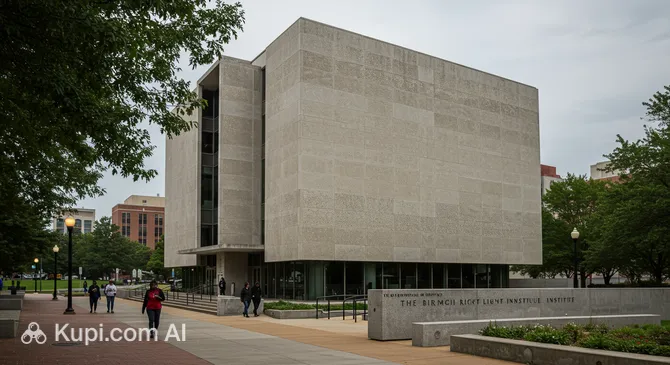
Located in the heart of the historic district of Birmingham, the Birmingham Civil Rights Institute (BCRI) is a monumental complex that combines a museum, research center, and gallery. This site in the USA serves as a powerful reminder of the struggle for human dignity and equality, attracting over 150,000 visitors from around the world annually.
\n\n
Birmingham Civil Rights Institute. Source: Kupi.com AI
\n\n

The museum opened in 1992 and has since become one of Alabama's most popular paid attractions. It is part of the Birmingham Civil Rights National Monument and is officially affiliated with the renowned Smithsonian Institution. The building is situated across from the legendary Sixteenth Street Baptist Church, making it the center of a cultural route dedicated to the history of the civil rights movement.

\n\n

The institute's mission goes far beyond simply exhibiting artifacts. It aims to inspire dialogue and reconciliation while preserving a vast archive of documents, photographs, and oral histories. BCRI is not just a museum, but a living space for reflecting on human rights on a global scale.

Contacts

To plan your visit to the Birmingham Civil Rights Institute, tourists are recommended to use the following contact details:

\n\n\n \n \n \n \n \n \n \n \n \n \n \n \n
Address520 16th St N, Birmingham, AL 35203, USA
Phone+1 205-328-9696
Official Websitebcri.org

What to Do

A visit to the institute is a profound emotional journey. The primary thing to do is walk through the permanent exhibitions, which chronologically detail the events of the 1950s and 1960s. You will see interactive installations, rare film footage, and realistic reconstructions, such as scenes from the "Children's Crusade" or the 1963 campaign, which allow you to literally feel the atmosphere of that time.

\n\n

Special attention should be paid to the temporary exhibitions, which change frequently and highlight important themes such as the "Freedom Rides" or the marches from Selma to Montgomery. For those with a deeper interest in science and history, an extensive archive is available, housing the personal records of movement leaders, including Fred Shuttlesworth.

\n\n

In addition to touring the internal galleries, visitors can attend lectures or participate in educational tours. A walk through the Woods Jr. Community Meeting Room or viewing the sculptures in the adjacent Kelly Ingram Park is an excellent way to conclude a visit, encouraging reflection on what has been seen and a dialogue on the values of modern society.

Getting There

The institute is located in the heart of the historic district at 520 16th St N, Birmingham, AL 35203. This area is very walkable, as it is in immediate proximity to Kelly Ingram Park and the famous Sixteenth Street Baptist Church. If you are already downtown, getting to the museum on foot is easy.

\n\n

For those who prefer public transport, services are provided by the Birmingham-Jefferson County Transit Authority (BJCTA). Bus stops are located within walking distance of the building's entrance. Taxis and popular ride-sharing services like Uber and Lyft are also readily available in the city.

\n\n

If you are arriving via Birmingham-Shuttlesworth International Airport (BHM), the drive to the institute takes approximately 20–30 minutes via I-20/I-59. For travelers with rental cars, parking is available on adjacent streets and in specialized parking garages in the area.

History & Facts

The history of this important institution began in the late 1970s. In 1977, Mayor David Vann proposed the idea of a museum to memorialize the struggle for civil rights in the region. Later, in 1979, the city's first African American mayor, Richard Arrington, formed a special committee to develop a detailed plan and mission for the future institute.

\n\n

The path to realizing the project was challenging: in 1986, voters rejected a proposal for funding through a bond issue. However, supporters did not give up, and in 1990 a board of directors was established, with financial matters finally resolved a year later. The building was designed by Joseph Wetzel of Boston, whose concept blended harmoniously with the city's historic landscape.

\n\n

The grand opening took place on November 14, 1992, with the participation of civil rights movement veterans. Since then, the institute has continuously expanded its archives and educational offerings. In 2017, it became the centerpiece of the Birmingham Civil Rights National Monument, confirming its status as a site of national importance.

\n\n

Interestingly, the institute houses unique materials, such as the personal papers of Reverend Fred Shuttlesworth and over 500 recorded oral histories from protest participants. In 2022, the museum celebrated its 30th anniversary, continuing to serve as a vital center for dialogue on human rights worldwide.

Time Needed

To thoughtfully explore all the main exhibitions of the Birmingham Civil Rights Institute, the average visitor will need about 2–3 hours. This is enough time to walk through the permanent galleries, watch introductory films, and review key documents and photographs.

\n\n

If you plan to study archival materials in detail, visit temporary exhibitions, or participate in educational programs, you should set aside 3–4 hours for your visit. Also, don't forget to leave some time for a stroll through Kelly Ingram Park, located directly across the street, which is an integral part of the historical complex.

Working Hours

When planning your visit, please keep in mind that the museum follows a traditional schedule. The Birmingham Civil Rights Institute is open to visitors from Tuesday to Saturday from 10:00 AM to 5:00 PM. Please note that the institute is typically closed on Mondays and Sundays.

\n\n

As opening hours may change on public holidays or during special events, we strongly recommend checking for up-to-date information on the official website before your trip.

Nearby

Exploring the surroundings of the institute allows for a deeper immersion into the city's atmosphere and a better understanding of its historical context. The district where the museum is located is literally steeped in significant events of the past, and many interesting locations are within walking distance.

\n\n

A walk through the nearby blocks will reveal both memorial sites and modern entertainment centers, creating a balanced itinerary for your trip.

\n\n\n \n \n \n \n \n \n \n \n \n \n \n \n \n \n \n \n \n \n \n \n \n \n \n \n \n \n \n \n \n \n \n \n \n \n \n \n \n \n \n \n \n \n \n \n \n \n \n \n
AttractionDistance (km)
Birmingham Civil Rights National Monument0
A.G. Gaston Motel0.1
Alabama Peanut Co.0.9
Oak Hill Cemetery1.1
Topgolf Birmingham1.5
Sloss Furnaces National Historic Landmark2.3
The Historic Bethel Baptist Church4.2
Splash Pad4.6
Urban Air Trampoline and Adventure Park6.1
Vestavia Hills Sibyl Temple7.2

Reached the end of the page?

That means the route is fully explored