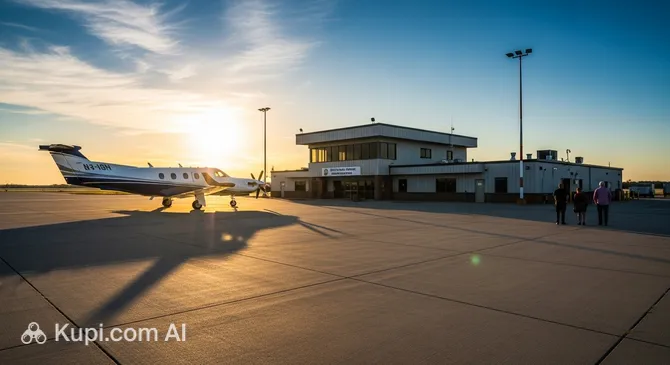
Travelling through Blytheville Arkansas International Airport has its own specifics, as this hub serves General Aviation. There are no regular passenger flights by major airlines here, so the terminal is oriented towards private jets, corporate charters, and cargo transport. This makes the departure and arrival process much more comfortable and individual.
Arrival time at the airport. Since there are no traditional mass-market registration queues here, arriving 2–3 hours early is not required. Arrival time should be coordinated with your private carrier or pilot. Usually, it is sufficient to be on-site 15–30 minutes before the scheduled departure time to calmly hand over luggage and pass the necessary formalities in the FBO (Fixed-Base Operator) terminal.
Registration and Security. Screening procedures at general aviation airports follow a simplified scheme compared to commercial hubs. You will not have to remove shoes or take out laptops in a general queue. However, identification documents are mandatory. If you are flying by charter, screening rules are set by the flight operator, but they always comply with basic US safety standards.
Seat selection on the plane. In private and charter flights, the concept of "seat selection at check-in" is absent. Seating in the cabin of a business jet or small plane is often free. In some cases, the pilot may ask you to occupy a specific seat for the correct balancing (centring) of the aircraft — such requests should be treated with understanding, as it is a matter of flight safety.
Hand luggage: what is allowed and prohibited. The strict "100 ml liquids" rule usually does not apply here unless you are transferring further to a commercial flight at another airport. Nevertheless, general federal bans on carrying weapons, explosives, and dangerous chemicals apply strictly. Coordinate luggage dimensions and weight in advance: on small vessels, weight restrictions can be even stricter than on low-cost carriers.
For passengers with transfers. Blytheville Airport is often used as a convenient stopover point. If you plan to transfer to a regular flight at a major hub (for example, in Memphis) afterwards, consider the transfer time. You will need to get to the other airport by ground transport or fly there, after which you must pass full security control according to TSA standards in the commercial terminal.
Customs control features. Despite the status of a general aviation airport, standard US customs rules apply for international flights (arriving from abroad). Importing cash amounts over 10,000 dollars is subject to declaration. It is also strictly forbidden to import many food products, plants, and seeds. Customs procedures may require prior notification of services, so clarify this issue with the flight organiser.
Saving time and money. The main advantage of this airport is time saving due to the lack of queues. To avoid unnecessary expenses, arrange a ground transfer or car rental in advance, as taxi services may not be constantly stationed at the terminal. If you are a pilot, check fuel prices and parking fees at the local FBO in advance.
In case of flight delay. Unlike regular airlines, delays here are most often related to weather conditions, as small aviation is more sensitive to the meteorological situation. Waiting takes place in comfortable terminal lounge zones. Keep in direct contact with the flight commander or your charter manager to receive the most up-to-date information on departure time.